

 Tema Innocent
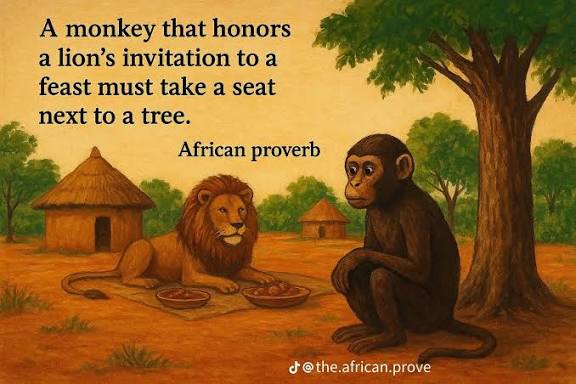
In the heart of Nyungwe Forest, where the canopy shimmered with morning dew and the wind carried the wisdom of ancestors, lived a monkey named Kato. He was small, sprightly, and endlessly curious. His fur was the color of roasted coffee beans, and his eyes sparkled with mischief and wonder. Kato was known for his clever tricks and daring leaps, but what set him apart was his thirst for stories—especially those whispered by the elders around the fire.
One story in particular had always fascinated him: the tale of Sefu, the lion king of the savannah. Sefu was mighty, feared, and revered. His roar could silence a thunderstorm, and his gaze could freeze a charging buffalo. Yet, every few seasons, Sefu would send out an invitation to the creatures of the forest, calling them to a grand feast beneath the ancient Baobab Tree. The feast was said to be magnificent—overflowing with food, music, and riddles. But it was also dangerous. Many who attended never returned.
The elders always warned, “If you honor the lion’s invitation, sit next to a tree. The tree is your ally.”
Kato never understood why. But when a messenger bird arrived one misty morning carrying a scroll sealed with Sefu’s mark, he knew his moment had come.
“To the creatures of the forest, You are invited to a grand feast beneath the Baobab Tree. Come in peace, come with honor. —Sefu the Lion.”
The forest buzzed with excitement and dread. Some animals prepared gifts, others whispered prayers. Kato, undeterred, packed a bundle of ripe bananas, a calabash of palm wine, and a small drum carved from fig wood. He bowed to the elders and promised to heed their advice.
The journey from the forest to the savannah was long and full of wonder. Kato passed herds of antelope grazing nervously, warthogs sharpening their tusks, and hyenas laughing with unease. The sun grew hotter as the trees thinned, and the golden grasses of the plains stretched endlessly before him.
As he approached the Baobab Tree, Kato gasped. It was enormous—its trunk wider than a hut, its branches like arms reaching for the sky. Beneath it sat Sefu, regal and terrifying, his mane glowing like fire in the afternoon sun. Around him, the feast was laid: roasted yams, honeyed locusts, grilled tilapia, millet cakes, and bowls of wild berries. Drums beat in rhythm with the lion’s breath, and dancers spun like leaves in the wind.
Most animals sat in the open, eager to be seen and favored. But Kato remembered the elders’ words. He bowed to the Baobab, placed a banana at its roots, and settled beside it. “You are my shield,” he whispered.
Sefu’s golden eyes flicked toward him.
The feast began. Animals laughed, ate, and boasted. The lion remained silent, watching. When the sun dipped low and the shadows grew long, Sefu stood.
“Now,” he roared, “let us play a game. A riddle for each guest. Fail, and you serve me forever. Succeed, and you leave with a gift.”
The laughter died. The air grew heavy.
One by one, animals were called forward. The hyena was asked, “Why does the moon follow the sun?” He stammered and was led behind the Baobab, never to return. The antelope was asked, “What is the meaning of thunder?” She trembled and vanished into the shadows.
Kato watched, heart pounding. He tapped his drum softly, letting its rhythm calm his nerves.
Then Sefu turned to him.
“Monkey,” he growled, “answer me this: ‘What walks without legs, speaks without a mouth, and dies when silence falls?’”
Kato froze. He looked at the Baobab, its bark etched with ancient scars. He listened to the wind rustling its leaves. He remembered the stories, the songs, the echoes of laughter in the forest.
And then he smiled.
“An echo,” he said.
Silence.
Then Sefu laughed—a deep, rumbling laugh that shook the earth and startled the birds from the trees.
“You are clever, monkey. You may leave. But tell me, why did you sit next to the tree?”
Kato bowed low. “Because the tree listens. It remembers. It protects. And the elders said, ‘The monkey that honors the lion’s invitation must sit next to a tree.’”
Sefu nodded. “You have honored wisdom. Take this seed. Plant it in your forest. It will grow into a tree that speaks truth.”
Kato accepted the seed with reverence. It was small, golden, and warm to the touch.
He returned to Nyungwe and planted it at the center of the forest. Seasons passed. Rain fell, sun shone, and the seed grew into a tree unlike any other. Its leaves shimmered with silver veins, and its bark hummed with stories. Children gathered beneath it to hear riddles whispered by the wind. Elders sat in its shade and remembered forgotten songs.
Kato became a legend—not for his tricks, but for his wisdom. He taught the young to listen to the trees, to respect the old, and to seek truth in silence.
And in villages across Africa, the tale was told again and again. Around fires, under stars, in classrooms and ceremonies, elders would say:
“When power invites you, bring your wits. And always sit next to a tree.”
Because in the wild, wisdom is your greatest shield.
This post was created with our nice and easy submission form. Create your post!
Written by
A sports Journalist with RabSports Uganda, Advocate for Children’s Rights and Youths, Amazing Storyteller with DW Akademie and UNICEF, Independent Researcher, Student at Muni University
Did this story move you? Every gift goes directly to Tema Innocent — writers on Muwado earn from reader appreciation, not algorithms. Even $1 makes a difference.






Muwado weekly chart
Get Africa’s top 10 stories every Thursday
No account needed — just your email.
Want to follow Tema Innocent and get notified every time they publish?
Create a free Muwado account →