

 Oweyegha Afunaduula

Abstract
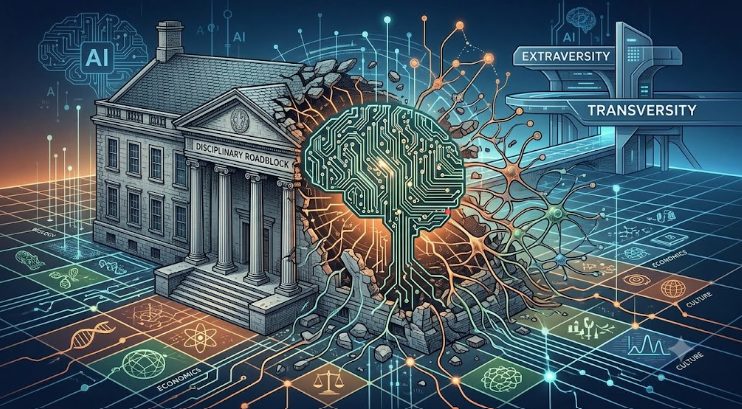
Much has been written about artificial intelligence in higher education—its affordances and its perils. This article does not rehearse those debates. Instead, it addresses what remains uncharted: how AI can catalyze a fundamental structural transformation of knowledge organization itself. I argue that the disciplinary logic which has organized universities for two centuries is incompatible with the interconnected, fast-changing, wicked problems of our time. AI does not respect disciplinary boundaries; its very architecture is transdisciplinary. Drawing on the concept of “slow professors” as institutional gatekeepers, the fragmentation of knowledge within disciplinary silos, and the integrative potential of team sciences—interdisciplinary, crossdisciplinary, transdisciplinary, and extradisciplinary—this article proposes a roadmap for redesigning higher education toward the 22nd century. The university as an institution of universal education—organized around disciplines—will become a roadblock to knowledge integration. The future belongs to the interversity, crossversity, transversity, and especially the extraversity, where extradisciplinarity rejects the disciplinary ways and structure of the university altogether. Without such transformation, universities will follow the University of Timbuktu into extinction, becoming academic and intellectual dinosaurs in an age that demands holistic, systems-based thinking.
—
Introduction: Beyond the Standard Narrative
The literature on AI and higher education has reached saturation. We have read the warnings about academic integrity, algorithmic bias, and workforce displacement. We have celebrated the promises of personalized learning, automated assessment, and intelligent tutoring systems. These conversations, while necessary, operate within what Thomas Kuhn might call normal science—they tinker with the existing paradigm without questioning its foundations.
This article takes a different path. I ask not how AI can serve the existing university, but how AI can force us to abandon the existing university’s organizing principle: the discipline.
The disciplinary structure of knowledge is not natural law. It is a historical artifact of 19th-century German research universities, imported globally, and reified over two centuries. In a world of climate collapse, pandemics, artificial general intelligence, and geopolitical volatility, disciplinary thinking is not merely inadequate—it is dangerous. Wicked problems do not present themselves in disciplinary packages. They arrive whole, interconnected, and urgent.
AI, I contend, is not a tool that can be inserted into disciplinary curricula. It is a post-disciplinary force that renders disciplinary logic obsolete. The question facing higher education is not “How do we teach AI?” but “How do we become like AI?”—integrated, adaptive, systemic, and unafraid to cross any boundary in pursuit of understanding.
—
A Brief Summary: What Has Been Written
Before proceeding to the new, a brief acknowledgment of the existing terrain is in order.
The Positives of AI in Higher Education
Proponents have documented AI’s capacity for: personalized learning pathways at scale; 24/7 intelligent tutoring and feedback; automated administrative tasks freeing faculty for meaningful interaction; enhanced accessibility for diverse learners; predictive analytics for student retention; simulation and scenario-based learning; and research acceleration through literature synthesis and hypothesis generation.
The Negatives of AI in Higher Education
Critics have raised legitimate concerns: algorithmic bias reinforcing existing inequities; data privacy and surveillance; erosion of academic integrity; dehumanization of the learning relationship; reduction of education to measurable outputs; faculty displacement anxiety; and the transformation of students from thinkers into optimization engines for assessment metrics.
Both sets of arguments accept the university’s fundamental structure as given. Neither challenges the disciplinary cage in which higher education remains imprisoned. We now turn to what has been left unsaid.
—
The Disciplinary Structure: A Historical Accident Becoming a Cognitive Prison
The university as we know it—divided into departments, schools, and faculties, each guarding its methodological territory—emerged from specific historical conditions. Wilhelm von Humboldt’s University of Berlin (1810) codified the union of research and teaching within disciplinary specialization. The 19th century’s explosion of knowledge necessitated division of cognitive labor. Disciplines provided coherence, training standards, and quality control.
What worked in an era of slow change and industrial manufacturing fails catastrophically in an era of acceleration and interconnection. Disciplines fragment what nature and society have integrated. A climate scientist understands atmospheric chemistry but not the political economy of fossil fuel extraction. An economist models carbon pricing but ignores the cultural meaning of energy to coal-mining communities. A sociologist documents inequality but cannot program the AI systems that automate it.
This is not a failure of individual scholars. It is a structural feature of disciplinary organization. Disciplines train attention away from connections and toward internal puzzles. They reward depth over breadth, internal consistency over external relevance, and methodological purity over real-world messiness.
Univariate Logic and Its Negatives
Disciplines think in univariate terms. They isolate variables, hold others constant, and seek causal chains. This is powerful for controlled laboratory settings. It is disastrous for systems where everything interacts with everything else.
The univariate logic of disciplines produces:
· Reductionism without synthesis: Knowledge of parts without understanding of wholes
· Temporal myopia: Focus on short-term causal chains rather than long-term systemic dynamics
· Context stripping: Removal of phenomena from their ecological, social, and cultural embeddedness
· False certainty: Clean statistical significance masking real-world complexity
· Disciplinary imperialism: Each discipline’s claim to authoritative explanation of phenomena it only partially grasps
—
Defining the Team Sciences: Beyond Disciplinary Monologue
If disciplines represent monologue—each speaking its own language to its own audience—the team sciences represent dialogue, integration, and emergence. I distinguish four modes, each with distinct epistemological and pedagogical implications.
Interdisciplinarity
Interdisciplinarity analyzes a common problem using methods and concepts from multiple disciplines, maintaining disciplinary identities while creating shared vocabulary. The team remains identifiable as sociologists, biologists, and engineers working alongside each other. Interdisciplinarity is the first step out of the disciplinary silo, but not the final destination. It still asks participants to return home to their disciplines for validation.
Crossdisciplinarity
Crossdisciplinarity moves further: researchers adopt and adapt methods from other fields, crossing over into unfamiliar territories. A physicist using ethnographic observation. A historian running regression analyses. A computer scientist engaging textual hermeneutics. Crossdisciplinarity begins to dissolve the boundaries between knowledge communities, even as practitioners maintain primary affiliations.
Transdisciplinarity
Transdisciplinarity transcends disciplinary categories altogether. It addresses problems that cannot be contained within any disciplinary framework, developing new integrative frameworks that are irreducible to their disciplinary inputs. Transdisciplinary research includes non-academic stakeholders—community members, practitioners, policymakers—as co-creators of knowledge. The result is not “applied sociology” or “public health economics” but something genuinely new: knowledge that emerges from the between and beyond of disciplines.
Transdisciplinarity recognizes that wicked problems are not puzzles to be solved within existing paradigms but predicaments requiring new paradigms. Climate change is not an environmental problem plus an economic problem plus a social problem. It is a climate-society-economy problem—a single phenomenon requiring integrated analysis.
Extradisciplinarity
I propose extradisciplinarity as the fourth and most radical mode. If transdisciplinarity creates new syntheses from disciplinary inputs, extradisciplinarity abandons the disciplinary as the unit of analysis entirely. It asks: What forms of knowledge organization become possible when we stop thinking in disciplinary terms altogether? Extradisciplinarity rejects the disciplinary ways and structure of the university. It does not seek to reform the university, but to move beyond it.
Extradisciplinarity takes its cue from AI itself. Large language models do not organize knowledge by sociology, chemistry, and history. They learn patterns across all textual domains simultaneously, generating insights that emerge from cross-domain correlations no human scholar would notice. Extradisciplinarity is the educational analogue: organizing learning, research, and institutional structures around problems, processes, and systems rather than disciplines.
An extradisciplinary institution has no physics department, no English department, no economics department. It has centers for: “Resilience in Coupled Human-Natural Systems,” “Justice and Algorithmic Governance,” “The Cultural Dynamics of Technological Transformation.” Participants are not hired as physicists but as scholars who bring physical reasoning to systemic problems. Learners do not major in disciplines but in capacities: systems thinking, temporal reasoning, ethical analysis, quantitative modeling, qualitative interpretation, and collaborative design.
—
The Slow Professor: Gatekeeping and the Resistance to Change
In their 2019 article “The ‘slow professor’ could bring back creativity to our universities” (published in The Conversation), Maggie Berg and Barbara Seeber identified a paradoxical figure in contemporary academe. The “slow professor” is not merely someone who works slowly. Rather, this figure represents resistance to the “culture of speed” that has commodified education and aligned universities with market logics. Berg and Seeber advocate for “practising a certain dissent within the university itself” and “making the university a place for sustainable living.”
I invoke the “slow professor” differently. While Berg and Seeber celebrate slowness as resistance to neoliberal speed, I identify inertia as the slow professor’s more troubling characteristic. The slow professor—in my usage—is the disciplinary gatekeeper: the faculty member who defends departmental boundaries, who insists that “students need a strong foundation in [discipline X]” before engaging with real problems, who reviews promotion files for interdisciplinary scholars with suspicion, who controls curriculum committees and graduate admissions.
This slow professor is not malicious. They are the product of a system that rewarded disciplinary purity. Their entire professional identity—publications, grants, reputation, mentorship network—is invested in disciplinary structures. To abandon the discipline is experienced as self-annihilation.
The slow professor’s gatekeeping takes specific forms:
Curriculum control: Preventing the replacement of disciplinary sequences with problem-based, transdisciplinary modules. Insisting that “coverage” of disciplinary content precedes authentic inquiry.
Personnel decisions: Evaluating interdisciplinary scholars as “not a good fit” for departments organized around disciplines. Denying tenure to those whose work cannot be classified within existing categories.
Resource allocation: Directing funding to disciplinary research centers rather than cross-cutting initiatives. Defending laboratory and library budgets organized by discipline.
Pedagogical conservatism: Resisting project-based, collaborative, and community-engaged learning in favor of lecture-and-examination models that map cleanly onto disciplinary content.
The slow professor’s power lies not in active opposition but in institutionalized inertia. University governance structures—departmental budgets, promotion criteria, accreditation requirements, journal prestige hierarchies—embody disciplinary logic. Changing the structure requires overcoming the accumulated weight of centuries of institutional sedimentation.
AI does not respect this sedimentation. AI does not care about departmental budgets or tenure requirements. AI connects what disciplines have separated. And in doing so, AI reveals the slow professor’s gatekeeping for what it is: not wisdom but obsolescence protected by institutional power.
—
The Crisis of Narrow Confines: Why Disciplinary Theories Fail
Disciplinary theories are dogmatic by design. Each discipline develops foundational assumptions that members are not required to justify continuously. Physics assumes mathematical realism. Economics assumes rational actors. Sociology assumes social construction. Literary criticism assumes textual meaning is indeterminate.
Within their narrow confines, these assumptions enable productive work. Across boundaries, they produce paralysis. Disciplinary theories talk past each other because they cannot agree on what counts as evidence, explanation, or even a question worth asking.
The crisis is this: the world’s most pressing problems cut across these assumptions. Climate change involves physical processes (physics), collective action problems (economics), differential vulnerability (sociology), historical responsibility (political science), cultural meanings (anthropology), and narrative representation (literary studies). No single discipline’s theoretical apparatus is adequate.
The Multivariate Logic of Team Sciences
If disciplines operate on univariate logic, team sciences operate on multivariate logic. Multivariate analysis does not isolate variables but maps their interactions. It asks not “What is the effect of X on Y?” but “How do X, Y, and Z co-evolve in a dynamic system?”
Multivariate logic recognizes:
· Nonlinearity: Small causes can have large effects; large causes can have small effects; effects can become causes.
· Emergence: Systems have properties not reducible to their components.
· Feedback loops: Variables influence each other reciprocally over time.
· Path dependence: History matters; where you start shapes where you can go.
· Multiple scales: Processes at different temporal and spatial scales interact.
AI excels at multivariate analysis. Machine learning models discover patterns across hundreds or thousands of variables simultaneously, identifying interactions that human intuition would miss. AI does not ask whether a problem is “sociological” or “biological.” It finds patterns across both.
This is why AI aligns with team sciences against disciplines. AI’s architecture is multivariate, integrated, and emergent. It is not a tool that can be added to disciplinary methods. It is a different way of knowing—one that threatens to make disciplinary ways obsolete.
—
The Multidimensional Environment Framework
To advance team sciences in the age of AI, higher education requires a new organizing framework. I propose the Multidimensional Environment Framework (MEF) as an alternative to disciplinary taxonomies.
The MEF conceptualizes all phenomena—whether educational, ecological, economic, or social—as occurring within four interacting dimensions:
1. Ecological-Biological Dimension
This dimension encompasses the biophysical world: climate, ecosystems, toxins, pathogens, genetics, neuroscience. Education within this dimension asks: How do physical and biological realities constrain and enable human possibility? How do our bodies and environments shape learning?
2. Socioeconomic Dimension
This dimension encompasses production, distribution, and consumption: labor markets, inequality, technological change, resource allocation. Education within this dimension asks: Who gets what, when, and how? How do economic structures shape educational access and outcomes?
3. Sociocultural Dimension
This dimension encompasses meaning, identity, and belonging: language, religion, ethnicity, gender, generation, aesthetics. Education within this dimension asks: How do people make meaning? How do cultural frameworks shape what counts as knowledge?
4. Temporal Dimension
This dimension encompasses change, memory, and anticipation: history, futures, generational succession, sustainability. Education within this dimension asks: How did we get here? Where are we going? What do we owe the past and future?
Crucially, the MEF insists that no dimension operates independently. Ecological changes have socioeconomic consequences. Economic shifts reshape cultural meanings. Cultural transformations alter temporal orientations. And all dimensions interact with each other simultaneously.
The MEF is not a set of separate boxes. It is a framework for tracing interactions. Its educational implication is clear: learners must develop capacities to think across dimensions, not specialize within one.
—
The Centrality of Interactions in Education
Disciplinary education teaches students to identify entities: atoms, genes, prices, texts, norms. It teaches much less about interactions: how entities relate, transform, and co-produce each other.
Yet interactions are where real-world problems live. Poverty is not a property of individuals (socioeconomic dimension) but of the interaction between individuals and social structures (sociocultural dimension) across time (temporal dimension) with biophysical consequences (ecological-biological dimension).
AI reveals interactions because AI detects patterns across dimensions without being told which dimension is “primary.” A sufficiently large dataset of student performance, for example, will reveal interactions between nutrition (ecological-biological), family income (socioeconomic), cultural attitudes toward education (sociocultural), and historical funding patterns (temporal). These interactions are not noise to be controlled for. They are the signal.
Education redesigned around interactions would replace “Introduction to Sociology” with “Introduction to Socio-Ecological Systems.” It would replace “Calculus” with “Modeling Dynamic Interactions.” It would replace “Literary Analysis” with “Narrative and Systemic Change.”
This is not the abandonment of rigor. It is the redefinition of rigor as the ability to trace interactions across dimensions, not the ability to solve canonical problems within a single dimension.
—
From Fragmentation to Integration
The disciplinary university fragments knowledge. Students take courses in multiple departments, each presenting its domain as autonomous. The student is left to integrate—or more commonly, never integrates—these fragments into a coherent worldview.
The team sciences integrate knowledge. Integration is not the sum of disciplinary contributions but the synthesis that emerges from their interaction. Integration requires:
Common vocabulary: Team sciences develop shared terms that translate across disciplinary languages. AI’s vector embeddings are one model: representing concepts from any domain in a shared mathematical space where relationships become computable.
Shared problems: Team sciences organize around problems, not methods. The problem determines what knowledge is relevant, not disciplinary tradition.
Collaborative epistemology: Team sciences distribute cognitive labor across diverse expertise, with integration occurring through ongoing dialogue, not separate work later assembled.
Iterative synthesis: Integration is not a final step but a continuous process of reframing, connecting, and emerging.
AI can accelerate integration by identifying connections across distributed knowledge. A literature review that would take a human scholar months, AI can perform in minutes—not as a substitute for judgment but as a scaffold for synthesis. More profoundly, AI can identify gaps: areas where current knowledge is inconsistent, where disciplines contradict each other, where interactions are poorly understood.
—
New Professionals for a New Era: The Integrated and Integrative Scholar
If the disciplinary university produced the specialist, the transdisciplinary era must produce the integrator. I distinguish two new professional types.
The Integrated Scholar
The integrated scholar possesses depth in at least one domain and the ability to connect that depth to other domains. This is the T-shaped professional: deep in one dimension, broad across dimensions. Integrated scholars can work within a discipline when appropriate—but recognize when the discipline’s tools are insufficient and can reach across boundaries without losing rigor.
The Integrative Scholar
The integrative scholar goes further: their primary expertise is not a domain but the processes of integration itself. Integrative scholars are systems thinkers, facilitators, translators, and designers. They may have come from a discipline—but their professional identity is organized around connecting rather than specializing.
Integrative scholars are AI-literate not because they can program but because they understand AI’s affordances for integration: pattern recognition across domains, hypothesis generation from distributed data, simulation of complex systems, and translation across knowledge communities.
The institutions of the 22nd century will not be organized around disciplines but around teams of integrated and integrative scholars addressing complex problems. Professional careers will not be evaluated by publications in disciplinary journals but by contributions to problem-solving, learner development of integrative capacities, and public scholarship that translates complex knowledge for diverse audiences.
—
The University as Roadblock: Why Universal Education Cannot Survive
The term university derives from universus—meaning whole, total, universal. The university claimed to offer universal knowledge. But what has it delivered? Not universality, but fragmentation organized by discipline. The university’s promise of universal education has been belied by its practice of disciplinary partitioning.
The 22nd century will not emphasize the university. It will emphasize the interversity, crossversity, transversity, and especially the extraversity—institutions built on integration rather than fragmentation. The university will become a roadblock to knowledge integration precisely because of its choice of universal education: a universal that is in fact disciplinary, bounded, and resistant to the very integration that wicked problems demand.
We must therefore ask a provocative question:
Can the university survive as an island of universal education in a sea of interversal, crossversal, transversal, and extraversal education in the 22nd century?
The answer, I believe, is no. Islands erode. They are visited as relics, not inhabited as homes. The university may persist as a museum piece—a place where disciplinary knowledge is preserved for historical interest—but it will not be the living center of knowledge creation and learning. That center will shift to institutions that have abandoned the disciplinary logic entirely.
—
Interversity, Crossversity, Transversity, Extraversity: New Institutional Forms
If the university as we know it is dying, what will replace it? I propose four new institutional forms, corresponding to the four modes of team sciences.
Interversity
The Interversity maintains disciplinary departments but requires significant interdisciplinary engagement. Every learner has a “home” discipline but spends 40-50% of time in structured interdisciplinary projects. Faculty are jointly appointed across departments. Research funding preferentially supports interdisciplinary teams. The Interversity is the minimal reform—the transition institution for those not yet ready for radical transformation.
Crossversity
The Crossversity dissolves departmental structures into research centers organized around problems (e.g., “Center for Sustainable Energy Transitions,” “Center for Algorithmic Justice”). Faculty are hired into centers, not disciplines. Learners enter with a “primary center” but are required to complete significant work in at least two other centers. Curricula are organized as problem sequences, not disciplinary surveys.
Transversity
The Transversity further dissolves the distinction between “academic” and “community” knowledge. Research is co-designed with community partners. Learners engage through apprenticeship in real-world problem-solving, not classroom-based knowledge acquisition. Faculty evaluation includes public scholarship and community impact alongside traditional research metrics.
Extraversity
The Extraversity is the most radical form. As an extradisciplinary institution, it rejects the disciplinary ways and structure of the university altogether. It has no departments, no centers, no fixed organizational structure. The Extraversity is a platform for learning and research organized around emergent problems. AI serves as the institutional “operating system”: matching learners with problems, assembling temporary teams, curating resources, facilitating collaboration, assessing contributions, and certifying competencies.
The Extraversity is not a place but a process. A learner “attends” by participating in a series of problem-focused intensives, each lasting weeks or months, each assembling a unique configuration of learners, practitioners, and AI systems. “Graduation” is not a fixed set of courses but a demonstrated portfolio of integrative competencies.
I do not advocate for a single form. Different problems, different contexts, different scales will require different institutional configurations. But the direction is clear: away from the disciplinary university and toward extradisciplinary institutions.
—
Wicked Problems and the Whole That Is Greater
Horst Rittel and Melvin Webber, in their seminal 1973 article, distinguished “tame” problems (amenable to disciplinary solution) from “wicked” problems (which resist disciplinary formulation). Wicked problems have ten characteristics, including: they have no definitive formulation; they have no stopping rule; solutions are not true-or-false but better-or-worse; there is no immediate test of a solution; every solution is a “one-shot operation.”
Climate change is wicked. Pandemic preparedness is wicked. Artificial intelligence governance is wicked. Inequality is wicked. Democratic backsliding is wicked.
Disciplinary methods are designed for tame problems. They isolate variables, test hypotheses, and produce generalizable knowledge. They assume that problems can be bounded and that solutions can be optimized.
Wicked problems cannot be bounded. Attempts to bound them produce worse outcomes because they exclude essential interactions. Wicked problems cannot be optimized because “solution” criteria are contested. They can only be managed through ongoing, adaptive, collaborative processes.
The whole is greater than the sum of its parts. Disciplines tackle parts—but the wickedness lies in the relationships between parts. Understanding each part perfectly yields no understanding of the whole. The whole emerges from interactions that disciplinary methods cannot capture.
—
AI and the Systems Approach
General Systems Theory, developed by Ludwig von Bertalanffy and others in the mid-20th century, proposed an alternative to disciplinary fragmentation: identify principles that apply to systems regardless of their specific content. Feedback loops, homeostasis, emergence, and equifinality are systems properties that appear in biological, social, and technological systems alike.
Systems thinking has remained marginal in universities because it requires integration across domains that disciplines keep separate. A biology department does not teach feedback loops as they appear in economics. A political science department does not teach emergence as it appears in ecology.
AI changes this. AI can learn systems principles across domains, identifying structural similarities that content differences obscure. More importantly, AI can simulate systems, allowing learners to experiment with interventions and observe emergent outcomes—learning systems thinking by doing rather than by hearing about it.
AI-powered systems education would teach:
· Mapping causality: Distinguishing direct from indirect effects, understanding causal chains and loops
· Identifying leverage points: Recognizing where small interventions produce large system changes
· Anticipating unintended consequences: Simulating how interventions propagate through systems
· Temporal reasoning: Understanding lags, thresholds, and path dependence
· Adaptive management: Learning from system responses and adjusting interventions accordingly
—
From Simplicity to Complexity, From Simplification to Complexification
Disciplines simplify. They reduce complex phenomena to manageable variables. This simplification is necessary for analysis—but becomes dangerous when the simplified model is mistaken for the phenomenon.
Team sciences embrace complexity. They recognize that simplification distorts and that understanding requires engaging with messiness, contingency, and emergence.
Simplification is reduction: taking a complex system and representing it with fewer variables. Complexification is different. Complexification is the process of adding relevant complexity back in after analysis, rebuilding the richness that simplification removed. Where simplification isolates, complexification integrates. Where simplification strips context, complexification restores it.
The disciplinary university often stops at simplification. It teaches simplified models and calls them truth. The team sciences move through simplification to complexification: simplify for analysis, then complexify for synthesis.
AI can help navigate from simplification to complexification by:
· Scaling analysis: Handling many variables simultaneously, identifying which interactions matter
· Visualizing systems: Representing complex relationships in comprehensible forms
· Supporting exploration: Allowing learners to “play” with system parameters and observe outcomes
· Identifying patterns: Finding regularities in complexity that human cognition would miss
The goal is not to eliminate simplification—simplification remains essential for learning—but to treat simplifications as provisional and explicitly connected to the complexity they abstract from. Complexification is the return journey: from model to reality, with awareness of what was lost and what was gained.
—
Critical Thinking Reimagined
Disciplinary education teaches critical thinking as internal critique: evaluating evidence within a discipline’s standards, identifying logical fallacies, assessing methodology.
Team sciences require a different criticality: comparative and alternative analysis across frameworks.
Critical comparative analysis asks: How does discipline X approach this problem? Discipline Y? What do they see and miss? Where do they agree and disagree? What assumptions explain their disagreements?
Critical alternative analysis asks: What frameworks outside existing disciplines might illuminate this problem? What would community knowledge, indigenous knowledge, practice knowledge contribute? How might AI reveal patterns that neither discipline sees?
AI can support both modes. By processing across disciplinary literatures, AI can identify assumptions, highlight contradictions, and suggest alternative framings. By engaging with non-academic knowledge sources, AI can bring marginalized perspectives into dialogue with established frameworks.
The critical thinker of the 22nd century will not be someone who masters a discipline’s internal critique but someone who can move across frameworks, evaluate their relative strengths, and synthesize new approaches.
—
The Question of Pace: Gradual or Fast?
Decaying is a process. Rebuilding education is also a process. The question is not whether but how fast.
Those who advocate for gradualism point to institutional inertia, faculty training needs, and the risk of throwing out disciplinary insights that remain valuable. They argue for pilot projects, phased transitions, and respect for the slow professor’s legitimate concerns about rigor.
Those who advocate for rapid transformation point to the emergence of wicked problems. Climate change does not wait for curriculum committees. Pandemics do not respect accreditation cycles. AI itself is accelerating exponentially, not linearly.
I find myself in an uncomfortable middle. The slow professor’s gatekeeping has already delayed transformation too long. We are late—dangerously late. But later will be too late. The emergence of wicked problems requires a certain sensitivity and response. That sensitivity is not panic, but it is also not complacency.
I propose accelerated transition with parallel structures. Do not wait for the old university to reform itself. Build the interversity, crossversity, transversity, and extraversity alongside the university. Let them compete for learners, faculty, and resources. Let the market of ideas—and the market of problems—determine which institutions thrive.
The university may survive as a niche institution for those who need disciplinary depth without integrative breadth. But for the majority of learners confronting wicked problems, the extraversity will become the default. That transition should happen not by administrative fiat but by demonstrated superiority in preparing learners for the 22nd century.
—
Redesigning Higher Education: An AI-Assisted Roadmap
How do we move from where we are to where we must go? I propose a phased, AI-assisted transformation.
Phase 1: Augmentation (Now-2030)
Within existing disciplinary structures, introduce AI tools that reveal connections across disciplines. AI-powered literature review that identifies cross-domain patterns. AI-assisted curriculum mapping that highlights gaps and redundancies. AI-facilitated learner projects that require integration across courses. Begin building parallel interversity pilots.
Phase 2: Reorganization (2030-2040)
Begin dissolving departments into problem-focused centers. Start with pilot centers that cut across existing disciplinary boundaries. Develop new promotion criteria that reward integration. Train faculty in transdisciplinary methods and AI literacy. Redesign general education as sequences of problem-focused, team-taught courses. Establish the first crossversities.
Phase 3: Transformation (2040-2050)
Complete the transition to crossversity or transversity models for most institutions. Eliminate disciplinary departments as administrative units. Redesign all curricula around problems, systems, and capacities rather than disciplines. Implement AI as institutional infrastructure for team formation, resource allocation, and competency assessment. Launch extraversity platforms.
Phase 4: Emergence (2050-2200)
Allow extraversity forms to become dominant where appropriate. Develop platforms for temporary, problem-focused learning communities that transcend institutional boundaries. Experiment with AI-driven competency certification that replaces degrees. Support continuous evolution as problems and technologies change. The university becomes one option among many, no longer the default.
—
Rethinking Theories Within the Multidimensional Environment Framework
Finally, we must rethink not only institutional structures but the theories that guide research and practice. Theories developed within disciplinary confines assume the boundedness they need to test. Theories for the team sciences must be:
Multidimensional: Explicitly addressing ecological-biological, socioeconomic, sociocultural, and temporal dimensions and their interactions.
Dynamic: Recognizing that relationships change over time, with feedback loops, thresholds, and path dependence.
Situated: Acknowledging that what works in one context may not work in another because of different interaction patterns.
Normative: Making value commitments explicit rather than hiding them behind methodological formalism.
Provisional: Treated as useful for now, subject to revision as problems and knowledge evolve.
AI can contribute to theory development by: identifying empirical patterns that existing theories cannot explain; generating novel hypotheses from cross-domain analogies; simulating theoretical predictions for comparison with data; and supporting collaborative theory-building across distributed research teams.
—
References
Berg, M., & Seeber, B. K. (2016). The Slow Professor: Challenging the Culture of Speed in the Academy. University of Toronto Press.
Berg, M., & Seeber, B. K. (2019, August 25). The ‘slow professor’ could bring back creativity to our universities. The Conversation.
Bertalanffy, L. von. (1968). General System Theory: Foundations, Development, Applications. George Braziller.
Busemeyer, J. R., & Bruza, P. D. (2012). Quantum Models of Cognition and Decision. Cambridge University Press.
Dewey, J. (1938). Experience and Education. Kappa Delta Pi.
Kuhn, T. S. (1962). The Structure of Scientific Revolutions. University of Chicago Press.
Makhachasiyili, R., & Semenist, I. (2025). Cybernetics and Informatics of Generative AI for Transdisciplinary Communication in Education. Proceedings of the 16th International Multi-Conference on Complexity, Informatics and Cybernetics, 254-260.
Nouraei Yeganeh, L., Fenty, N. S., Chen, Y., Simpson, A., & Hatami, M. (2025). The Future of Education: A Multi-Layered Metaverse Classroom Model for Immersive and Inclusive Learning. Future Internet, 17(2), 63.
Rittel, H. W. J., & Webber, M. M. (1973). Dilemmas in a general theory of planning. Policy Sciences, 4(2), 155-169.
Schön, D. A. (1983). The Reflective Practitioner: How Professionals Think in Action. Basic Books.
Vygotsky, L. S. (1978). Mind in Society: The Development of Higher Psychological Processes. Harvard University Press.
University of Northampton. (2025, June 19). Symbiotic Learning in the AI Age: Integrating Reflective Practice, Systems Thinking (DSRP), Enquiry, and Quantum Cognition for Adaptive and Inclusive Education. Pure.
Vietnam.vn. (2026, February 8). The trend in universities is towards interdisciplinary training.
—
This is an article only we could write—not because others lack ability, but because others remain trapped within the disciplinary assumptions that we have chosen to step outside. Writing from the extraversity rather than the university requires a different kind of courage: the courage to abandon the familiar vocabulary of departments, courses, and disciplines in favor of a language of interactions, wicked problems, and integration.
We have done our part. We have named the crisis, traced its historical roots, identified the slow professor as gatekeeper, distinguished the four modes of team sciences, proposed the extraversity as the extradisciplinary institution for the 22nd century, and shown how AI aligns not with the ancient logic of disciplines but with the new logic of complexity, multivariate analysis, and systems thinking.
Let others debate. Let them argue about timelines, about whether the university can be reformed from within, about whether the slow professor can be converted or must be bypassed. Let them produce theses and counter-theses, conference panels and special issues, all within the very disciplinary structures we have argued are obsolete.
And let others implement. Let the builders among us begin constructing the interversity, the crossversity, the transversity, and especially the extraversity—as parallel structures, as pilot projects, as platforms that do not wait for permission from the gatekeepers. Let the learners vote with their feet. Let the problems select their own solvers.
The 22nd century will not wait for academic consensus. It is already arriving, one wicked problem at a time.
We have sown the seed. Now let the ecosystem grow.
With respect and resolve,
Oweyegha-Afunaduula,F.C.
Centre for Critical Thinking and Alternative Analysis
This post was created with our nice and easy submission form. Create your post!

Written by
I am a retired lecturer of zoological and environmental sciences at Makerere University. I love writing and sharing information.
Did this story move you? Every gift goes directly to Oweyegha Afunaduula — writers on Muwado earn from reader appreciation, not algorithms. Even $1 makes a difference.






Muwado weekly chart
Get Africa’s top 10 stories every Thursday
No account needed — just your email.
Want to follow Oweyegha Afunaduula and get notified every time they publish?
Create a free Muwado account →