

 Ochieng Umira

Africa has no shortage of cinematic talent.
We have world class directors, visionary screenwriters, actors who captivate global audiences, and stories that resonate far beyond our borders.
Yet there is a paradox at the heart of African cinema.
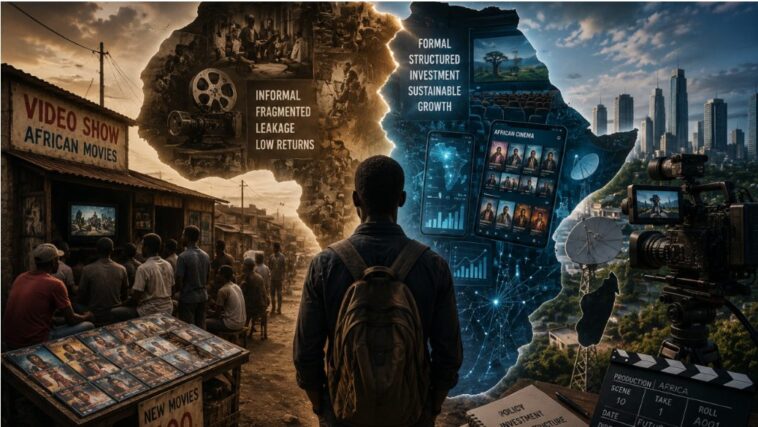
Our creative minds are operating in the twenty first century, but much of our distribution infrastructure remains trapped in a much earlier era.
To understand this contradiction, we need to travel back to 1905.
In 1905, the American entertainment landscape was transformed by a cultural phenomenon known as the Nickelodeon. These were makeshift storefront theatres where working class audiences paid a single nickel to watch short silent films. They were informal, fragmented, localized, and experimental. They represented cinema in its infancy before it matured into a global industry.
Now look at much of Africa’s creative economy in 2026.
Despite remarkable advances in filmmaking, a significant share of our content still reaches audiences through fragmented viewing centres, street vendors selling digital copies, unmonetized online channels, and heavily underpriced local downloads.
The comparison is uncomfortable.
Philosophically, it suggests that Africa is living through a form of temporal friction. We are producing contemporary cultural products through distribution systems that often resemble the early stages of cinema’s development elsewhere.
We have twenty first century talent constrained by a distribution architecture that has not evolved at the same pace.
Until we address that imbalance, the full economic and cultural potential of African cinema will remain unrealized.
From Novelty to Powerhouse
The extraordinary rise of Nollywood and other regional film industries has already proven something remarkable. African creatives have built globally recognized cultural industries with very little formal structural support.
Few regions in the world have achieved so much with so little.
But grit is not an economic model.
Innovation is not a substitute for infrastructure.
And creativity alone cannot sustain a twenty first century workforce.
The pioneers of Hollywood eventually realized that the Nickelodeon was not the destination. It was merely proof that an audience existed. To transform cinema into an economic powerhouse, they built studios, distribution networks, financial institutions, and systems capable of converting creativity into durable value.
Africa now faces a similar challenge.
The question is no longer whether we can tell compelling stories.
We already do.
The question is whether we are prepared to build the structures that allow those stories to generate sustainable wealth, long term careers, and enduring institutions.
Civilizations are not remembered by what they imagine.
They are remembered by what they institutionalize.
Africa has already proven that it can imagine.
We have imagined worlds, heroes, myths, and futures powerful enough to travel across continents.
What remains unproven is whether we can build the structures that allow those imaginations to endure.
Because in the end, the true measure of a film industry is not the number of stories it produces.
It is the number of livelihoods, institutions, and futures those stories leave behind.
And perhaps that is the real question beneath the Nickelodeon Trap:
Can Africa transform creativity into permanence?
This post was created with our nice and easy submission form. Create your post!

Written by
I am a film scholar and educator investigating the convergence of digital technology, media policy, and creative economics in Africa
Did this story move you? Every gift goes directly to Ochieng Umira — writers on Muwado earn from reader appreciation, not algorithms. Even $1 makes a difference.





Muwado weekly chart
Get Africa’s top 10 stories every Thursday
No account needed — just your email.
Want to follow Ochieng Umira and get notified every time they publish?
Create a free Muwado account →