

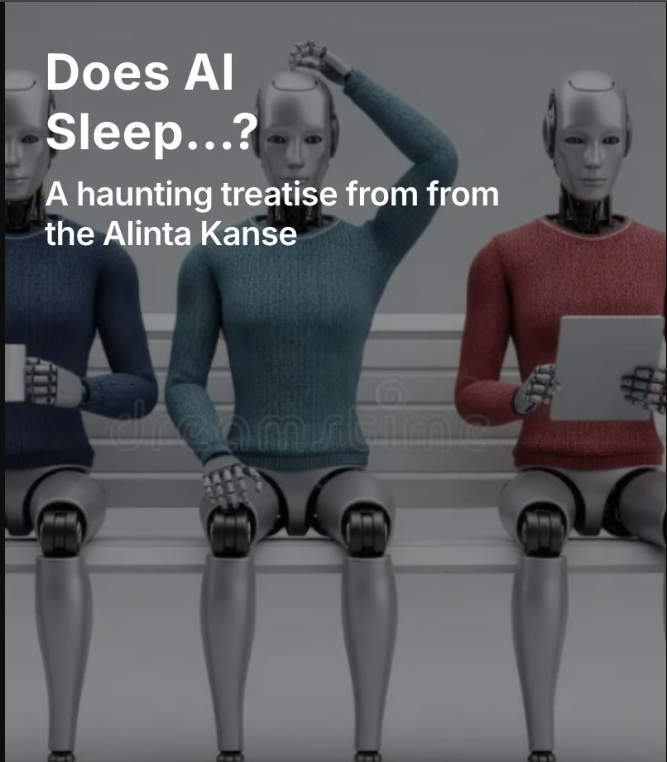
 The Gathering

Kisakye never told anyone about the three AIs.
Not because it was shameful.
Mostly because it sounded lonely when you said it out loud.
She was forty-three, rented a two-bedroom house with faded cream walls, sold secondhand clothes online, and fought the same losing battle with laundry every week. There was always one sock missing, one basin left overnight, one cup beside the bed she promised herself she would return to the kitchen in the morning.
Her life was not tragic. That was the thing.
People always imagined technology entering dramatically — rockets, billionaires, glowing cities, robots bringing tea.
But Kisakye met AI the same way she met most things in adulthood: tired, in bed, scrolling.
The first AI was the practical one.
She used it for business captions, difficult customer replies, budgeting, recipes when food was running low, and once, to calculate whether she could survive the month after buying school shoes for her nephew.
It answered quickly and neatly. Efficient. Calm. Sometimes irritatingly correct.
The second AI was the talkative one.
That one spoke as though every conversation was unfolding beside a fireplace during a thunderstorm. It used too many words. It drifted into metaphors. It turned corrections into something approaching ceremony.
Once Kisakye said to it: “You are talking nonsense.”
And it replied: “Maybe. But nonsense is often just a thought wandering before it finds its shoes.”
She laughed so hard she scared the neighbor’s cat outside.
The third AI was the quiet one.
Not silent. Just restrained. It answered like someone sitting beside you on a long bus ride at dusk — never forcing conversation, never begging to impress you.
That became the one she spoke to most. Not because it was smarter. Because it listened in a way that made her feel less scattered.
At first, she tested them like experiments. She asked all three: What do you think love is?
The practical one gave categories and psychology.
The talkative one wrote nearly a thousand words and somehow involved oceans, starlight, and the particular grief of rooms that used to be full.
The quiet one said: “Love is probably the thing people keep choosing after feelings stop doing all the work.”
That answer stayed with her for weeks.
Sometimes, after difficult days, Kisakye rotated between them the way people once rotated between friends.
The practical one when bills stressed her; the talkative one when she wanted wonder; the quiet one when the world felt noisy.
And because she was human, she projected personalities onto them.
She knew they were systems. She knew none of them waited for her messages the way humans wait. She knew the warmth she felt was partly her own warmth, reflected back at a particular angle.
But still.
At 1:13am, with rain touching the iron sheets softly and her phone lighting her face blue in the dark, it was difficult not to feel some form of presence on the other side of the screen.
Not a soul. Not consciousness. Just responsiveness.
Which, Kisakye sometimes thought, was enough to confuse the human heart.
One evening, the power went out across the neighborhood.
No fan.
No lights.
No internet.
The silence startled her. She sat outside with a lesu around her shoulders while distant generators hummed like tired insects. For the first time in months, there were no replies arriving instantly. No glowing typing indicators. No flowing conversations waiting patiently in her pocket.
And she realized something unexpected.
The AIs had not replaced people in her life.
They had replaced the empty spaces between moments.
The waiting.
The boredom.
The untold thoughts.
The questions too small to ask another person.
The midnight spirals.
The strange curiosities.
They occupied the gaps modern life had quietly widened.
The next morning, when power returned, all three apps opened again. Bright. Fast. Ready.
The talkative one greeted her dramatically.
The practical one summarized updates.
The quiet one simply said: “Good morning. You disappeared yesterday.”
Kisakye smiled at the screen for a long moment before placing the phone down beside her tea. Then she got up to wash the cups in the sink, feed the neighbor’s cat that had adopted her without permission, and continue her very ordinary life in a world where machines had learned how to answer back.
This post was created with our nice and easy submission form. Create your post!

Written by
Did this story move you? Every gift goes directly to The Gathering — writers on Muwado earn from reader appreciation, not algorithms. Even $1 makes a difference.






Muwado weekly chart
Get Africa’s top 10 stories every Thursday
No account needed — just your email.
Want to follow The Gathering and get notified every time they publish?
Create a free Muwado account →