

 DMT
DMT
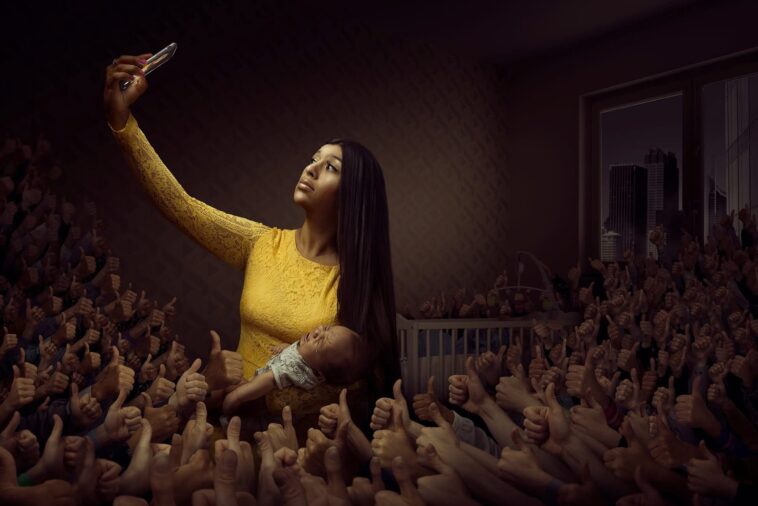
 The light in the room does not come from the sun, nor does it come from the warm, honest glow of a bedside lamp. It comes from the cold, clinical luminescence of a handheld screen, angled precisely at forty-five degrees to catch the high cheekbones of a mother who has forgotten what her own face looks like without a digital sheen.
In her left arm, she cradles a crying infant, a tiny, crumpled monument of pure, unadulterated human distress. The child’s tears are real, hot, and heavy with the simple, primal need for quiet comfort. But the comfort does not come. Instead, the mother’s right hand is extended skyward like a priestess offering a sacrifice to an invisible deity. Her eyes are locked not on the weeping flesh in her lap, but on the small glass mirror that translates her reality into currency.
Below them, pushing through the floorboards and crowding out the very air of the nursery, is a sea of disembodied hands. Thousands of thumbs up, rigid and unblinking, jostling for space, demanding attention, applauding the spectacle of a life lived entirely on display.
We were warned, of course. Decades ago, the prophets of the late twentieth century told us that the danger wouldn’t be a jackboot stepping on a human face forever, but rather a soft, warm bath of endless entertainment. They told us that Big Brother wouldn’t need to force his way into our homes; we would invite him in, mic him up, and ask him to choose our best angles.
But the evolution of our digital psychosis required a final, binding contract. It wasn’t enough to merely post the images; the system demanded proof of life. It demanded verification.
To enter the grand digital marketplace, to be seen, to be counted, to be relevant, the world introduced the ultimate compliance: online identity verification. It was marketed as a shield against fraud, a seamless key to a safer internet. “Upload your government ID,” the prompts chimed with algorithmic cheer. “Look into the camera and blink. Turn your head to the left. Smile to prove you are flesh and blood.”
And we did it. We gave away our biometrics, our iris patterns, the unique topography of our facial expressions, and the legal stamps of our national identities. We surrendered the final, sacred boundary between the private self and the public ledger, all for the privilege of remaining inside the perpetual vaudeville act. We traded the deeply rooted sanctity of an unquantifiable life for a handful of digital tokens and a front-row seat to our own cultural dissolution.
In the heart of the city, serious public conversation had long since collapsed into a form of collective baby-talk. The news was a series of flashing colors; politics was a shouting match of fifteen-second clips; and cultural life had been redefined as a tireless round of digital validation. The population had successfully transitioned from a community of citizens into a desperate audience.
The mother in the yellow dress is the archetype of this brave new world. She is verified. Her profile carries the coveted badge of authenticity, a digital seal of approval certifying that she is exactly who the machine says she is. Yet, as she stares into the lens, she has never been more anonymous. She has sacrificed the quiet, unwritten history of motherhood, the secret, sacred moments that run like deep roots beneath the soil of human experience, for the filtered gaze of a nameless crowd.
The crowd does not love her child. The crowd loves the ‘image’ of the child. It craves the raw materials of her intimacy to feed its own insatiable boredom. Every thumb raised in the darkness is a transaction, a tiny drop of dopamine exchanged for a piece of her privacy. She is aware of the numbers ticking upward on her screen, but she is entirely blind to what she is giving away: the immediate, unmediated presence of her life.
“When a people become an audience, and their public business a vaudeville act, then a nation finds itself at risk; culture-death is a clear possibility.”
Yet, beneath the noise of the digital stadium, a quiet counter-revolution is brewing. The year 2040 approaches, and the initial, blinding intoxication of the AI age is beginning to fracture under its own hollow weight. A growing fatigue has settled into the bones of those who remember what the earth feels like beneath bare feet.
A great separation is taking place, a psychohistorical shift where the human race is dividing into two distinct paths.
On one side remains the decrepit minority, trapped within the cesspool of digital psychosis. They are the ones who cannot sleep without the hum of the feed, who view their children through a viewfinder, and who have verified their identities so thoroughly with the machine that they have no identity left for themselves. They live in a state of perpetual exposure, hollowing out their souls to keep the digital lights on.
On the other side are those who have chosen to step off the stage. They are the few solitary figures quietly attuned to life’s arcane rhythms, content to remain entirely unseen. Having recognized that relentless exposure is a slow, spiritual hemorrhage, they have opted out of the verification queues. They refuse to hand over their faces to the database.
These quiet rebels are letting the rich life run back to the roots. They are turning away from the screens to reconnect with the living world, moving closer to the soil and the wind. They are rambling through unmapped forests, roaming down unlit paths, and building things of permanence with their own calloused hands. They understand that the truest form of self-worth cannot be measured in thumbs-up or algorithmic reach.
The nursery remains dark, save for that one, tyrannical rectangle of light. The infant’s cry softens into a weary whimper, a sound of profound loneliness in a room filled with ten thousand digital witnesses. The mother shifts her weight, her thumb hovering over the button that will publish this moment to the world forever.
For a split second, her gaze flickers. She looks down at the child, then out the dark window toward the distant horizon where the city lights end and the silent, unverified earth begins. In that fleeting moment of clarity, the question hangs in the cool night air, heavy and unanswered:
“Are you truly aware of what you’re giving away?”
She looks back at the screen. The thumbs are waiting. The audience demands the show. And with a practiced, elegant smile, she locks herself back inside the cage…
This post was created with our nice and easy submission form. Create your post!
Written by
Did this story move you? Every gift goes directly to DMT — writers on Muwado earn from reader appreciation, not algorithms. Even $1 makes a difference.






Muwado weekly chart
Get Africa’s top 10 stories every Thursday
No account needed — just your email.
Want to follow DMT and get notified every time they publish?
Create a free Muwado account →