

 Musanjufu Benjamin Kavubu

Politics is often discussed as though leadership transitions are moments of rupture. In reality, the most successful transitions in modern history have been those that preserved continuity while creating room for renewal. Few examples illustrate this better than China in the years following Chairman Mao Zedong.
When Mao died in 1976, China faced a changing world. The revolutionary era that had defined the country’s politics for decades was coming to an end. The challenge before the Chinese Communist Party was not whether to abandon its founding principles, but whether it could adapt those principles to a new reality. Under the leadership that followed, China maintained the political foundations laid by the revolution while introducing a new generation with different priorities, different methods, and a different understanding of the international environment.
The result was one of the most remarkable national transformations in modern history. Uganda today finds itself facing a different but equally important moment. President Yoweri Kaguta Museveni has dominated Uganda’s political landscape since 1986. Regardless of where one stands politically, few can deny that he has shaped the modern Ugandan state. The Uganda of today is vastly different from the Uganda that emerged from years of instability and conflict in the 1970s and early 1980s.
Yet the world that President Museveni entered nearly four decades ago is not the world Uganda faces today. The Cold War has ended. China has risen. BRICS has expanded. Africa is increasingly speaking the language of industrialization, regional integration, and economic sovereignty. The African Continental Free Trade Area promises to create the largest free trade area in the world by number of participating countries. Digital technology is transforming governance, commerce, and communication. A new generation of Ugandans has grown up with expectations very different from those of their parents.
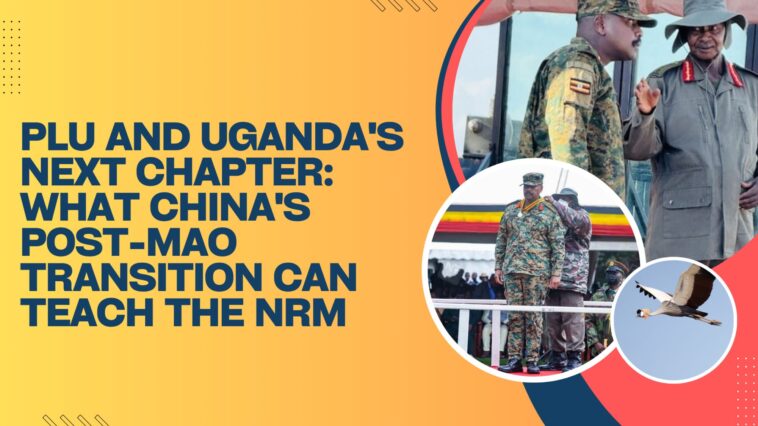
Every political movement that hopes to remain relevant must eventually answer a difficult question: how does it renew itself without losing its identity? This is where the emergence of Patriotic League of Uganda and the growing political profile of Muhoozi Kainerugaba become significant.
Much of the public discussion around Muhoozi has focused on his family connection to the President. That conversation is understandable, but it risks missing a larger political development taking place within the National Resistance Movement itself. Across history, political organizations survive not because they remain frozen in time but because they allow new factions, new ideas, and new generations to emerge within them.
In China, the post-Mao generation did not dismantle the Communist Party. Instead, it repositioned it to confront a changing world. The question facing Uganda is whether a similar process of renewal can occur within the NRM.
Supporters of PLU argue that the organization represents precisely that possibility. Its messaging frequently emphasizes anti-corruption, patriotism, Pan-African cooperation, youth participation, and national development. Whether one agrees with every position it advances is ultimately secondary to the fact that it is attempting to articulate a future-oriented vision inside an established political movement.
This matters because corruption remains one of Uganda’s most persistent challenges. Every discussion about economic transformation eventually encounters the same obstacle. Investors require predictability. Citizens demand accountability. Public resources must be directed toward development rather than personal enrichment.
If Uganda is to compete in an increasingly interconnected world, anti-corruption cannot remain merely a slogan. It must become a governing principle. The Pan-African dimension is equally important. The twenty-first century is increasingly becoming an era of continental blocs and regional cooperation. No African country, including Uganda, can achieve its full potential in isolation. The future lies in stronger trade corridors, integrated infrastructure, shared industrial development, and greater cooperation across borders.
This is one reason why many young Ugandans are attracted to political language that places Africa at the center of its vision rather than viewing the continent through the lens of dependency. The comparison with China is not about copying China’s political model. Uganda and China have different histories, different cultures, and different institutions. The lesson is something simpler.
Successful states recognize when the world is changing and prepare new leadership capable of navigating that change. China understood that the world of the late twentieth century required different skills from those that had defined the revolutionary era. Uganda may be approaching a similar moment. The country still needs stability, security, and continuity. It also needs innovation, technological modernization, institutional reform, and a political language that resonates with younger generations.
Whether Muhoozi ultimately becomes the central figure in that transition remains a matter for Uganda’s political process to determine. What is increasingly difficult to ignore, however, is that a generational conversation is already underway.
History rarely waits for political organizations to prepare themselves. It rewards those capable of adapting before change becomes unavoidable. The NRM’s greatest challenge may not be defeating external opponents. It may be managing its own evolution in a way that preserves its achievements while creating space for a new generation to leave its mark.
If the experience of post-Mao China teaches anything, it is that renewal is not a sign of weakness. It is often the condition for survival. For Uganda, the coming years may reveal whether the emergence of PLU and the growing prominence of Muhoozi Kainerugaba represent merely another chapter in the country’s politics or the beginning of a broader transition toward a new phase of national development.
That question will not be answered by slogans. It will be answered by performance, by institutions, and by whether a new generation can translate ambition into results. History, after all, judges political movements not by how long they remain in power, but by how effectively they prepare their countries for the future.
This post was created with our nice and easy submission form. Create your post!

Written by
<a href="https://benjaminwatchblog.wordpress.com/">Benjamin WATCH blog</a>, Community Manager <a href="http://afrobloggers.org.zw/">Afrobloggers</a>, Social Media and Africa Lead Coordinator Africaniwa, Real Estate enthusiast, Team Manager <a href="https://kyambogorugby.com/">Kyambogo Rugby </a>
Did this story move you? Every gift goes directly to Musanjufu Benjamin Kavubu — writers on Muwado earn from reader appreciation, not algorithms. Even $1 makes a difference.






Muwado weekly chart
Get Africa’s top 10 stories every Thursday
No account needed — just your email.
Want to follow Musanjufu Benjamin Kavubu and get notified every time they publish?
Create a free Muwado account →