

 Dr. Vijayakumar Parameswaran Unnithan
Nico had not expected to find India in Germany.
The MBA classroom at this German University was almost what one would expect. The grey walls, functional furniture, and electronic gadgets. Nothing exotic. Nothing to suggest that within the next two hours, his understanding of how stories work and how organisations transform would be permanently altered.
The visiting professor from India had brought four paintings. Not slides, not data visualisations. Actual paintings on canvas, propped against the whiteboard like artifacts in a museum that had lost its way.
“Just observe,” he said. “Tell me what you see, what you understand”
The first painting stopped him. Dark, turbulent colours—greys bleeding into blacks, stormy blues churning across the canvas. Mechanical fragments scattered like broken machinery. There was something violent about it, something that made his chest tighten. This was not abstract art for contemplation. This was an organisational crisis made visible.
Nico, practical and German and trained to find solutions, felt his mind reaching for frameworks. Change management models. Lewin’s three stages. Kotter’s eight steps. But the painting refused to be categorised. It demanded to be felt first.
The second painting shifted. Blues, still uncertain but lighter. Calmer.
The third showed systems struggling to align—order emerging from chaos like a puzzle assembling itself mid-air.
The fourth bloomed with yellows and golds, puzzle pieces connected, and there— the horse again. Not a machine. A living, breathing system.
“These are the four phases of transformation at this Indian Petrochemical Organisation,” the professor explained.
“But before I tell you what happened, share what do you see?” For ninety minutes, the class debated.
An optimist found hope even in the first dark painting. A pessimist saw systemic failure in the fourth’s apparent success. Someone noted the leader figure’s warm colours contrasting with the followers’ cooler tones—the loneliness of a vision that others cannot yet perceive.
Nico contributed his observations, built on others’ insights, and felt his thinking expand in real time. This was not a case study to analyse. This was an organisational experience to enter. And something was happening to him that he could not name. That night in his small apartment, Nico could not sleep.
The four paintings kept cycling through his mind. Crisis. Vision. Struggle. Integration. The horse—that living system, finally adaptive and whole. But the story felt incomplete. What comes after integration? After an organisation learns to move with living grace, what is next? Surely transformation does not end with “we adapted.” There must be something beyond.
At 2 a.m., he gave up trying to sleep. He found his old colours from a hobby he had abandoned years ago when business school consumed everything. His hands moved before his mind fully understood what they were doing.
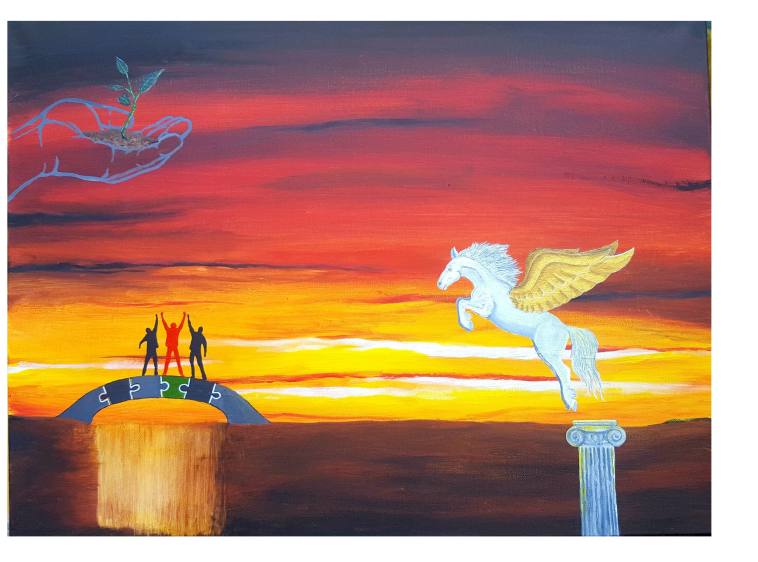
By dawn, he had created the fifth painting. A Pegasus. The horse from the fourth painting had grown wings. What was adaptive had become transcendent. The organisation that had learned to respond fluidly to its environment had now gained the capacity to rise entirely above constraints, to soar and imagine possibilities unconstrained by current reality. Nico stared at what he had created, exhausted and oddly exhilarated. He had not been assigned this.
The professor did not ask for extensions or interpretations. This had emerged from somewhere else—the place where stories become demands rather than entertainments. The narrative had taken hold of him, and completing it was not optional. It was necessary.
The next morning, slightly sheepish, he showed the professor his Pegasus.
He studied it in silence. Then smiled. “This is what stories do when they work,” he said. “They don’t just inform. They activate. You became a co-creator, not a consumer.”
Nico had not thought of it that way. He thought he had gotten carried away, maybe been unprofessional. But he was right—something had shifted.
The four paintings had not taught him about organisational transformation. They had pulled him into it, made him think through what happens when systems learn, adapt, and eventually transcend. “You know what you have done?” the professor continued. “You have demonstrated systems thinking. You did not just see four discrete stages. You saw a pattern that extends into the future. You understood that transformation is not a destination but a capability. That is what the Pegasus represents, not success, but the capacity for perpetual transcendence.”
Nico carried the Pegasus painting with him. It hangs in his office now, years later, at the startup where he is Head of Strategy.
His team knows the story of how a set of paintings from an Indian company’s transformation, shown by an Indian professor in a German classroom, moved him so deeply that he had to extend the narrative. When his team faces complex challenges—interconnected problems with no clear solutions, moments when they can not see the system for the parts—he tells them about the paintings. About how slowing down to truly see, about how inviting multiple interpretations, about how systems reveal themselves only when you stop trying to control them. And sometimes, when a strategic plan feels too neat, too linear, too much like they are treating the organisation as a machine, he asks: “Are we building a better mechanism, or are we growing wings?”
The professor later told him that his Pegasus had taught him something he had not fully articulated, that the measure of a good story is not agreement or comprehension. It is activation. A story that works does not leave you informed. It leaves you compelled to create, to extend, to add your verse to the song.
Nico never planned to become part of a teaching method or a research project. He was just an MBA student trying to understand organisational change. But stories do not ask permission. They find people who are ready to listen and transform them into tellers.
The four paintings told one story. Nico’s Pegasus told another. Together, they tell a third that transformation, organisational or personal, is not about reaching a final state. It is about developing the capacity to keep transforming.
In India, the original four paintings still exist. In Germany, a fifth painting hangs. And somewhere between India and Germany, in the space where stories cross borders and take flight, the real transformation continues. Not in the paintings themselves, but in what they make us see.
Not in the story told, but in the stories we can not help but tell in return.
The Pegasus flies still.
About the Author Dr. Vijayakumar Parameswaran Unnithan is a scholar- practitioner working at the intersection of career theory, employability, and organisation development. He is the originator of the Post-Skill Professional (PSP) Framework and Career Architect at Careertotus Consultants Pvt Ltd. He is the President of Asia Organisation Development Network (AODN) and publishes in leading management journals. Views are Personal.
This post was created with our nice and easy submission form. Create your post!

Written by
Did this story move you? Every gift goes directly to Dr. Vijayakumar Parameswaran Unnithan — writers on Muwado earn from reader appreciation, not algorithms. Even $1 makes a difference.






This is a meaningful story.
Thanks!!