

 Rita Ngenzi

The Ecosystem Debt Behind Africa’s Entrepreneurship Gap
The Ecosystem Debt Behind Africa’s Entrepreneurship Gap
Rita Ngenzi
Rita Ngenzi
Published Aug 3, 2026
Following
Last year, I came across a reflection by McKevin Ayaba describing “death by a thousand ecosystem cuts.” The phrase gave language to something I had been observing for years: across Africa, businesses rarely fail because of one defining mistake. They struggle under the cumulative weight of ecosystem failures that no single entrepreneur can solve alone.
More recently, I listened to a conversation between Eche Emole and Iyinoluwa Samuel Aboyeji Jr on the Afropolitan Podcast. Discussing Africa’s innovation ecosystem, Iyin argued that the continent has had “no leg day,” investing heavily in ventures while underinvesting in the infrastructure needed to sustain them.
Both observations point toward the same conclusion: Africa’s challenge is not a shortage of entrepreneurs. It is an underinvestment in the ecosystems that enable entrepreneurship.
Entrepreneurship is an ecosystem outcome.
Businesses do not emerge in isolation. They are the product of the environment in which they operate, the infrastructure they rely on, and the institutions that connect opportunity to enterprise. When those systems are weak or fragmented, entrepreneurs inherit challenges that no amount of resilience can fully overcome.
Africa does not have an entrepreneurship problem. It is one of the most entrepreneurial regions in the world. Every day, millions of people start businesses out of ambition, necessity, creativity, and resilience. Yet business failure rates remain persistently high.
The instinct is to look to entrepreneurs for answers. Did they have the right business model? Did they execute well enough? Did they raise enough capital? Were they resilient enough?
These are the wrong starting questions.
The more fundamental one is this:
What kind of ecosystem did we expect them to build within?
Across much of Africa, entrepreneurs are expected to build businesses while simultaneously navigating fragmented markets, developing talent, influencing policy, accessing finance, establishing supply chains, and building digital infrastructure.
That is not entrepreneurship.
It is institutional substitution.
Entrepreneurs are compensating for missing systems. They carry ecosystem debt: the accumulated cost of underinvestment in the institutions, infrastructure, and relationships that make entrepreneurship possible. Where ecosystems are strong, entrepreneurs devote their energy to creating value.Where ecosystems are weak, that same energy goes into fixing the ecosystem itself, a burden that was never theirs to carry.
That burden rarely arrives as a single blow. Policy uncertainty, weak public digital infrastructure, inadequate production infrastructure, limited access to finance, fragmented markets, skills shortages, disconnected support institutions: any one of these can end a business outright. But that is rarely how it happens. More often, no single failure is dramatic enough to take the blame. It is the accumulation, not any one collapse, that quietly becomes the cause of death.
For decades, the dominant response has been to invest directly in entrepreneurs through incubators, accelerators, expanded access to finance, business development programmes, and celebrated success stories.
These investments matter, but they treat the problem at the level of the founder, while the underlying cause sits at the level of the system.
Venture creation is not the starting point of an entrepreneurial economy.
It is the outcome of one.
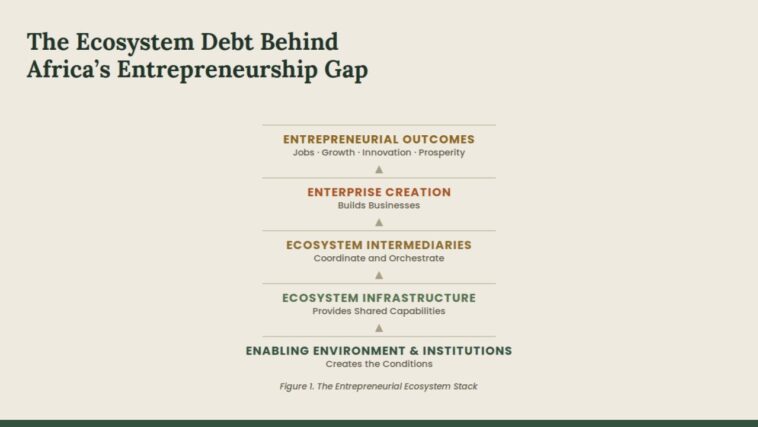
Entrepreneurial ecosystems are built upon three interconnected layers. Together, they determine whether entrepreneurship becomes an isolated success story or a repeatable engine of economic transformation.
The first is the enabling environment. This includes effective policies and regulation, good governance, intellectual property protection, investment and tax frameworks, trade agreements, and the broader institutional conditions that shape how businesses operate.
The second is ecosystem infrastructure. This is the productive capability entrepreneurs need to build and grow. It includes digital public infrastructure, ecosystem data and intelligence, research and innovation infrastructure, shared production and prototyping facilities, standards, testing and certification systems, talent development systems, market access infrastructure, and financial infrastructure.
The third is ecosystem intermediaries. These are the organizations that connect people, institutions, and opportunities across the ecosystem. Innovation hubs, entrepreneur support organizations, business development centres, accelerators, incubators, industry associations, technology transfer offices, and investor networks do not replace infrastructure.
They activate it.
Policy creates the conditions. Ecosystem infrastructure provides shared capabilities. Ecosystem intermediaries coordinate and orchestrate.
When these three layers work together, they reduce the cost of entrepreneurship, lower the risk of innovation, strengthen collaboration, and increase the likelihood that businesses survive, scale, and create value.
Just as roads enable trade, ecosystem infrastructure enables enterprise.
This also explains why well intentioned policies, programmes, and investments so often fall short of their intended outcomes.
The cause sits deeper than funding or implementation.
It is a delivery gap: the distance between what a policy, programme, or investment is designed to achieve and what society ultimately experiences. That distance is rarely explained by a lack of ambition. More often, it reflects ecosystems that are too fragmented to translate individual efforts into collective outcomes.
When ecosystems are fragmented, even the best policies struggle to deliver.
When ecosystems are connected, policy enables infrastructure, infrastructure strengthens intermediaries, intermediaries empower entrepreneurs, and entrepreneurs build businesses that create jobs, wealth, innovation, and economic transformation.
Structural transformation requires investing in ecosystems with the same intentionality as ventures: strengthening the enabling environment, building ecosystem infrastructure, and empowering the intermediaries that connect ideas, institutions, capital, and markets.
For too long, entrepreneurial success has been measured by the strength of the founder.
It is time to measure it by the strength of the ecosystem surrounding them.
Because entrepreneurship is not an individual achievement.
It is an ecosystem outcome.
This post was created with our nice and easy submission form. Create your post!

Written by
Ecosystem Builder I Innovation Strategist I Advancing Africa’s Entrepreneurship, Innovation, and Creative Economies
Did this story move you? Every gift goes directly to Rita Ngenzi — writers on Muwado earn from reader appreciation, not algorithms. Even $1 makes a difference.






Muwado weekly chart
Get Africa’s top 10 stories every Thursday
No account needed — just your email.
Want to follow Rita Ngenzi and get notified every time they publish?
Create a free Muwado account →