

 Ochieng Umira
The most urgent question about artificial intelligence in African cinema is not whether it will replace filmmakers.
It is whether it will replace the conditions under which filmmakers imagine.
Much of the current debate circles employment, copyright, productivity, and cost. Those questions matter. But they may not be the deepest question before us. Every technological revolution reshapes not only what we can produce, but what we consider possible. The camera changed memory. Television changed attention. The internet changed distribution.
Video generation AI may change imagination itself.
That is a more unsettling proposition.
For the first time in history, a filmmaker in Nairobi, Kigali, Lagos, or Accra can type a prompt and generate images that would once have required a production designer, a cinematographer, a visual effects team, and weeks of planning. We celebrate this as democratization, and in many ways it is. AI lowers the barrier to entry. It widens access to visual production. It hands independent creators extraordinary new tools.
But every tool carries a hidden philosophy.
The question is not whether AI can generate African images.
The question is whether it gradually begins to define what African images should look like.
The paradox of infinite images
Video generation AI appears to offer infinite visual possibility. In reality, it may be producing something closer to infinite variation within an increasingly familiar pattern.
This is the paradox of the algorithmic imagination.
A model can generate a thousand versions of a sunset over the Serengeti, a futuristic Lagos skyline, or a traditional village rendered in cinematic light. The images differ in detail, but they tend to share a recognizable grammar: symmetrical composition, dramatic color grading, shallow depth of field, emotionally legible faces, the same cinematic aesthetics circulating everywhere at once.
The machine produces variation.
But variation is not originality.
Originality has historically emerged from what resists prediction: memory, ritual, scarcity, political struggle, language, accident, cultural specificity. AI, by contrast, generates images through statistical learning. It recombines patterns drawn from enormous datasets. It is extraordinarily good at producing what resembles what has already existed.
The danger is not that AI lacks creativity.
The danger is that it may make familiar creativity overwhelmingly convenient.
African cinema was born from the wrong turn
African cinema has never been defined by abundance.
It has been defined by invention.
Across the continent, filmmakers have repeatedly turned limitation into aesthetic innovation. Limited budgets produced improvisational performance. Scarce equipment produced inventive visual strategy. Oral storytelling traditions reshaped cinematic narrative. Multiple languages produced hybrid forms of dialogue. Community participation blurred the line between performer and audience.
What outsiders often read as technical constraint frequently became cultural distinction.
The history of African cinema is, in many ways, a history of productive detours.
Its most important films were often the films that should not have worked by industrial logic. They emerged from local realities that global cinema had not yet standardized.
This is why I worry about what I call aesthetic convergence.
The silent standardization of imagination
Aesthetic convergence is the process by which AI-assisted image generation gradually narrows stylistic diversity — making globally familiar visual forms easier, cheaper, and more reproducible than culturally specific ones.
Imagine a generation of African filmmakers who begin every project with AI-generated concept art.
They prompt for locations.
They prompt for costumes.
They prompt for camera angles.
They prompt for mood boards.
They prompt for entire sequences.
The AI becomes not merely a production assistant but a curator of visual possibility.
Over time, a subtle shift occurs.
Filmmakers do not consciously decide to imitate global aesthetics.
They simply choose from the options most readily at hand.
This is how standardization tends to happen.
Not through coercion.
Through convenience.
The same latent visual archive begins to shape films across countries, languages, and traditions. The Maasai village starts to resemble the Ethiopian highlands. The Nigerian market begins to resemble a stylized Marrakech. The future imagined in Kigali begins to resemble the future imagined in Los Angeles.
Difference survives.
But it becomes increasingly decorative.
From representation to imagination
For decades, scholars of African media have asked who has the power to represent Africa.
That remains an essential question.
But AI pushes us toward another one.
Who has the power to generate the images through which Africa imagines itself?
Representation concerns the image that already exists.
Imagination concerns the image that has not yet been made.
If most video generation models are trained primarily on globally dominant audiovisual cultures, then African filmmakers are increasingly creating with tools whose underlying visual assumptions may not be African at all.
This is not an argument about bias alone.
It is an argument about epistemology.
Every image-generation system carries implicit assumptions about beauty, realism, emotion, space, movement, and narrative.
A tool trained on existing patterns may struggle to generate futures that lie outside those patterns.
This matters because cinema does not merely reflect society.
Cinema rehearses possible worlds.
The narrowing of the future
The deepest loss may not be aesthetic.
It may be temporal.
African cinema has always been a laboratory for alternative futures — from postcolonial liberation narratives to speculative Afrofuturism, filmmakers have imagined political, spiritual, and social worlds that did not yet exist.
AI risks narrowing that horizon.
Not by prohibiting alternative futures.
By making certain futures statistically more probable than others.
When predictive systems become creative partners, imagination begins to orbit around what the model can easily produce.
The strange becomes difficult.
The unfamiliar becomes expensive.
The culturally specific becomes underrepresented.
The unimagined becomes invisible.
This is the death of the wrong turn.
The griot and the algorithm
African oral traditions offer a revealing contrast.
A griot rarely tells the same story the same way twice.
Digression is not a flaw.
It is a method.
The storyteller wanders deliberately, improvises, folds in new events, responds to the audience, lets memory reshape the narrative. The story stays alive because it refuses optimization.
The algorithm works differently.
Its purpose is to reduce uncertainty.
Its intelligence lies in prediction.
It seeks the path most likely to satisfy expectation.
The griot expands possibility.
The algorithm concentrates probability.
One opens the story.
The other closes it.
A film policy for imagination
This is why African film policy must move beyond the question of AI adoption.
The central policy question is whether we are building the infrastructure for African imagination, or merely importing the infrastructure of global prediction.
We should be asking different questions.
Who owns the datasets that will generate African futures?
What languages are represented?
What archives are preserved?
What aesthetic traditions are encoded?
Can African countries build culturally grounded generative models trained on African cinematic histories, oral traditions, visual cultures, and performance practices?
Can public investment in AI become a project of cultural preservation rather than aesthetic standardization?
The challenge is not to reject AI.
The challenge is to keep AI from becoming the invisible curator of African possibility.
A closing meditation
Every civilization is ultimately shaped by the images it can imagine.
The camera once expanded that capacity.
Video generation AI may do the same.
Or it may quietly narrow it.
The greatest risk is not that African filmmakers will lose their jobs.
It is that they may gradually lose the habit of taking the wrong turn.
Because the wrong turn has always been where new cinemas are born.
A generation from now, historians may not ask whether AI entered African filmmaking.
That will be obvious.
They may ask a harder question instead.
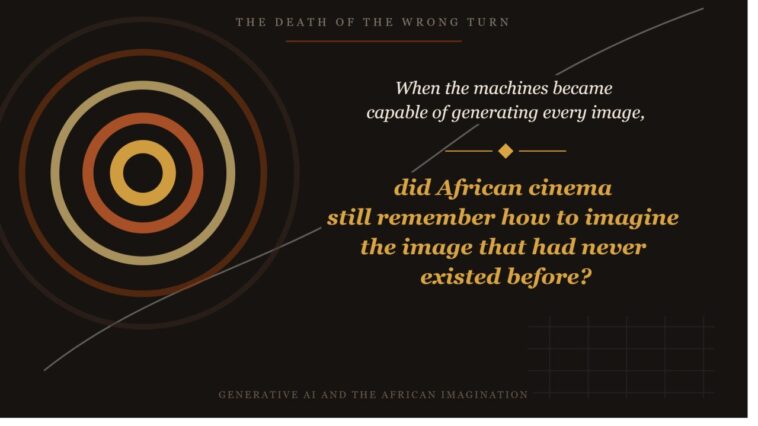
When the machines became capable of generating every image, did African cinema still remember how to imagine the image that had never existed before?
This post was created with our nice and easy submission form. Create your post!

Written by
I am a film scholar and educator investigating the convergence of digital technology, media policy, and creative economics in Africa
Did this story move you? Every gift goes directly to Ochieng Umira — writers on Muwado earn from reader appreciation, not algorithms. Even $1 makes a difference.





Muwado weekly chart
Get Africa’s top 10 stories every Thursday
No account needed — just your email.
Want to follow Ochieng Umira and get notified every time they publish?
Create a free Muwado account →