

 Musanjufu Benjamin Kavubu

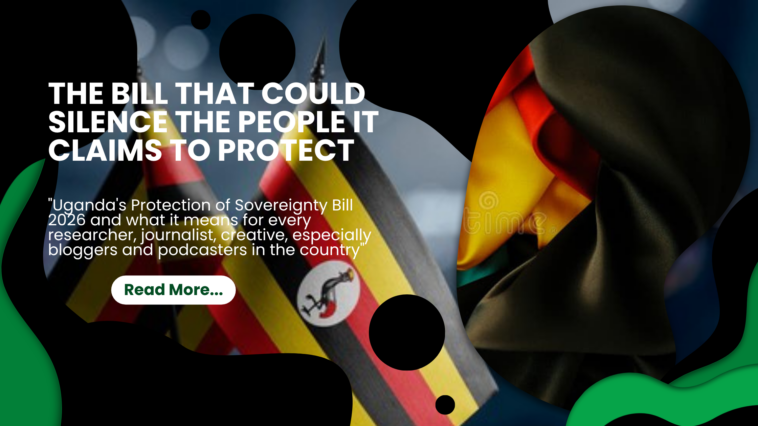
Uganda’s Protection of Sovereignty Bill 2026 and what it means for every researcher, journalist, creative, especially bloggers and podcasters in the country.
There is a bill sitting in Uganda’s parliament right now that could make it a criminal offence to co-host a podcast with your cousin in London. To publish research funded by a Chinese or European university. To write a report critical of government economic policy. To receive a grant from an African foundation and use it to make a documentary film.
The Protection of Sovereignty Bill 2026, Bill No. 13, was gazetted on 13 April 2026. The NRM Parliamentary Caucus endorsed it on 27 March. By most informed assessments, its passage is a matter of timing, not outcome.
The stated purpose is legitimate. No serious person disputes that foreign interference in elections, destabilization campaigns funded from abroad, or the weaponisation of civil society against the state are real threats worth addressing. Uganda is a sovereign country and has every right to protect itself. That principle is not in dispute here.
The problem is not the goal. The problem is the instrument being used to pursue it.
The Bill defines a foreigner to include Ugandan citizens living outside Uganda. Read that again. Your relative in the diaspora, that Ugandan academic at a British university, the journalist working in Nairobi, the entrepreneur based in Dubai is legally a foreigner under this Bill. Any professional collaboration with them, any funding relationship, any co-authored paper or co-produced podcast and guest blog post from them, potentially falls within its reach.
The Bill requires that any foreign funding above UGX 400 million annually, roughly $110,000 must receive prior written approval from the Minister of Internal Affairs. Not a regulatory body. Not an independent tribunal. A minister, with no stated timeline for processing, no objective criteria for refusal, and no independent appeal mechanism. Every international research grant, every foundation award, every development funding relationship above that threshold becomes contingent on a single ministerial signature.
The economic sabotage clause is arguably the most dangerous provision in the document. It criminalises publishing information that “weakens or damages the economic system or viability of the country.” It does not require that you intended to cause damage. It does not require that damage actually occurred. It only requires that someone in authority decides your analysis weakened economic stability. For a journalist writing about Uganda’s debt levels, a researcher examining government fiscal policy, or a think tank publishing currency depreciation data, this clause is a sword hanging over every publication. The penalty is twenty years in prison.
The Bill also extends to digital platforms explicitly. Podcasters, bloggers, YouTube commentators, X Space hosts, all fall within its reach if their content is deemed to promote foreign interests or influence the public against government policy. After all WordPress, Substack, Spotify and wherever you publish are foreign platforms.
Uganda’s research economy is not self-sufficient. Makerere University, the country’s flagship institution, received approximately UGX 25 billion from the government’s Research and Innovation Fund in the last financial year. That sounds significant until you understand that billions of dollars flow annually into Ugandan academic and policy work through bilateral donors, international foundations, and UN agencies. The historic funding partnerships between Makerere and the Carnegie Corporation, NORAD, and Sweden’s Sida have been foundational to sustaining research capacity and graduate training for decades. Every one of those partners qualifies as a foreigner under the Bill’s definitions.
The creative economy faces the same exposure. A Ugandan documentary filmmaker receiving a grant from the Bertha Foundation. A podcast host supported by DW Akademie. A novelist receiving a publishing advance from a foreign literary press. All of them, under a literal reading of this Bill, are agents of foreigners engaged in activities that require ministerial registration and disclosure.
For think tanks and policy research institutions including Development Watch Centre, the Economic Policy Research Centre, and the Sino-Uganda Research Centre, the threat is existential. These organisations derive analytical credibility precisely from their international partnerships, their peer review processes, and their engagement with global scholarly networks. A think tank policy paper reviewed by academics at the University of Pretoria carries more institutional weight than one that has not been. The Bill threatens not merely the funding of these partnerships but the intellectual legitimacy they provide.
Foreign agent laws do not primarily work through prosecution. They work through fear.— The Russian experience, documented by Amnesty International, Human Rights Watch & the European Parliament
This Bill was modelled closely on Russia’s 2012 Foreign Agents Law. That is not an allegation, it is visible in the structure and language of the legislation itself. The Russian experience has been exhaustively documented by Amnesty International, Human Rights Watch, and the European Parliament. The conclusion is consistent: foreign agent laws do not primarily work through prosecution. They work through fear. By creating broad, vague definitions with enforcement at ministerial discretion, they produce pervasive self-censorship. Organisations stop doing certain research. Journalists avoid certain topics. Academics withdraw from certain partnerships. Not because they have been prosecuted, but because no one knows exactly where the line is, and the penalty for crossing it is twenty years.
In Russia, the law expanded progressively from obvious targets to reach academic research, environmental journalism, economic analysis, and historical memory projects. The vague definitions were not an oversight. They were the mechanism. Uganda’s Bill reproduces this structural feature precisely.
What makes this particularly painful is the timing. Ugandan startups attracted $30 million in venture capital in 2025, a sevenfold increase from the previous year, overtaking Rwanda and Tanzania as the leading startup destination in East Africa for the first time on record. Uganda’s knowledge economy, still in a formative stage, is showing genuine momentum. Young researchers, journalists, and creators are building institutions that give African analysis its own voice and audience.
This Bill arrives at precisely that moment and tells international investors, research partners, and creative collaborators that working with Ugandans requires ministerial permission. That is not a sovereignty-protecting message. That is a signal that Uganda’s most capable people may soon need to leave in order to do their work freely.
The Bill has not yet passed. The parliamentary process still provides a window. The most important amendments to push for are narrow and specific: an explicit carve-out for academic research under institutional ethical review; a definition of political activity that excludes journalism and cultural production; an independent appeals mechanism for ministerial funding decisions; and a narrowed economic sabotage clause that requires actual intent and actual harm.
For organisations already operating in this space, the compliance architecture needs to be built now, before the Bill passes. Dedicated financial accounts for foreign income. Documented editorial independence in every grant agreement. Registration formalised where it is not yet complete. And a qualified Ugandan constitutional lawyer engaged before the first enforcement action, not after.
The sovereignty of Uganda is not protected by silencing the Ugandans who explain it to the world. It is protected by building institutions strong enough, independent enough, and analytically credible enough to speak for themselves. That is the work the Bill, in its current form, puts at risk. At the East African Perspective podcast, we are rattled by this bill and what it means for our future.
This post was created with our nice and easy submission form. Create your post!

Written by
<a href="https://benjaminwatchblog.wordpress.com/">Benjamin WATCH blog</a>, Community Manager <a href="http://afrobloggers.org.zw/">Afrobloggers</a>, Social Media and Africa Lead Coordinator Africaniwa, Real Estate enthusiast, Team Manager <a href="https://kyambogorugby.com/">Kyambogo Rugby </a>
Did this story move you? Every gift goes directly to Musanjufu Benjamin Kavubu — writers on Muwado earn from reader appreciation, not algorithms. Even $1 makes a difference.




Muwado weekly chart
Get Africa’s top 10 stories every Thursday
No account needed — just your email.
Want to follow Musanjufu Benjamin Kavubu and get notified every time they publish?
Create a free Muwado account →