

 Ochieng Umira
Every year, brands spend millions fighting a losing battle against the five-second “Skip Ad” button.
Meanwhile, a Kenyan web series has quietly demonstrated a more effective model: stop interrupting the story and become part of the story.
As part of my research into digital film distribution in Kenya, I analysed 26,760 audience comments across twenty episodes of Disco Matanga, a YouTube series created by Jacky Vike (Awinja). What I found challenges several assumptions about audience behaviour, content distribution, and the future of African cinema.
The dominant narrative in African film circles is that local content must be “globalised” to scale.
The data suggests the opposite.
Cultural Authenticity Is Not a Limitation. It Is a Distribution Strategy.
One of the most surprising findings was that audiences were not primarily engaging with funeral rituals, despite the series being built around a funeral narrative.
The strongest engagement drivers were:
• Linguistic hybridity and code-switching (20%)
• Inter-ethnic chemistry (15%)
• Diaspora engagement (12%)
• Humour and entertainment (12%)
• Season continuity discussions (10%)
• Economic realities (8%)
• Cultural pride (7%)
In other words, audiences were not simply consuming culture.
They were consuming identity, belonging, recognition, nostalgia, and community.
That distinction matters because it suggests cultural authenticity is not a barrier to reach. It may be the mechanism through which reach is achieved.
The Diaspora Discovery
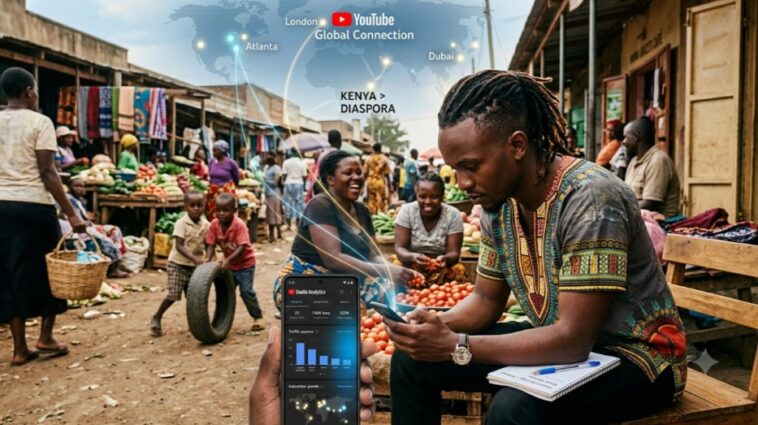
Perhaps the most significant finding was the role of the digital diaspora.
Viewers from Canada, Saudi Arabia, the Gulf States, Lebanon, China, and the United States repeatedly described Disco Matanga as a bridge back home.
Many media executives assume broader appeal requires greater cultural neutrality.
The evidence points in a different direction.
There are thousands of generic comedy videos on YouTube.
There are very few high-quality Kimaragoli-language dramas.
In platform economics, cultural specificity creates scarcity.
What appears niche locally can become highly valuable globally because it occupies a largely uncontested cultural space.
For African filmmakers, this may be one of the most important strategic lessons of the digital era: authenticity is not the enemy of scale. It is often the source of differentiation.
Disco Matanga’s Hidden Business Model
The series also offers a masterclass in platform ecosystem economics.
Brands such as Safaricom’s M-Pesa, Britam Insurance, Airtel Kenya, and Odoo are not awkwardly inserted into episodes as interruptions. They are integrated directly into the story’s problem-solving logic.
In Season One, Episode Three, a dispute involving a Britam life insurance policy becomes the central conflict driving the narrative.
M-Pesa transactions appear naturally because they reflect the economic reality of everyday life.
The result is something much more sophisticated than product placement.
It is a fully activated multi-sided marketplace where creators, audiences, brands, and platforms co-produce value simultaneously.
Because Jacky Vike retains creative control over how brands appear, audience trust remains intact. Commercial products become narrative solutions rather than narrative disruptions.
This produces a form of brand equity that traditional advertising struggles to manufacture.
The Real Challenge Facing African Filmmakers
The findings also reveal a deeper structural issue.
Africa’s biggest creative challenge is no longer simply the digital divide.
It is what I call the Algorithmic Divide.
The question is no longer who can upload content.
The question is who understands how visibility is created once content is uploaded.
This leads to what I describe as the Strategic Literacy Gap: inequalities in a creator’s ability to interpret analytics, understand platform dynamics, manage online communities, negotiate partnerships, protect intellectual property, and convert visibility into sustainable economic outcomes.
Many creators know how to make excellent content.
Far fewer know how to analyse audience retention curves, optimise click-through rates, identify traffic sources, activate diaspora communities, or transform engagement into long-term revenue.
The evidence from Disco Matanga is revealing.
Across twenty episodes, creator engagement remained consistently active through pinned comments, audience interaction, release announcements, and community participation.
These are not minor promotional tactics.
They are distribution competencies.
A Post-Streaming Future?
The findings arrive at an important moment for Africa’s screen industries.
As streaming platforms reassess their investments across African markets, the future may increasingly belong to creators who own their audience relationships rather than depend exclusively on institutional gatekeepers.
The successful African filmmaker of the future may need to be more than a storyteller.
They may also need to be:
• A community builder
• A data analyst
• A digital distributor
• A brand strategist
• An entrepreneur
The creator economy is not a complete solution to Africa’s employment challenges, but it represents one of the few sectors where a young person with a smartphone, internet access, and a compelling story can access regional and global markets without waiting for permission from traditional institutions.
Every successful creator ecosystem generates opportunities not only for actors but also for editors, writers, designers, marketers, videographers, community managers, and digital entrepreneurs.
The Takeaway
The lesson from Disco Matanga is remarkably simple.
Do not dilute your voice to fit an imaginary global audience.
Lean into your specific truth.
Build a community.
Master the platform.
Understand the data.
Own the audience relationship.
Because in the digital economy, cultural authenticity is not a constraint on visibility.
It may be the most powerful visibility strategy available.
This post was created with our nice and easy submission form. Create your post!

Written by
I am a film scholar and educator investigating the convergence of digital technology, media policy, and creative economics in Africa
Did this story move you? Every gift goes directly to Ochieng Umira — writers on Muwado earn from reader appreciation, not algorithms. Even $1 makes a difference.





Muwado weekly chart
Get Africa’s top 10 stories every Thursday
No account needed — just your email.
Want to follow Ochieng Umira and get notified every time they publish?
Create a free Muwado account →