

 Isabelle Ugochukwu

In January, BBC News published an article by Mansur Abubakar and Makuochi Okafor about a fatal incident that has since echoed far beyond Nigeria’s borders.
‘Tragic death of Adichie’s young son pushes Nigeria to act on health sector failings‘
A story not just about the tragic loss of a young boy’s life, but about the danger and true cost of silence.
The death of the young son of Chimamanda Ngozi Adichie, alongside multiple other alleged cases of medical negligence, has forced a nation to confront what patients have been whispering for years, often behind closed doors and without recourse:
The system is failing them.
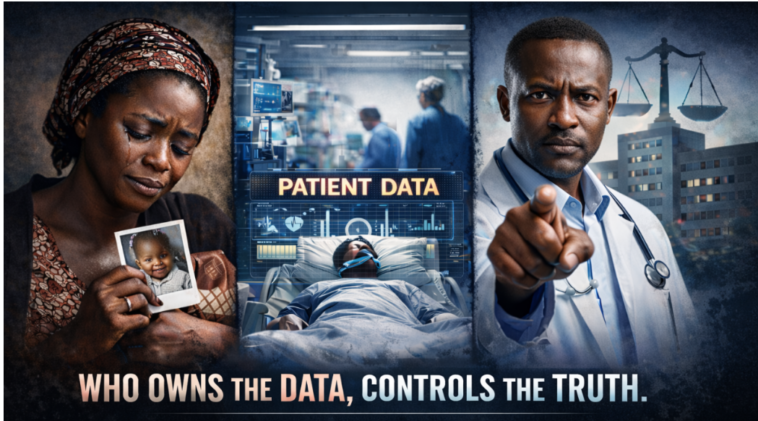
Denied oxygen. Excessive sedation. Surgical instruments left inside a patient’s body. Labour lasting more than 24 hours without intervention. Families who knew something was wrong, but had no data, no evidence, no leverage, no power, and no voice that could not be dismissed.
What this revealed to me
After leading R&D for MedTech Solutions – speaking with hundreds of patients across several sub-Saharan African countries over the past three years, this article did not surprise me. Rather, it confirmed a stark reality I wish I weren’t so acutely aware of:
That these are not isolated incidents, but symptoms of a cross-continental healthcare system designed without the patient in the data value chain.
The uncomfortable truth about health data
Healthcare today generates enormous volumes of data. But most of it serves institutions, regulators, insurers, or researchers.
Very little of it serves the patient.
In many systems, especially across emerging markets, when something goes wrong:
- There is no real-time patient-reported record
- No longitudinal view of care from the patient’s perspective
- No neutral, auditable trail linking symptoms, interventions, delays, and outcomes
- No way to surface systemic risk before tragedy strikes
By the time investigations begin, the damage is done.
Why patient-owned data changes everything
At MedTech Solutions , we are building what healthcare has long avoided:
Infrastructure where the patient is not a bystander, but the data owner.
In practice, this means:
- Patients capturing symptoms, care experiences, and outcomes in real time
- Data that exists independently of any single clinician or facility
- A longitudinal health record controlled by the individual, not locked in silos
- Aggregated, anonymised insights that reveal patterns no whistleblower ever could
We are doing this because when patients are included in the data value chain, three things happen:
- Incidents surface earlier – Patterns of harm, delay, or unsafe care no longer rely on media exposés or tragic deaths to be recognised.
- Clinicians and hospitals are protected as well as held accountable – Data separates individual error from systemic failure, enabling clinical governance based on evidence rather than blame.
- Healthcare systems become measurable, not anecdotal – Quality, safety, and continuity of care can finally be tracked at scale.
This data is not just vital. It is revenue-viable.
There is a persistent misconception that patient-centred infrastructure is “nice to have” but not investable. That misconception has slowed progress for years.
The opposite is true.
Patient-generated, real-time health data is:
- Foundational for life sciences, AI, and public health surveillance
- Essential for regulators overseeing quality and compliance
- Critical for governments designing policy and safety frameworks
- Highly valuable for payers and partners entering African markets, making informed purchasing, manufacturing, and distribution decisions, while reducing adverse events and cost leakage
Most importantly, it enables ethical data markets where:
- Patients are included, not extracted from
- Value is shared, not concentrated
- Trust becomes an asset, not a liability
This is why the future of healthcare data will not be built on extraction, but on participation.
The real question
Many will read the BBC article and ask the same familiar question:
Will anything actually change?
My work has made one thing unmistakably clear to me: task forces don’t change systems. Sustainably built infrastructure and strong governance do.
If we want fewer tragedies, fewer symbols of national failure, fewer stories that surface only after lives are lost, we must fund the systems that surface truth before the headlines.
We must invest in the pipes, not just the promises. In real-time data, not retrospective reports. In companies building patient-owned infrastructure for the continent.
Because when patients are invisible in the data, their suffering is invisible too.
And that is a cost no healthcare system – nor the world – can afford to keep paying.
This post was created with our nice and easy submission form. Create your post!

Written by
Founder & CEO MedTech Solutions | Building Health Data Infrastructure for Africa | Powering Global Health Intelligence | Advancing Global Health with Data
Did this story move you? Every gift goes directly to Isabelle Ugochukwu — writers on Muwado earn from reader appreciation, not algorithms. Even $1 makes a difference.






Muwado weekly chart
Get Africa’s top 10 stories every Thursday
No account needed — just your email.
Want to follow Isabelle Ugochukwu and get notified every time they publish?
Create a free Muwado account →