

 Tema Innocent
Upon being offline for a while, I opened my X app and was immediately struck by chaos. My feed was ablaze with videos of mobs, teargas, and a bleeding youth sprawled on the dusty streets of Yumbe. Hashtags like #Yumbe and #WestNile were trending, and the posts were coming in fast—some angry, some mocking, some pleading for calm. What had happened in this quiet town tucked in Uganda’s West Nile sub-region?
It all started with a sermon.
Sheikh Kasim Abdallah, a bus driver and Imam at Munir Mosque, had recorded a sermon the previous week condemning pork sales in Yumbe. He called it a “cultural imposition” and urged Muslims to reject it entirely. In a district where Muslims make up 76% of the 934,340 residents, his words struck a chord. The video spread like wildfire on X and WhatsApp, racking up thousands of views. By the morning of November 4, rumors of his arrest were swirling—and the streets were stirring.
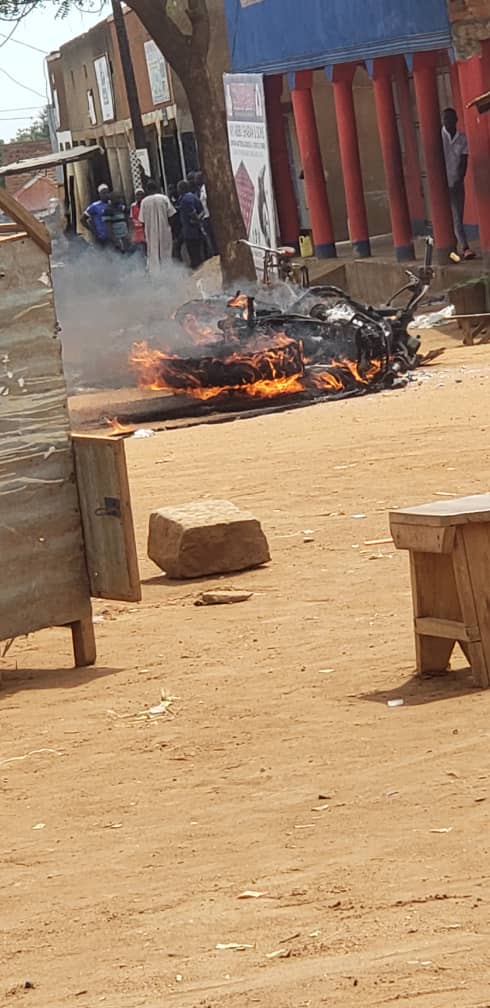
Between 8 and 2 PM, Yumbe transformed. Youths, reportedly 100 to 200 strong, mobilized in protest. The first targets were pork joints and Christian-owned hotels. Armed with pangas and arrows, mobs stormed the RDC office and set a government motorcycle ablaze. Police responded with teargas and live bullets. Videos posted by @DailyMonitor and @KSTVUg showed the chaos unfolding in real time. A bleeding youth, captured in a photo by @CapitalFMUganda, became the face of the unrest.
By midday, at least six people had been hospitalized. No deaths were confirmed, but the emotional toll was heavy. Schools closed briefly. Rumors of church burnings spread across X, though none were verified. The UPDF and UPF cordoned off the area, and by afternoon, calm had returned—but the damage was done.
Scrolling through X, I saw the full spectrum of reactions. Some users defended the protests, asking why pork joints were allowed in an 80% Muslim area. Others condemned the violence as “total madness.” Satirical posts mocked the idea of fighting over pork, with one user calling it “a war against the National Animal.” Political jabs flew, with accusations that pork eaters had voted for the wrong leaders. And amid it all, calls for peace trickled in from religious leaders and civil society.
The timeline of events was as vivid as it was disturbing. Around 8:00 AM, early posts warned of clashes between Christian and Muslim youths. By 9:00 AM, mobs had stormed government offices and vandalized businesses. Between 10:00 and noon, the violence peaked—gunshots rang out, and images of injured protesters flooded social media. By 2:00 PM, security forces had regained control, but the tension lingered.
Yumbe’s unrest wasn’t just about pork. It was about identity, coexistence, and the tension between tradition and modernity. The district, bordering South Sudan and the DRC, is ethnically diverse—home to Lugbara, Aringa, and Kakwa communities. It’s a trade hub, but also a pressure cooker. Refugee inflows and government programs like the Parish Development Model have introduced new dynamics, including diverse food ventures that challenge cultural norms.
The protests exposed fault lines that run deeper than meat. They revealed how quickly a sermon can become a spark, how fast social media can fan flames, and how fragile peace can be in a place where faith and livelihood collide.
The damage was not just physical. One government motorcycle was burned. Five to seven pork joints were vandalized. Businesses shut down. The estimated financial loss hovered around UGX 10 to 20 million. But the emotional and social damage was harder to quantify. Fear gripped communities. Trust eroded. And the specter of radicalization loomed.
Stakeholders weighed in. The Muslim community was split—some defended the protests as a stand for cultural values, while others criticized them as backward and divisive. The Christian community expressed fear and confusion. Government officials blamed “misguided youth,” while critics pointed to lapses in security and communication. Civil society called for dialogue. Media outlets like @DailyMonitor and @newvisionwire provided real-time coverage, while influencers like @IAmMichealAA urged calm and reflection.
General sentiment on X? Roughly 60% condemned the violence, 30% defended cultural values, and 10% leaned into humor or political commentary. Engagement was highest among West Nile accounts, showing how deeply local this conflict felt—even as it echoed national and global debates about religion, commerce, and coexistence.
As I continued scrolling, one post stuck with me. @Osuta_Snr asked, “Why are we killing each other over imported beliefs?” It was a question that cut through the noise. In a region where Islam and Christianity arrived through colonial and missionary routes, the tension between faith and local identity remains unresolved. Pork, in this case, was not just food—it was a symbol, a trigger, a battleground.
The role of X in all this cannot be overstated. It was the platform where the sermon spread, where the protests were organized, where the violence was documented, and where the debates raged. It amplified voices, but also polarized them. It informed, but also inflamed. And in the absence of verified information, rumors and memes filled the void.
What happens next?
In the short term, authorities must monitor for reprisals. Vendors face economic fallout. Communities need reassurance. In the long term, the risks are deeper—radicalization, interfaith division, and the erosion of social cohesion. The government must enforce anti-incitement laws fairly. Interfaith councils must facilitate dialogue. Economic initiatives must be inclusive and neutral. And platforms like X must invest in moderation, especially in sensitive regions.
As I closed the app, I couldn’t shake the image of that bleeding youth. Nor the sound of gunshots echoing through the posts. Nor the question that lingered: What does peace look like in a place where pork can spark a riot?
Yumbe burned that day—not just in flames, but in spirit. And the echoes of that sermon, those pangas, and those posts will linger long after the streets have cleared.
This post was created with our nice and easy submission form. Create your post!
Written by
A sports Journalist with RabSports Uganda, Advocate for Children’s Rights and Youths, Amazing Storyteller with DW Akademie and UNICEF, Independent Researcher, Student at Muni University
Did this story move you? Every gift goes directly to Tema Innocent — writers on Muwado earn from reader appreciation, not algorithms. Even $1 makes a difference.






Muwado weekly chart
Get Africa’s top 10 stories every Thursday
No account needed — just your email.
Want to follow Tema Innocent and get notified every time they publish?
Create a free Muwado account →