

 Caesar Obong Ng'bong ocen

Chapter Twenty: The Cost of Healings (part one)
After Soroti, Pastor Okello gained unimaginable fame as a miraculous pastor.
People spoke of him in markets, in churches, in taxi parks, and in homes. Stories about him spread faster than the wind. Some claimed that his hands carried divine power. Others swore that diseases fled from his touch. A few went even further, whispering that he was the reincarnation of Jesus Himself, returned to walk among ordinary men.
Yet there were a handful of us who knew a different truth.
We knew that before the white robes, before the Bible, before the crowds gathered around him seeking blessings, Pastor Okello had been something else entirely.
He had been a soldier.
A killer.
An informant.
A master of espionage.
A man who had spent most of his life navigating the darkest corners of human existence.
The crowds saw a shepherd. We remembered the wolf that had learned to wear the skin of a shepherd.
That contradiction fascinated me.
What troubled me even more was that both versions of the man were genuine.
Okello had always possessed a dangerous gift. Whatever path he chose, he pursued it with an intensity that bordered on obsession.
When he was a soldier, he became one of the most feared warriors of his generation. Stories of his operations travelled across districts and borders. Men spoke his name in hushed tones, and enemies altered their plans whenever intelligence reports suggested he might be nearby.
When he entered politics, the corrupt discovered that manipulation no longer worked. White-collar thieves, fraudsters, and tricksters avoided him whenever possible. He possessed an instinct for deception that had been sharpened by years in intelligence work. Lies rarely survived long in his presence.
And now he was a pastor.
Once again, he had gone to the extreme.
The church compound was overflowing every day. People travelled long distances seeking healing. The sick arrived in wheelchairs. The blind came holding the hands of relatives. The desperate arrived carrying every imaginable burden. Some returned home claiming they had been cured. Others simply returned with hope, and sometimes hope itself was enough to keep a person alive.
One evening, the four of us sat together in a modest room behind the church.
The atmosphere was unusually quiet.
Pastor Okello sat opposite Peter Kaburu and me. His wife occupied a chair near the doorway, silently observing the conversation. The fading sunlight filtered through the window and cast long shadows across the room.
Okello leaned back and studied us carefully.
“Mr. Obong and your friend Kaburu,” he said at last, “I must warn you first.”
His voice was calm, but experience had taught me that calmness often preceded one of his lessons.
“To win people’s hearts,” he continued, “one must act with precision and endurance. Barking in front of your enemies is never the answer. Anger clouds judgment. Pride blinds the eyes. Patience defeats more enemies than rage ever can.”
He paused and folded his hands.
“And unforgiveness,” he added, “is unacceptable in the eyes of the Great One.”
I exchanged a glance with Peter.
For a moment, I could not tell whether Okello was preaching or teaching intelligence tradecraft disguised as scripture.
Perhaps it was both.
That was the peculiar thing about him.
The language had changed, but the strategy remained the same.
He still spoke like a commander briefing operatives before a mission.
He still analysed human behaviour as though every interaction concealed a hidden objective.
He still viewed patience as a weapon.
I listened carefully.
This was a man who had survived wars, coups, political betrayals, assassinations, and exile. Every lesson he shared had been paid for with blood, loss, and experience.
Yet there was something unsettling about the transformation.
The same discipline that had once made him a feared soldier was now fueling his ministry.
The same relentless determination that had hunted enemies across battlefields was now pursuing miracles.
The same mind that had once gathered intelligence now studied human suffering.
It was as though he had not changed his nature at all.
He had merely changed his battlefield.
The war was no longer against armed men.
It was against pain, despair, disease, and hopelessness.
As I sat there listening, I realised why people found him convincing.
Most pastors spoke about faith.
Okello behaved as though faith were a military campaign.
Failure was not an option.
Retreat was unacceptable.
Doubt was treated as an enemy position that needed to be overrun.
Perhaps that was why crowds followed him.
People recognised conviction when they saw it.
Still, I could not ignore a troubling question lingering in my mind.
Every miracle came at a cost.
Every victory demanded a sacrifice.
And men who spent their lives fighting wars often struggled to live peacefully when the battles ended.
The crowds saw the miracles.
What they did not see was the burden carried by the man performing them.
Nor did they understand that every extraordinary gift eventually demands payment from the person who possesses it.
As Pastor Okello continued speaking, I began to wonder whether his greatest battle was still ahead of him.
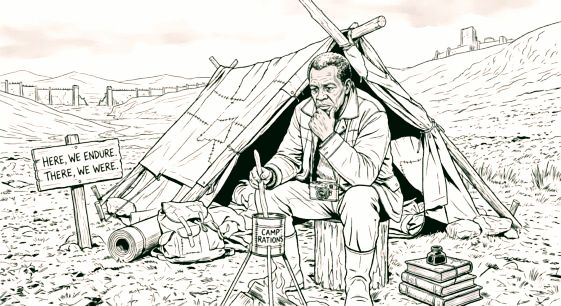
Many people who had met us in Soroti began calling us the Cave Men of God. The title spread from village to village, from trading centres to churches, until it became impossible to escape. Wherever we went, people treated us with a level of respect that neither Peter nor I felt comfortable carrying.
The weight of that attention began to interfere with our daily lives.
Twenty-four hours a day, seven days a week, we were no longer ordinary men. We could not walk through a market unnoticed. We could not sit beneath a tree and enjoy a quiet conversation. We could not even stop at a roadside vendor to buy fried cassava chips or my favourite Ugandan fast food—a freshly made rolex—without attracting a crowd.
Someone would recognise us.
Then another person would point.
Within minutes, dozens of people would gather around us.
Some came seeking prayers. Others wanted blessings. Some merely wanted to touch our hands. Mothers brought children suffering from illnesses. Elderly men asked for healing. Young people requested advice about marriage, business, and education, as though we possessed answers to every problem life could create.
The stories about us had grown far beyond reality.
According to rumours, Peter and I could heal diseases. We could identify hidden illnesses. We could see spirits. We could predict misfortune before it happened. Every week a new story emerged, and every week the stories became more unbelievable.
The truth mattered very little.
People believed what they wanted to believe.
In fact, our fame kept the police busy almost all the time. Crowds followed us wherever we went, creating confusion and traffic disruptions. Officers frequently found themselves escorting us through marketplaces and public gatherings simply to prevent people from overwhelming us.
Freedom had become a myth.
Both Peter and I longed for the days when we could disappear into a crowd and be forgotten.
Ironically, we had survived caves, hunger, fear, and exile only to find ourselves imprisoned by admiration.
There were moments when I missed the anonymity of hardship.
At least when nobody knew your name, you still belonged to yourself.
It seemed that General Okello—now Pastor Okello—had long understood the cost of fame before Peter and I ever encountered it. Perhaps that was why he watched over us so carefully. He knew that admiration was rarely free. Every gift came with expectations. Every crowd carried dangers hidden beneath smiles. Every miracle attracted both followers and enemies.
A few years earlier, I had enjoyed a small measure of fame myself.
I had written about earth batteries and demonstrated simple experiments that could power LED lights. To many readers, the results appeared extraordinary. Some called them scientific wonders; others called them tricks. Whatever the truth, those writings earned me modest recognition among people who read books and followed unusual ideas.
But that fame was nothing compared to what we were experiencing now.
Miracles had become the real breadwinner.
The wealthy arrived in expensive vehicles and left behind envelopes so thick that one could barely close a hand around them. Others transferred money directly. Seven-figure gifts became common. On particularly remarkable days, even eight-figure donations were not unheard of.
It was almost irresistible.
After all, what living man does not dream of financial security?
For years Peter and I had struggled through uncertainty, hardship, and exile. Now money seemed to arrive effortlessly, carried on the faith and gratitude of strangers.
We had hit a jackpot unlike anything either of us had imagined.
Yet every jackpot attracts gamblers, thieves, and rivals.
The greatest hostility came from certain religious figures who viewed our growing reputation as a direct threat to their livelihoods. They preached against us in public while secretly investigating us in private. They dismissed the healings as deception, yet they closely monitored every gathering we attended.
Many of them had built entire ministries around carefully crafted illusions.
Some relied on suggestion, theatrics, and psychological manipulation. Others secretly administered substances that created temporary sensations of relief, convincing desperate people that they had been healed. The relief would last for a few hours or a few days before the suffering returned, at which point the victims would be encouraged to return with more offerings and greater faith.
The business was profitable.
Extremely profitable.
And now two former cave dwellers, accompanied by a retired soldier-turned-pastor, were disrupting that business.
The more attention we received, the more hostility we attracted.
Rumours began to circulate. Anonymous threats arrived. Strange men appeared near church gatherings and disappeared before they could be identified. Vehicles followed us for several kilometres before turning away. Some people warned us to be careful. Others advised us to leave the region altogether.
What disturbed me most was not the threats themselves.
It was the determination behind them.
These men wanted us discredited, ruined, or removed entirely. To them, we were not fellow believers. We were competitors standing between them and a source of income that had enriched them for years.
Pastor Okello recognised the danger immediately.
Unlike Peter and me, he had spent most of his life studying enemies. He understood how power operated and how greed transformed ordinary men into dangerous adversaries.
One evening he looked at us and shook his head.
“Fame,” he said quietly, “is easier to acquire than to survive.”
At the time, I thought he was being overly cautious.
Later, I would discover that he was not cautious enough.
It seemed to me that Okello had spent his life studying the things most people forget to study.
While others focused on weapons, uniforms, and ranks, he studied psychological warfare. He studied variables, motivations, probabilities, and the hidden forces that influenced human behaviour. He understood determination not merely as a virtue but as a measurable force capable of altering the outcome of events. He thought in vectors and trajectories, tracing the direction in which individuals, organisations, and even entire nations were moving.
Above all, he possessed a model of self-discipline that bordered on the extraordinary.
Okello was a writer of criminal playbooks and a reader of human weakness. He understood elegant equations, yet he never lost sight of the messiness of the realities that existed beneath them. He knew that every model eventually collided with emotion, fear, greed, ambition, and chance.
Perhaps that was what distinguished him from many other Ugandan generals.
He was not merely a soldier.
He was an architect.
Years earlier, he had helped design systems of intelligence and espionage that operated in silence, unseen by the public yet influencing the course of events from behind the curtain. He understood information as thoroughly as other men understood bullets. He knew that the right piece of intelligence, delivered at the right moment, could achieve what an entire battalion could not.
Ironically, those same skills had prepared him for life as a clergyman.
The battlefield had changed, but the principles remained remarkably similar.
Both professions required patience. Both demanded an understanding of human nature. Both relied upon trust, persuasion, and leadership. The only difference was that one sought to defeat enemies while the other sought to guide souls.
To some people, Okello would always be the hardened army general—a man capable of running regression analyses, probability models, and strategic forecasts in the middle of a military campaign. He approached warfare as a complex system of interacting variables, where success depended not only on strength but also on understanding patterns that others failed to see.
To others, especially those who filled the church every Sunday, he was a compassionate pastor and overseer. They saw a patient man who listened carefully, prayed sincerely, and dedicated himself to easing the suffering of others.
Peter and I occupied an unusual position.
We had seen both men.
We had seen the calculating strategist hidden behind the gentle smile. We had witnessed the disciplined commander beneath the pastor’s robes. We knew that when Okello entered a room, he was constantly observing, measuring, and assessing, even when he appeared relaxed.
Yet there was nothing deceptive about him.
The soldier was real.
The pastor was real.
The strategist was real.
The compassionate overseer was real.
The contradiction existed only because most people believed that a man could be only one thing at a time.
Okello had become many things over the course of his life, but each version had been built upon the same foundation: discipline, patience, and an unshakable belief that every problem, no matter how complicated, contained a solution waiting to be discovered.
Whether he stood on a battlefield or behind a pulpit, he remained exactly what he had always been—a student of human nature.
“You see, a scientist does not abandon an experiment after one failed attempt.”
Okello’s words struck me with unexpected force.
Even now, I remember the moment clearly. The statement sent my heart pounding like that of a prisoner standing before the gates of a detention facility, waiting for the final order that would determine whether he walked free or remained behind bars.
Peter heard the same words, but I suspect he interpreted them differently.
I heard a warning.
Okello was not talking about science.
He was talking about people.
He was talking about those who had built fortunes from deception, those who sold hope in carefully measured doses and transformed human suffering into a source of income. Such men would not simply accept defeat because a few of their schemes had failed. They would adapt. They would observe. They would revise their methods and try again.
That was the nature of experimentation.
That was also the nature of obsession.
For a moment the room fell silent.
Outside, I could hear the distant murmur of people gathered beyond the church compound. Even at that hour there were still patients waiting for prayers, mothers carrying sick children, elderly men leaning on walking sticks, and curious visitors hoping to catch a glimpse of the Cave Men of God.
The title had begun as a joke.
Now it felt like a sentence.
Our lives had always been lived in exile.
Political exile.
Social exile.
Intellectual exile.
Even when we were surrounded by people, Peter and I often found ourselves standing outside the ordinary flow of life, looking in through a window that never quite opened.
This time, however, healing had become another form of exile.
If exile meant losing the freedom to live as an ordinary man, then we were more exiled than ever before.
We could not travel without attracting attention.
We could not sit in a restaurant without someone requesting prayer.
We could not buy cassava chips or a rolex from a roadside vendor without creating a crowd.
Every public appearance became an event.
Every conversation became a consultation.
Every act of kindness became evidence of supernatural power.
The strange thing about imprisonment is that not all prisons have walls.
Some are built from expectations.
Others are built from admiration.
The strongest are built from myths.
People had created a version of Peter and me that no longer belonged to us. They saw healers where we saw frightened men trying to understand events beyond our comprehension. They saw certainty where we carried doubts. They saw power where we felt responsibility.
The crowds envied us.
They saw the donations, the respect, the influence, and the growing fame.
What they did not see was the exhaustion.
What they did not see was the constant vigilance.
What they did not see was the fear that one day someone desperate enough, greedy enough, or fanatical enough would decide that we were worth more dead than alive.
Okello understood all of this.
That was why he watched us with the eyes of a commander rather than those of a pastor.
He had spent a lifetime studying the consequences of success.
Victory, he often implied, was not the end of a struggle.
Victory merely changed the nature of the struggle.
The enemies became different.
The stakes became higher.
The consequences became more severe.
As I looked at him across the room, I realised that his warning was not directed at our enemies alone.
It was directed at us.
We had survived caves, exile, imprisonment, hunger, and uncertainty.
The question now was whether we could survive fame.
And judging by the expression on Okello’s face, he was not entirely certain that we could.
To be continued
This post was created with our nice and easy submission form. Create your post!

Written by
Caesar Obong Ng'bong Ocen is a Ugandan writer whose work traverses narrative fiction, cultural memory, and moral inquiry. Drawing on African cosmologies, and reflective storytelling, his writing engages with issues of power, identity, faith, and the human condition within post‑conflict societies. His series blends political realism with interior psychological struggle, articulating the tensions between duty and conscience, tradition and modernity, exile, redemption. Obong Ng'bong's work bridges literary and social worlds: it interrogates African historical and political realities while exploring philosophical and ethical questions that resonate across disciplines. His narratives are grounded in cultural authenticity and moral depth, making them relevant to both literary and humanistic inquiry. He also mentors emerging writers and contributes to dialogue on African storytelling traditions and their place in contemporary literature.
Did this story move you? Every gift goes directly to Caesar Obong Ng'bong ocen — writers on Muwado earn from reader appreciation, not algorithms. Even $1 makes a difference.





Muwado weekly chart
Get Africa’s top 10 stories every Thursday
No account needed — just your email.
Want to follow Caesar Obong Ng'bong ocen and get notified every time they publish?
Create a free Muwado account →