

 Caesar Obong Ng'bong ocen

Chapter Twenty-One: Border Line (Part Two)
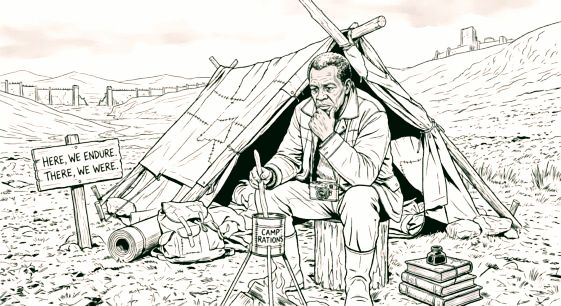
Night settled over the refugee settlement with remarkable speed, as I came to think of it.
One moment the mountains were visible against the evening sky; then, the next, they had become dark silhouettes standing watch over the frontier.
Small cooking fires flickered across the camp as firewood, reeds, and charcoal smoke drifted through the air.
Somewhere nearby, a child cried.
Somewhere else, a woman sang a lullaby in a language I did not recognise—a language that resembled a fusion of Luganda, Kinyarwanda, and perhaps French or even English. To tell you the truth, it was a mixture of all those languages, and the settlement was never truly silent.
Even in darkness, life continued as Peter and I remained beneath the tarpaulin, thinking about the next phase of our lives. Peter’s notebook rested between us.
Neither of us spoke for several minutes because there was nothing to speak about, or perhaps because I could not stop thinking about what I had read.
Names, transactions, routes, and connections were the things that troubled me most—not the evidence itself.
But the scale at which it operated.
No local scheme or isolated act of corruption.
The network stretched beyond districts and beyond borders, feeding upon instability. In fact political conflict was not an obstacle to its operations but fuel to keep the systeem moving as I had come to recognise it.
“Does Okello know…?” I awkwardly asked.
“No.” He answered in a low semi tone that sounded more like the low C keys of a church organ
“Why not?” I questioned to which hos eyes remained fixed on the darkness beyond the camp.
“Because I don’t know who—or how—I can trust anyone beyond these boundaries.”
His answer surprised me.
Peter Kaburu had spent years uncovering secrets and analysing events, yet the uncertainty in his voice made a clear reality that something was wrong and was in deed very wrong.
Now it lingered there.
Heavy and persistent.
“Not even Okello, Maggie, or two I.C. know about these?”
He answered with a faint smile.
“I trust Okello,” I replied.
He exhaled like a wounded buffalo, then paused.
“That’s different from trusting everyone around him.”
The wind strengthened, and I realised that the tarpaulin was fluttering loudly beside us.
For a moment, I thought I heard footsteps nearby. Then I turned back toward Peter and saw that his eyes were fixed on the tarpaulin. That was when I realised that he had heard them too.
His body stiffened.
We both looked toward the edge of the shelter, but there was nothing.
Only darkness, shadows, and vanity.
Yet the feeling remained.
The feeling of being watched.
Peter leaned closer and whispered to me.
“Three nights ago, someone searched my shelter.”
“What?”
“Did they take anything?” I asked, then I intentionally interrupted myself after realising how stupid the question was.
“What were they looking for?”
Peter took a deep breath. He rolled locally cured tobacco, dried green leaves, and seeds into a spliff, lighting it with a burning reed. Inhaling deeply, I found the smoke surprisingly smooth on my nose and throat as he exhaled.
Later, his eyes heavy from the herb, he leaned back. “The notebook,” he answered in a sleepy, bassline voice.
My stomach tightened.
“Did they find it?”
He shook his head.
“No.”
“How do you know?”
A humourless smile appeared across his face, the kind that said everything without saying anything.
“Because you’re reading it.”
I could not argue with that.
The smile vanished from Peter’s face almost immediately.
“This is no longer about missing aid,” he said.
“I know,” I replied, though the cannabis was making my own voice sound distant to my ears.
“No.” His voice dropped, turning into a firmer, heavy bassline that seemed to vibrate through the floorboards. “You don’t.”
He jabbed a finger toward the notebook. “Some of these names belong to some of the most prominent businessmen in Kampala, Nairobi, Kigali, and Mombasa. My own uncle, the father of Oburu, is one of them. He was the one behind my attack. I know that. But I don’t know why he really wants me dead. Perhaps I am the one holding him back from taking over the Tropical Belt.”
His finger dragged lower down the page, leaving a faint smudge over the ink. The smoke from his spliff hung thick between us, trapping the heat in the tarplin.
“Give and take. That’s how it’s done here, Obong. Some of these businessmen use politicians the way a man uses a condom—pick, play, and drop.”
He looked up, his jaw clenched tightly, his eyes glassed over with a wet sheen. The casual brutality of his words hit me like a physical blow. The Tarplin felt suddenly claustrophobic, and the silence that followed was suffocating.
Further down the page, he continued.
“Some belong to security officials.”
Then he looked directly at me.
“And some belong to people who publicly condemn corruption while secretly profiting from it.”
The weight of his words settled heavily between us.
In the distance, thunder rolled across the mountains.
The rainy season was approaching.
Dark clouds moved silently across the sky.
For a long moment, neither of us spoke.
Then Peter asked a question.
“Do you remember the cave?”
I laughed quietly.
“How could I forget?”
“No.”
His expression remained serious.
“I mean the feeling.”
I frowned.
“What feeling?”
“The feeling that something was following us.”
I remembered immediately.
The strange sensation that had haunted us in the tunnels.
The feeling that unseen eyes were watching from beyond the darkness.
At the time, I had dismissed it as fear, exhaustion, or imagination.
Now I was no longer certain.
Peter leaned back against the support pole.
“I have that feeling again.”
A chill ran through me.
The camp suddenly seemed different.
Less secure.
Less temporary.
More exposed.
The sounds of conversation drifted from nearby shelters.
Generators hummed.
Dogs barked somewhere beyond the perimeter.
Yet beneath those ordinary sounds lurked something else.
An unease I could not explain.
Peter reached into his bag again.
This time, he removed a folded map.
He spread it across the ground between us.
Several locations had been marked in red ink.
Goma.
Bunia.
Beni.
Kigali.
Mpondwe.
Kilembe.
And several other smaller settlements scattered across the borderlands.
“What am I looking at?”
“Supply routes.”
I studied the markings.
“They seem normal.”
“They are.”
His finger traced a line across the map.
“Until you compare them with the delivery records.”
Realisation slowly dawned on me.
“Some supplies never arrived.”
Peter nodded.
“Exactly.”
His finger moved again.
“Yet somebody signed for them.”
Another mark.
“Some shipments existed only on paper.”
Another.
“Others crossed the border twice.”
The pattern became visible.
Complicated.
Deliberate.
Profitable.
The network was not stealing aid randomly.
It was managing theft on an industrial scale, like a business.
Thunder echoed across the valley once more.
This time, it was closer.
Lightning flashed briefly beyond the mountains.
For a fraction of a second, the entire camp was illuminated.
Then darkness returned.
Peter folded the map carefully.
“The war created refugees, and humanity became big business when suffering was induced.”
He looked toward the camp.
“The refugees created funding.”
He folded the notebook shut.
“The funding created opportunity.”
Then his voice hardened.
“And opportunity created predators.”
The word lingered in the air.
Predators.
Not thieves or criminals, but predators.
The distinction mattered.
Predators survived by feeding on weakness.
The refugees were weak.
The displaced were vulnerable.
The hungry were desperate.
And somewhere beyond the mountains, powerful people were feeding upon all three.
A whistle sounded from the edge of the camp.
Aid workers were conducting a routine headcount.
Families began returning to their shelters.
The settlement gradually quietened.
I watched them move through the darkness.
Children.
Mothers.
Grandparents.
Entire lives compressed into temporary shelters.
Most would never know the forces shaping their suffering, or even the names hidden within Peter’s notebook.
Perhaps that ignorance was intentional.
Power worked best when it remained invisible.
Peter suddenly stood.
“Come.”
I looked at him and answered without a second thought—the kind of answer that makes even a wise man a fool.
“Where?” I asked.
He pointed toward the far, muddy edge of the settlement. “There is someone I want you to meet.”
I rose slowly, my limbs still weighted down by the cannabis. “Who?”
His expression became unreadable. “A man who was supposed to be dead.”
Above us, thunder cracked with a force that shook the valley floor. Fat, heavy drops began to pelt the camp, and within seconds, the downpour turned into a deafening roar as it thrashed against thousands of UN plastic tarps and zinc roofs. The surrounding hillsides vanished. The maze of muddy pathways emptied instantly, and the sprawling city of tents retreated into a dim world of shadows and rushing water.
Peter tucked the notebook deeper beneath his canvas jacket, turned, and stepped out into the deluge. My heart hammered against my ribs, but for reasons I couldn’t explain, I followed him into the gray blur. Somewhere ahead, hidden deep within this sea of displaced souls, waited a man whose bare survival threatened everything powerful people wanted buried. The ghosts of the Tropical Belt were waking up—and the storm was bringing them right to us.
This post was created with our nice and easy submission form. Create your post!

Written by
Caesar Obong Ng'bong Ocen is a Ugandan writer whose work traverses narrative fiction, cultural memory, and moral inquiry. Drawing on African cosmologies, and reflective storytelling, his writing engages with issues of power, identity, faith, and the human condition within post‑conflict societies. His series blends political realism with interior psychological struggle, articulating the tensions between duty and conscience, tradition and modernity, exile, redemption. Obong Ng'bong's work bridges literary and social worlds: it interrogates African historical and political realities while exploring philosophical and ethical questions that resonate across disciplines. His narratives are grounded in cultural authenticity and moral depth, making them relevant to both literary and humanistic inquiry. He also mentors emerging writers and contributes to dialogue on African storytelling traditions and their place in contemporary literature.
Did this story move you? Every gift goes directly to Caesar Obong Ng'bong ocen — writers on Muwado earn from reader appreciation, not algorithms. Even $1 makes a difference.




Muwado weekly chart
Get Africa’s top 10 stories every Thursday
No account needed — just your email.
Want to follow Caesar Obong Ng'bong ocen and get notified every time they publish?
Create a free Muwado account →