

 Caesar Obong Ng'bong ocen

Chapter Twenty-One: Border Line (part One)
The first time I saw Peter Kaburu in the refugee settlement, I walked past him without recognising him.
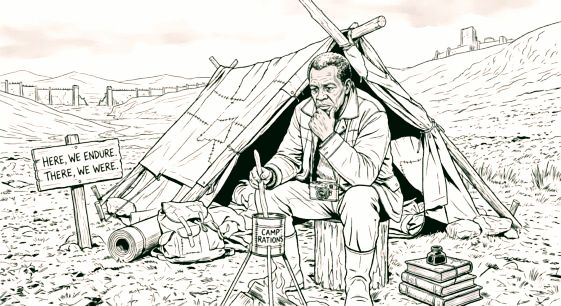
The man sitting beneath a weather-stained tarpaulin looked like countless others who had arrived at the border carrying little more than exhaustion. His beard had grown wild and uneven. His shirt, once neatly pressed, hung loosely from his thin frame. Dust covered his sandals and clung stubbornly to his trousers. The harsh sun of the frontier had darkened his skin and carved fresh lines into his face.
Yet it was not his appearance that unsettled me.
It was his eyes.
Since our return from the Busoga–Lango cave, Peter Kaburu had become something far beyond the man I once knew. In Uganda he was spoken of as a national symbol of faith, a figure around whom hope quietly gathered. He had gained the ability to heal minor injuries and even complex illnesses that doctors could not easily identify. That gift, or curse, had made him both revered and feared. It also made him a target—hunted by both rebel groups and government forces operating across the Congo borderlands, each believing he was either a weapon to control or a threat to eliminate.
Peter Kaburu had always possessed the eyes of a man in pursuit of something. Even during moments of rest, they searched. They observed. They measured. They questioned. Those eyes had carried him through forgotten archives, abandoned military compounds, secret meetings, and dangerous investigations.
Now they seemed burdened by something heavier than fatigue.
They carried disappointment.
Not disappointment in a person.
Disappointment in humanity itself.
I stood several metres away and watched him.
For a moment I wondered whether I should call his name.
Then he looked up.
Our eyes met.
A faint smile appeared upon his face.
The smile of a man who had already lost everything that could be taken from him.
“You found me,” he said.
His voice was calm.
Almost too calm.
I sat beside him.
“How is General Okello, do you know I lost contact with the entire team when all hell broke loose?” Peter questioned me
“My faith kept me strong, I thought the war had taken you away. Now I know…” I answered, to which his smile faded because my response sounded more like a rehearsed, badly written script for a screenplay.
“Some days I wasn’t sure myself.”
Peter answered and the silence began to grow between us.
The refugee settlement stretched before us like a temporary city built from uncertainty.
White tents and plastic shelters covered the landscape. Smoke rose from cooking fires. Children ran through narrow pathways between shelters. Women queued patiently beside water tanks. Aid workers moved from family to family carrying clipboards and medical supplies.
Beyond the camp, the mountains of the Democratic Republic of Congo towered above the horizon.
Their peaks disappeared into drifting clouds.
Ancient.
Silent.
Indifferent.
They had watched generations of wars come and go.
Kingdoms had risen beneath those mountains.
Empires had collapsed beneath those mountains.
And still they remained.
The wind carried the laughter of children across the camp.
I listened carefully.
It seemed almost impossible.
How could laughter survive in a place born from suffering?
Yet there it was.
Clear.
Bright.
Defiant.
Perhaps that was humanity’s greatest gift.
The ability to continue living even after life had broken apart.
Peter followed my gaze.
“They laugh every evening,” he said.
“That’s a good thing.”
He nodded slowly.
“Yes.”
A pause followed.
“Sometimes I think they’re the strongest people here.”
I looked around the settlement.
Every face carried a story.
A mother nursing a child beneath a tree.
An old man staring silently toward the border.
A teenager repairing a torn shelter.
A young woman cooking cassava over a charcoal stove.
Each carried memories they rarely spoke about.
Each carried losses invisible to the eye.
And among them sat Peter Kaburu.
A refugee.
At least according to the registration card hanging around his neck.
The irony would have been amusing if it were not so tragic.
Peter had not fled artillery fire.
He had not escaped a massacre.
No militia had burned his home.
No soldiers had driven him from his village.
Peter Kaburu had become a refugee because powerful people had decided the truth was dangerous.
The border had merely completed the process.
For several minutes neither of us spoke. Do you still crave for bats meet? Peter questioned with a wide smile as he broke the silence that had began to grow between us
The silence allowed old memories to return.
Memories of how Peter had arrived here.
Memories of how a humanitarian mission had transformed into a nightmare.
Three months earlier, Pastor Okello had approved a humanitarian initiative along the Uganda-Congo border.
Following the extraordinary attention generated by our healing ministry, numerous organisations approached him with partnership proposals.
Most sought publicity.
Some sought influence.
A few genuinely wished to help displaced communities.
Pastor Okello examined every proposal carefully.
Years in politics, intelligence, and war had taught him to distrust appearances.
Eventually he chose a programme focused on refugee support and community rehabilitation in border regions.
Peter volunteered immediately.
The decision surprised nobody.
He claimed he needed a break from mysteries.
A break from secrets.
A break from conspiracies.
I remember laughing when he said it.
Peter Kaburu seeking a quiet life was like a fisherman trying to avoid water.
Curiosity followed him wherever he went.
The moment he arrived near Goma, he began documenting everything.
The condition of the camps.
The distribution of food.
Medical shortages.
Water access, security concerns and most importantly the testimonies of displaced families.
At first his work received widespread praise.
Aid organisations welcomed him.
Community leaders appreciated his reports.
Local officials happily posed beside him for photographs.
Compassion made excellent publicity.
Everyone wanted to be associated with helping refugees.
For a while everything seemed normal.
Then Peter began asking questions.
That was always where trouble began.
The first inconsistency appeared during a food delivery.
Official records listed twenty trucks carrying maize flour.
Peter counted fourteen.
Six trucks had vanished.
No explanation existed.
When he raised the issue, officials dismissed it as an administrative error.
A week later, medical supplies disappeared.
Then fuel.
Then blankets.
Then tents.
The pattern repeated itself with disturbing consistency.
Missing inventory.
Missing documentation.
Missing accountability.
Always accompanied by convenient explanations.
Clerical mistakes.
Transport delays.
Miscommunication.
Lost paperwork.
Peter had spent too many years investigating corruption to believe such excuses.
Corruption rarely announced itself openly.
It disguised itself as confusion.
As incompetence.
As bureaucracy.
The deeper he investigated, the clearer the pattern became.
Aid was being stolen.
Not occasionally.
Systematically.
Deliberately.
Professionally.
He began documenting everything.
Names.
Dates.
Vehicle registrations.
Delivery schedules.
Financial transactions.
Communication records.
Suspicious meetings.
Questionable contracts.
Every discovery led to another.
Every answer revealed deeper questions.
One evening my phone rang.
Peter’s name appeared on the screen.
The moment I answered, I sensed something had changed.
His voice carried unusual gravity.
“Obong.”
“What happened?”
A pause followed.
Then he spoke.
“I think I’ve found something much bigger than theft.”
I sat upright immediately.
Whenever Peter used those words, disaster usually followed.
“What have you found?”
Silence.
Then:
“I think some people profit from keeping the crisis alive.”
The statement chilled me.
War had always produced opportunists.
History was filled with men who grew wealthy from suffering.
Yet Peter sounded as though he had discovered something even darker.
“What exactly are you saying?”
“I’m saying every displaced family represents funding.”
He paused.
“Every emergency attracts donations.”
Another pause.
“Every shipment creates opportunity.”
I understood immediately.
The implication was horrifying.
For some people, peace was bad for business.
Conflict generated revenue.
Instability generated contracts.
Human misery generated profit.
Peter believed he had stumbled upon a machine powered by suffering.
A machine operating across borders.
A machine protected by influence.
A machine few people dared question.
One month later the rumours began.
At first they seemed harmless.
People whispered that Peter was asking unusual questions.
Then they suggested he was gathering intelligence.
Soon the stories multiplied.
One claimed he worked for foreign governments.
Another claimed he supplied information to armed groups.
Some accused him of espionage.
Others accused him of smuggling.
The accusations contradicted one another.
That did not matter.
Rumours do not survive because they are logical.
They survive because they are useful.
Local radio stations discussed him.
Anonymous sources emerged.
Social media accounts appeared overnight.
Articles repeated allegations without evidence.
Commentators demanded investigations.
Influencers amplified suspicion.
The lie spread faster than the truth could respond.
Peter attempted to defend himself.
Few listened.
By then the narrative had acquired its own momentum.
People no longer asked whether the accusations were true.
They asked whether they might be true.
That was enough.
I often remembered something Pastor Okello once told us.
An army can occupy territory.
A politician can occupy government.
But whoever controls belief occupies the human mind.
At the time it sounded philosophical.
Now it sounded like a warning.
Someone had weaponised belief.
No bullets were required.
No arrests.
No assassinations.
Only a story.
A carefully crafted story.
Repeated often enough.
Shared widely enough.
Accepted quickly enough.
Stories can become prisons.
And Peter Kaburu had been locked inside one.
The collapse happened rapidly.
His security clearance was suspended.
His accommodation contract was terminated.
Former colleagues stopped answering calls.
Organisations distanced themselves.
Associates disappeared.
People who once praised him now avoided being seen beside him.
The transformation was terrifying.
A respected investigator became a suspected threat almost overnight.
Not because evidence existed.
Because perception existed.
When conflict intensified around the border, chaos engulfed the region.
Thousands crossed into Uganda.
Families arrived carrying children, bags, and memories.
Registration centres processed endless lines of frightened people.
Officials worked around the clock.
In that confusion, distinctions vanished.
Every person crossing the border became a refugee.
Peter became one of them.
A journalist.
An investigator.
A humanitarian worker.
Reduced to a number on a registration sheet.
The memory dissolved.
I found myself once more sitting beneath the tarpaulin beside him.
The sun had begun descending behind the mountains.
Long shadows stretched across the settlement.
Evening approached.
Peter reached into a worn canvas bag.
Carefully, he removed a notebook which had it’s a little worn out and damaged cover.
Several pages were stained by rain.
Others were swollen from humidity.
Yet he handled it with remarkable care.
As though it contained something alive.
Or dangerous.
Perhaps both.
“You kept it?” I asked.
He nodded.
“They took everything else.”
“What is inside?”
For the first time, a spark appeared in his eyes.
The old Peter Kaburu.
The investigator.
The man who refused to surrender.
“The reason they wanted me gone.”
He handed me the notebook.
I opened it.
My heartbeat quickened almost immediately.
Names.
Financial records.
Transfer schedules.
Account numbers.
Communication logs.
Supply routes.
Corporate links.
Political connections.
Security contractors.
Cross-border transactions.
The deeper I read, the more disturbing the picture became.
This was not simple corruption.
This was architecture.
A structure.
A system.
A network feeding upon instability.
The theft of aid was merely one symptom.
The real disease lay beneath it.
Influential individuals.
Organisations.
Businesses.
Interests stretching across borders.
Protected by money.
Protected by power.
Protected by silence.
Suddenly everything made sense.
The rumours.
The accusations.
The campaign against Peter.
He had not discovered a thief.
He had discovered a machine.
And machines protect themselves.
I closed the notebook slowly.
The evening wind swept across the settlement.
Children were returning to their families.
Cooking fires burned brighter.
Darkness gathered among the distant mountains.
Peter leaned against the support pole.
For the first time since my arrival, determination replaced exhaustion.
“They thought the rumours would bury me.”
I looked at him.
“Did they?”
A faint smile returned.
This time it was genuine.
“No.”
The answer came without hesitation.
“Why not?”
He turned toward the border.
Toward the mountains.
Toward the darkness beyond them.
Then he spoke quietly.
“Because I found something bigger than their lies.”
Night descended across the frontier.
The camp lights flickered into life.
Far away, thunder rolled through the mountains.
As I sat beside him, I remembered Pastor Okello’s warning once again.
The most important battles are rarely fought with bullets.
They are fought with stories.
And somewhere beyond that border, powerful men were already preparing the next one.
… To be continued…
This post was created with our nice and easy submission form. Create your post!

Written by
Caesar Obong Ng'bong Ocen is a Ugandan writer whose work traverses narrative fiction, cultural memory, and moral inquiry. Drawing on African cosmologies, and reflective storytelling, his writing engages with issues of power, identity, faith, and the human condition within post‑conflict societies. His series blends political realism with interior psychological struggle, articulating the tensions between duty and conscience, tradition and modernity, exile, redemption. Obong Ng'bong's work bridges literary and social worlds: it interrogates African historical and political realities while exploring philosophical and ethical questions that resonate across disciplines. His narratives are grounded in cultural authenticity and moral depth, making them relevant to both literary and humanistic inquiry. He also mentors emerging writers and contributes to dialogue on African storytelling traditions and their place in contemporary literature.
Did this story move you? Every gift goes directly to Caesar Obong Ng'bong ocen — writers on Muwado earn from reader appreciation, not algorithms. Even $1 makes a difference.






Muwado weekly chart
Get Africa’s top 10 stories every Thursday
No account needed — just your email.
Want to follow Caesar Obong Ng'bong ocen and get notified every time they publish?
Create a free Muwado account →