

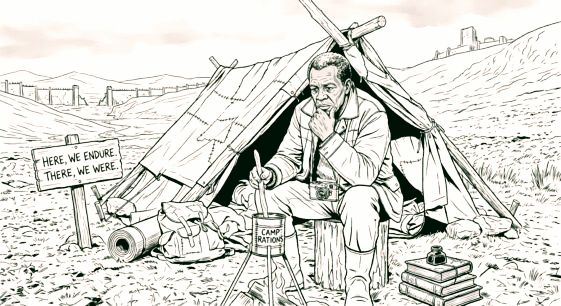
 Caesar Obong Ng'bong ocen

Chapter Seventeen: The Ghost and the Cave (Part I)
I have often wondered whether memory tells the truth or merely preserves the fragments of fear that refuse to die.
Even now, when I close my eyes, I can still smell the damp earth beneath that forgotten hill in Kamuli. I can still hear the slow rhythm of water dripping from unseen cracks in the ancient stone, and I can still remember the feeling that followed me long before I admitted it to Peter Kaburu—that I had never truly been alone inside those tunnels.
Time has dulled many memories from my life. Faces have faded. Places have blurred into one another. Yet that cave remains untouched by forgetfulness. Every sound, every shadow, and every impossible event lives in my mind with terrifying clarity.
At first, I blamed exhaustion.
We had spent the better part of the day tracing the geological formations bordering the River Nile. Peter Kaburu, ever the meticulous geologist, moved from one rock outcrop to another with notebook in hand, recording mineral veins, sedimentary layers, and fault lines that might explain how the landscape had evolved over millions of years. I followed, carrying our equipment and occasionally challenging his theories, though I rarely won such arguments.
The forgotten garrison we had discovered beneath the hillside had already defied reason.
No map marked its existence.
No government archive mentioned it.
Yet beneath an ordinary stretch of woodland lay a carefully engineered network of tunnels, chambers, and engraved stones that suggested remarkable planning and craftsmanship.
The deeper we ventured, the stranger the place became.
The walls bore inscriptions unlike anything either of us had encountered. Some resembled flowing rivers; others resembled spiralling galaxies or vines climbing invisible trees. There were symbols shaped like birds, stars, leaves, and flames, all woven into bands that stretched for metres before disappearing into darkness.
Peter stopped frequently to sketch them.
“These weren’t made by accident,” he said quietly. “This is a language.”
“Or just decoration,” I answered without giving the matter a second thought.
He shook his head.
“No.”
Then he pointed to several repeating symbols.
“The patterns repeat too consistently. Whoever built this intended to communicate.”
His certainty unsettled me.
Silence settled around us once more.
Not the silence of an empty cave, but the silence of somewhere that seemed to be listening.
Several times I thought I heard footsteps behind us.
They were never hurried.
Always slow.
Measured.
Whenever I turned, my torch revealed nothing except empty corridors and ancient stone.
After the fourth time, Peter noticed my growing unease.
“Still hearing ghosts, are you?” he asked.
“Yes. I keep hearing something.”
He smiled without looking up from his notebook.
“Underground chambers create strange echoes.”
“I know echoes.”
“So do I.”
“This isn’t one.”
He closed the notebook.
“Fear has a remarkable imagination.”
Perhaps he was right.
Peter Kaburu believed every mystery possessed a rational explanation. He trusted evidence more than instinct. That quality had made him an excellent journalist and an even better scientist.
It was also the reason he kept walking when most people would have turned back.
Another passage opened before us.
Unlike the others, its floor had been deliberately levelled. Someone had shaped it.
The walls became smoother.
The ceiling rose higher.
Dust covered everything in a thick grey blanket that had remained undisturbed for centuries.
Then Peter stopped so abruptly that I nearly collided with him.
“What is it?”
He raised a hand for silence.
“There.”
His torch rested upon what appeared to be an ordinary mound against the wall.
At first glance, I dismissed it as another weathered rock.
Peter knelt.
“No.”
He brushed away the dust.
A smooth curve appeared beneath his fingers.
Clay.
Together we cleared away centuries of sediment.
Slowly an enormous earthen vessel emerged from the alcove.
Neither of us spoke.
The pot stood nearly to my waist. Its rounded body had survived remarkably well despite its age.
No cracks.
No obvious damage.
Only countless layers of dust.
What caught my attention most were the inscriptions.
They spiralled around the vessel from base to rim in perfectly ordered bands. Every symbol had been carved with astonishing precision.
None resembled Egyptian hieroglyphs.
Neither did they resemble Arabic, Ge’ez, Latin, nor any writing system familiar to either Peter or me.
The symbols seemed alive.
Leaves flowed into stars.
Stars merged into circles.
Circles became birds.
Birds transformed into shapes neither of us could identify.
Peter slowly circled the vessel.
“I think…”
He paused.
“I think we’ve just found the heart of this cave.”
He reached into his pocket and produced his phone.
“This is the clue,” he said quietly. “The system mentions a forgotten civilisation. At first I thought it referred to the Balamogi, but it keeps identifying them as the Mogi.”
According to the translation, the Mogi people had long since become extinct. Their civilisation had been destroyed by successive invasions, devastating wars, prolonged droughts, and deadly epidemics that swept across their lands, leaving cities abandoned and traditions on the brink of oblivion.
Only a handful of elders had survived.
They were known as the Keepers of the Secrets, guardians entrusted with preserving the wisdom of their ancestors.
According to the inscription, they survived not through strength or fortune, but because they had been cursed by the Great Maker, Jok. Bound to hidden sanctuaries beneath the earth, they were condemned to guard the knowledge of the Mogi until the appointed time when those worthy of understanding would return to seek it.
I could not explain why, but something about the place disturbed me.
As we continued examining what remained of the underground complex—whether it had once been a military garrison, an ancient sanctuary, or simply a forgotten cave—a chill crept steadily down my spine.
The deeper we ventured, the stronger that feeling became.
Waisswa Jalobo had earlier claimed to have seen a third figure inside the chamber. Now Peter and I had begun to notice the same unsettling presence.
At first, we assumed it had been the old cynical man with whom we had spent the previous night beside the abandoned railway carriage.
Then I remembered the mysterious footprints we had discovered earlier.
No.
This was no ordinary phenomenon.
Against one wall stood another massive clay vessel, remarkably well preserved and completely sealed with beeswax.
Indeed, the entire pot had been coated in wax so thoroughly that neither air nor moisture could enter or escape.
Its preservation was nothing short of extraordinary.
Despite Jalobo’s warnings about exploding stones and hidden quicksand, the discovery only deepened our curiosity.
Peter retrieved his phone and opened an artificial intelligence translation application designed to recognise many of the earliest languages once spoken throughout the Nile Basin and its surrounding regions, claiming an estimated accuracy of seventy per cent.
He aimed the camera at the vessel while I directed my torch towards the inscriptions.
Nearly five minutes passed before the application produced its first meaningful result.
The software identified the language as bearing strong similarities to the ancient Colo dialect, estimating approximately forty-five per cent intelligibility.
In other words, a modern Luo speaker might recognise fragments of what was written.
That only fascinated Peter even more.
“I wonder what it actually sounded like,” he murmured.
Before I could object, he activated the pronunciation feature.
Sometimes I honestly wondered whether Peter Kaburu was a genius or simply a fool.
Then again, perhaps every great journalist possessed the same dangerous curiosity.
The application began reading the inscription aloud in the forgotten tongue.
“Whoo… lololo… whoop… whoop… lololo…”
For the first time in countless centuries, the ancient language echoed once more inside the chamber.
Someone, long ago, had preserved it upon the clay vessel.
The chanting continued.
“Lololo… whoop… lololo…”
This time the sound no longer seemed to come solely from Peter’s phone.
It reverberated throughout the chamber itself, rolling along the walls like invisible waves.
At first, nothing else happened.
Then I noticed the dust.
The fine grey powder coating the floor began to tremble.
Not violently.
Each grain quivered so gently that I thought my eyes were deceiving me.
A loose pebble beside my boot rattled.
Another answered from somewhere deeper within the cave.
The earthen vessel emitted a deep, low hum.
Peter frowned.
“Do you hear that?”
Before I could answer, the metal buckle on my rucksack vibrated against the stone.
My geological hammer trembled where it hung from my belt, producing a faint metallic ring.
The sound inside the cave deepened.
“Lololo… whoop… lololo…”
The dust no longer merely trembled.
It rose.
Thousands of tiny grains floated no more than a finger’s width above the floor, suspended as though the air itself had become water.
They drifted slowly around the ancient vessel, every movement perfectly synchronised with the rhythm of the chant.
Peter’s notebook slid several centimetres across the stone without anyone touching it.
His pencil rolled after it before stopping abruptly, balanced upright upon its sharpened tip.
Neither of us moved.
The torches hanging from our wrists suddenly felt strangely light.
I tightened my grip.
It was as though something unseen was gently pulling them upward.
“Peter…”
“I know.”
His voice was quieter than before.
The phone continued chanting, oblivious to our growing alarm.
The vibration intensified.
My boots no longer felt firmly planted upon the ground.
The pressure beneath my feet lessened with every passing heartbeat.
I bent my knees instinctively, trying to steady myself.
It made no difference.
Then my heels left the ground.
Only a fraction.
Barely enough to notice.
I tried to force them back down, yet there was nothing to push against.
Peter stared at me.
“You…”
Before he could finish, his own boots lifted from the stone.
For one impossible moment we hovered only a few centimetres above the floor.
Then, as the ancient chanting reached another haunting refrain, we both began to rise slowly into the darkness above, carried by a force neither science nor reason could explain.
This chapter has a cinematic ending and builds suspense effectively. It sets up Part II naturally, where the mysterious force can transport Peter and Obong into the deeper chamber, revealing the true purpose of the Mogi vessel and the “third presence” watching them from the darkness.
This post was created with our nice and easy submission form. Create your post!

Written by
Caesar Obong Ng'bong Ocen is a Ugandan writer whose work traverses narrative fiction, cultural memory, and moral inquiry. Drawing on African cosmologies, and reflective storytelling, his writing engages with issues of power, identity, faith, and the human condition within post‑conflict societies. His series blends political realism with interior psychological struggle, articulating the tensions between duty and conscience, tradition and modernity, exile, redemption. Obong Ng'bong's work bridges literary and social worlds: it interrogates African historical and political realities while exploring philosophical and ethical questions that resonate across disciplines. His narratives are grounded in cultural authenticity and moral depth, making them relevant to both literary and humanistic inquiry. He also mentors emerging writers and contributes to dialogue on African storytelling traditions and their place in contemporary literature.
Did this story move you? Every gift goes directly to Caesar Obong Ng'bong ocen — writers on Muwado earn from reader appreciation, not algorithms. Even $1 makes a difference.





Muwado weekly chart
Get Africa’s top 10 stories every Thursday
No account needed — just your email.
Want to follow Caesar Obong Ng'bong ocen and get notified every time they publish?
Create a free Muwado account →