

 Caesar Obong Ng'bong ocen

Chapter Six: The Fountain of Knowledge
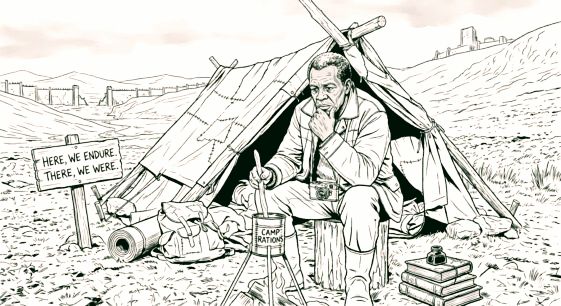
A week after the failed attempt on Peter Kaburu’s life at his father’s home in Nagongera, I found myself hiding with him beneath the earth.
The room in which we sheltered was unlike anything I had ever seen before. It was neither a bunker nor a workshop, yet it possessed characteristics of both. The walls were rough and damp. The air carried the smell of soil, rust, coal dust, and old engine oil. Copper rods lay stacked against one wall in carefully organized bundles. Beside them stood hundreds of galvanized rods arranged with such precision that they appeared to have been placed there long before our arrival.
The room was dark.
Not the darkness of night, but the darkness of a place forgotten by the sun.
At the time, I did not question why those materials were there.
Fear has a strange way of changing a man.
When danger approaches, reason abandons its post. Questions that should be asked remain unspoken. Curiosity gives way to survival. A man fleeing death rarely concerns himself with engineering, architecture, or science. He concerns himself with breathing long enough to see another sunrise.
I remember sitting on a wooden crate while Peter moved calmly through the chamber.
Outside, powerful men wanted him dead.
Inside, he behaved as though he had merely relocated his office.
There was no panic in him.
No bitterness.
No visible anger.
He carried himself with the same confidence he displayed in public gatherings, village meetings, and business negotiations.
Watching him was unsettling.
Most people become smaller when confronted by danger.
Peter appeared to become larger.
“Do you know anything about earth batteries?” he asked suddenly.
I laughed.
“No.”
The answer embarrassed me more than I expected.
The truth was that I knew very little about innovation.
I belonged to that generation of educated people who could recite information, pass examinations, write reports, and quote experts, yet struggled to build anything useful with our own hands. Our schools rewarded memory. They rewarded obedience. They rewarded conformity.
They taught us how to seek employment.
They rarely taught us how to create solutions.
Peter Kaburu, on the other hand, possessed the mind of an inventor.
His father owned land, cattle, and businesses. He had grown up surrounded by privilege. Yet unlike many privileged men, he spent his life solving problems most people never noticed.
“We need electricity,” he said.
I looked around the tunnel.
“There is no electricity down here.”
“There will be.”
The certainty in his voice irritated me.
We were underground.
There were no power lines.
No generators.
No solar panels.
No connection to the national grid.
To me, electricity came from dams, transformers, and utility companies.
Peter seemed to operate according to a different understanding of reality.
For nearly two hours he disappeared into other sections of the tunnel network.
When he returned, he carried gloves, a hammer, coils of wire, and several containers whose purpose I could not identify.
Then he handed me a hammer.
“Help me.”
We worked for the rest of the day.
Copper rods were driven deep into the damp soil.
Beside each copper rod, a galvanized rod was installed.
Copper.
Galvanized.
Copper.
Galvanized.
The pattern repeated itself endlessly across the chamber.
Hundreds of rods disappeared beneath the earth.
Once they had been positioned, Peter connected them using wire, creating a network that stretched from one end of the room to the other.
Then came the salt.
Two large sacks.
Fifty kilograms each.
The contents were scattered across the floor before being soaked with water.
The damp soil absorbed the mixture.
The chamber soon resembled a muddy construction site.
Afterward Peter connected several wires to what appeared to be a crude control unit assembled from recycled components.
Then he sat down.
“We wait.”
For nearly an hour nothing happened.
I began preparing my argument about wasted effort.
Then a small bulb flickered.
Once.
Twice.
Then steadily.
Another bulb illuminated.
Then another.
Soon light spread through the chamber.
I stared upward in disbelief.
Electricity.
Underground.
Generated beneath our feet.
At that moment I understood something important.
Knowledge is dangerous.
Not because it possesses power.
But because power follows wherever genuine knowledge goes.
For the first time since arriving in the tunnels, I realized I was living beside a man whose understanding of the world exceeded that of many professors, ministers, engineers, and businessmen.
Months passed beneath the earth.
The tunnel system was far larger than I had imagined.
Entire sections remained unexplored even after weeks of residence.
Some chambers contained tools.
Others stored food.
Several functioned as workshops.
One room resembled a slaughterhouse.
Another contained shelves filled with books, maps, journals, and old documents.
The deeper one travelled, the more impossible the entire place seemed.
We developed routines.
In the morning we cooked.
During the afternoon I wrote.
At night Peter worked on projects he rarely explained.
The underground electrical system allowed me to charge my laptop and continue documenting everything I had witnessed since arriving in Osukuru.
Meanwhile Peter occupied himself with preserving old film reels.
Hundreds of them.
Night after night he projected them onto a wall and photographed each frame individually using a smartphone.
The process was painfully slow.
Yet he performed it with remarkable patience.
One evening I finally asked why.
“What is on those films?”
“History.”
“What kind of history?”
“The kind people destroy when it becomes inconvenient.”
That was all he said.
The answer troubled me for days.
The longer I remained underground, the more I realized the tunnels were not merely hiding places.
They were archives.
Vaults.
Repositories of memory.
While governments preserved official history, Peter appeared committed to preserving forgotten history.
Life underground continued.
Weeks became months.
Above us, governments changed policies, businesses opened and closed, elections were discussed, and ordinary people continued their lives.
Below ground, time seemed frozen.
The tunnels existed outside society.
We were not prisoners.
Yet we lived like fugitives.
The isolation might have continued indefinitely had Peter not mentioned Mary.
It happened during dinner.
We were eating rice and roasted beef inside a chamber that served as a kitchen.
Without warning he placed his spoon down.
“I miss her.”
The statement surprised me.
Peter rarely discussed emotions.
“Mary?”
He nodded.
For several moments neither of us spoke.
Then he looked away.
“I wonder how she is doing.”
That single sentence revealed more about his state of mind than anything he had said in months.
For the first time, he looked tired.
Not physically tired.
Emotionally tired.
The following morning I informed him that I intended to return to Kampala.
He offered no objection.
Instead, he helped prepare supplies for the journey.
The next day I departed.
Part of the journey was completed aboard an oil tanker whose driver asked very few questions.
Hours later I arrived near Kireka, not far from Kyambogo University.
Standing beside the road, watching traffic move through the city, a realization struck me.
Six months.
I had spent six months underground.
The city looked familiar and foreign at the same time.
Buildings remained where I remembered them.
Yet everything felt different.
Perhaps Kampala had not changed.
Perhaps I had.
My first destination was Lubaga.
Mary welcomed me with a smile that nearly erased months of hardship.
She looked healthier than I expected.
Stronger.
There was happiness in her eyes.
Only later did I discover she was pregnant.
Peter had ensured she lacked nothing.
The house belonged to him.
Tenants paid rent.
Additional assets generated income elsewhere in the city.
Even while hiding underground, he continued providing for his family.
As we spoke, another familiar face appeared.
Maggie Okello.
The moment she saw me, her expression changed.
“So you’re back.”
“I never left permanently.”
“Where is Peter?”
The question arrived immediately.
I pretended not to understand.
Maggie stepped closer.
“The country needs him.”
I remained silent.
Some conversations are dangerous not because of what is said, but because of what might accidentally be revealed.
Fortunately, the confrontation ended before it escalated.
The following day General Okello arrived accompanied by Felix, 2IC, Maggie, and Mary.
The atmosphere was unexpectedly friendly.
There were no accusations.
No interrogations.
Instead, the General handed me a brown envelope.
Inside were documents related to my publications.
As the visitors prepared to leave, 2IC quietly pulled me aside.
“You people misunderstand the General.”
“Do we?”
“Yes.”
He glanced toward the departing group.
“Those papers are your approvals. Use them wisely.”
Then he followed the others outside.
I spent the remainder of the evening staring at the documents.
For the first time in months, my future seemed uncertain in a different way.
Not because I was hiding.
But because I was finally free.
And freedom, I would soon learn, carried dangers of its own.
The weeks that followed passed in a blur of ink, paper, and ambition.
For months I had written inside tunnels beneath the earth, uncertain whether anyone would ever read a single page.
Now I watched those pages transform into books.
The biography of John Owino was printed first.
Sales were disappointing.
The Dark Room performed slightly better.
Then came Ghost Roads of the East.
Everything changed.
The first print run vanished within weeks.
Bookshops requested additional copies.
University students discussed it.
Journalists reviewed it.
Foreign visitors purchased entire cartons.
One afternoon a tall white man walked into the printing press and ordered twelve copies without even asking the price.
The printer smiled.
“You have something special here.”
Perhaps he was right.
Or perhaps the public was simply fascinated by Peter Kaburu.
The mystery surrounding Osukuru and its tunnels captured imaginations.
Whatever the reason, demand continued growing.
Soon I was attending book-signing events.
The experience felt surreal.
Only months earlier I had been hiding underground.
Now strangers stood in queues waiting for signatures.
Hotels replaced tunnels.
Conference halls replaced storage chambers.
Buffet breakfasts replaced emergency food stores.
Hot water replaced cold buckets.
For a while, life seemed determined to compensate for every hardship I had endured.
Money arrived steadily.
Then rapidly.
Then overwhelmingly.
For the first time in my life, financial worries disappeared.
Unfortunately, success attracts attention.
Not all attention is friendly.
Among the attendees at my presentations was a large Russian businessman.
He appeared repeatedly.
Unlike most readers, he asked technical questions.
Questions about copper rods.
Questions about conductivity.
Questions about underground systems.
Questions about Peter Kaburu.
At first I answered politely.
Then cautiously.
Eventually he introduced me to several associates.
Meetings followed.
Translation rights were negotiated.
Contracts were signed.
The financial offer was enormous.
I accepted.
Months later I boarded an aircraft heading north.
I believed I was travelling to discuss books.
I was wrong.
Descriptions I had written as observations had been interpreted as engineering instructions.
Stories became blueprints.
Mystery became science.
By the time I arrived in Siberia, teams of engineers had already attempted to recreate Peter Kaburu’s underground battery system.
The results had been disastrous.
Snow covered the landscape.
The cold entered the bones.
At the facility, hundreds of rods protruded from frozen ground.
Immediately I recognized mistakes.
Yet before I could explain anything, accusations began.
“You lied.”
“You sold fiction as science.”
By sunset I was under arrest.
The detention centre was cold, concrete, and merciless.
Days lost meaning.
Food arrived irregularly.
Usually rice without salt.
Sometimes less.
The guards repeated the same questions.
“Battery?”
“Electricity?”
“Kaburu?”
Nothing I said satisfied them.
By the fourth day I was emotionally broken.
That was when Nikolai arrived.
Unlike everyone else, he carried food.
Chicken.
Rice.
Bread.
Chips.
Rum.
I ate until breathing became difficult.
Only afterward did he introduce himself.
“My name is Nikolai Previnsiker. Philosopher, inventor, and geoscientist.”
Then he smiled.
“We have been treating the wrong man as a criminal.”
That sentence changed everything.
Over the following days we talked endlessly.
Engineering.
History.
Agriculture.
Literature.
Gradually memories returned.
The damp soil.
The coal dust.
The moisture.
The spacing between rods.
Then one morning Nikolai asked the question everyone wanted answered.
“Can it be rebuilt?”
“Not exactly.”
“But partially?”
“Perhaps.”
That answer was enough.
Preparations began immediately.
A twelve-metre excavation was dug.
Copper rods were installed.
Galvanized rods followed.
Carbon-rich material was added.
Salt and water were introduced.
Sensors surrounded the site.
Yet something felt absent.
Peter had never revealed every detail.
We were reconstructing memory rather than knowledge.
And memory is imperfect.
Still, the work continued.
The final test was scheduled for a stormy afternoon.
Dark clouds gathered overhead.
Thunder rolled across the plains.
Several workers suggested postponement.
Management refused.
The experiment proceeded.
Meters activated.
Readings appeared.
Small fluctuations registered.
Then lightning struck.
The flash turned night into day.
A powerful surge travelled through the ground.
Chaos erupted instantly.
Alarms screamed.
Monitors overloaded.
Cables exploded.
One technician collapsed beside a maintenance station.
The electrical discharge killed him before anyone could help.
Rain and snow fell together.
Workers ran in every direction.
For nearly an hour confusion dominated the facility.
When calm finally returned, investigators assessed the damage.
Much of the monitoring equipment had been destroyed.
Entire sections of cabling had melted.
Yet not everything had failed.
A few instruments remained operational.
To everyone’s astonishment, they continued recording electrical output.
The readings were modest.
Far below the capabilities of Peter Kaburu’s original system.
Yet they were real.
Current continued flowing through surviving sections of the network.
Enough to illuminate lights.
Enough to charge batteries.
Enough to power small devices.
The engineers repeated their measurements for days.
The results remained consistent.
The system worked.
Partially.
Imperfectly.
Mysteriously.
The death of the technician overshadowed every discussion.
No one celebrated openly.
Yet beneath the grief lingered respect.
For the first time, they understood they had not been dealing with fantasy.
Something real existed behind the legends surrounding Peter Kaburu.
One evening Nikolai stood beside the excavation staring at the surviving monitors.
“This works.”
“Partially.”
“And Kaburu’s system?”
I looked toward the glowing instruments.
“This is only an echo.”
My release came less than a week later.
The transformation was almost absurd.
Days earlier I had been a prisoner.
Now I was an honoured guest.
Handshakes replaced threats.
Invitations replaced interrogations.
The same people who had accused me now sought my advice.
Nothing about me had changed.
The only difference was evidence.
Before the experiment I possessed truth without proof.
After the experiment I possessed proof.
Human beings often claim to value truth.
In reality, they value evidence.
On my final evening in Siberia, Nikolai invited me to his residence overlooking a frozen valley.
We sat beside a fireplace drinking tea.
For hours we discussed civilization.
At one point he said something I never forgot.
“We mistake information for knowledge.”
I laughed.
“That sounds like something Peter would say.”
“Then Peter is wiser than most governments.”
His words remained with me.
Information exists everywhere.
Libraries contain information.
Governments collect information.
Universities distribute information.
The internet overflows with information.
Yet genuine knowledge remains rare.
Knowledge requires understanding.
Understanding requires experience.
And experience often demands suffering.
Peter Kaburu understood soil because he had worked with it.
He understood tunnels because he had built them.
He understood survival because powerful men had repeatedly tried to destroy him.
The battery beneath Osukuru was not merely a machine.
It was the product of decades of observation, failure, experimentation, and persistence.
No blueprint could fully reproduce it.
Because part of the system existed inside Peter’s mind.
The following morning I departed Siberia.
As the aircraft climbed above the frozen forests, I looked down at the endless white landscape.
I had arrived as an author.
I had become a prisoner.
Then a witness.
Then an unwilling participant in one of the most extraordinary scientific experiments of my life.
Yet my thoughts remained fixed on a single place thousands of kilometres away.
Osukuru.
The tunnels.
The darkness beneath the earth.
And the man who had shown me that knowledge is not measured by certificates hanging on walls but by the ability to transform ideas into reality.
For the first time, I understood why so many people feared Peter Kaburu.
They did not fear his wealth.
They did not fear his influence.
They feared his independence.
A man who controls resources can be challenged.
A man who controls institutions can be removed.
But a man who possesses knowledge carries his power wherever he goes.
That power cannot easily be confiscated.
It cannot easily be imprisoned.
It cannot easily be destroyed.
The aircraft continued south.
Beyond the clouds lay Africa.
Beyond Africa lay Uganda.
And somewhere beneath the red soil of Osukuru remained the original fountain from which all these mysteries flowed.
The Fountain of Knowledge.
Not a place.
Not a machine.
But a reminder that true power begins in the mind long before it appears in the world.
This post was created with our nice and easy submission form. Create your post!

Written by
Caesar Obong Ng'bong Ocen is a Ugandan writer whose work traverses narrative fiction, cultural memory, and moral inquiry. Drawing on African cosmologies, and reflective storytelling, his writing engages with issues of power, identity, faith, and the human condition within post‑conflict societies. His series blends political realism with interior psychological struggle, articulating the tensions between duty and conscience, tradition and modernity, exile, redemption. Obong Ng'bong's work bridges literary and social worlds: it interrogates African historical and political realities while exploring philosophical and ethical questions that resonate across disciplines. His narratives are grounded in cultural authenticity and moral depth, making them relevant to both literary and humanistic inquiry. He also mentors emerging writers and contributes to dialogue on African storytelling traditions and their place in contemporary literature.
Did this story move you? Every gift goes directly to Caesar Obong Ng'bong ocen — writers on Muwado earn from reader appreciation, not algorithms. Even $1 makes a difference.




Muwado weekly chart
Get Africa’s top 10 stories every Thursday
No account needed — just your email.
Want to follow Caesar Obong Ng'bong ocen and get notified every time they publish?
Create a free Muwado account →