

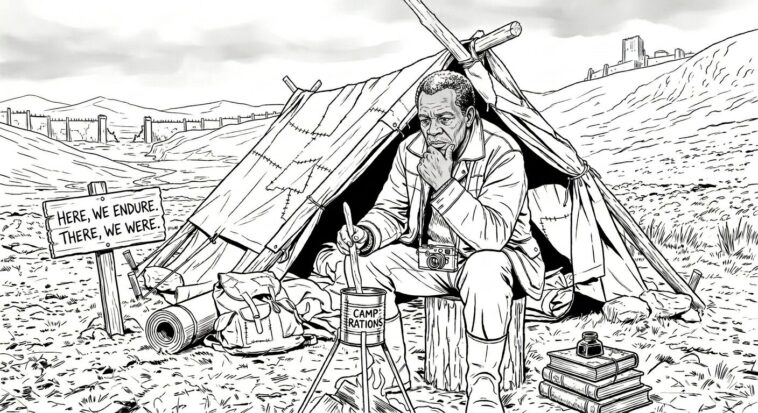
 Caesar Obong Ng'bong ocen

Chapter Five: The Final Destination
By the second morning of my stay in West Budama, I had already abandoned the purpose of my visit to the region or to say what had brought me there.
Officially, I had traveled from the comfort of my Martin Road residency in Kampala through Jinja-Malaba Road in the company of Oburu a cousin brother of Peter Kaburu and the son of an ex streaming wealthy man that I only came to know about after reaching budama land, to document the life of John Owino, a man whose biography seemed to drift between history and folklore. Yet the deeper I ventured into Osukuru and the surrounding villages, the more elusive John Owino became. Every person I spoke to described a different man. To some he was a farmer. To others a trader. To a few he was something else entirely, a figure whose life intersected with stories people preferred not to tell in daylight.
But if John Owino was a mystery, the stories of underground tunnels were an obsession.
Every path eventually led back to them.
Every conversation ended there.
Hidden passages.
Forgotten chambers.
Roads beneath roads.
Entire routes running beneath villages and hills, connecting places that ought never to have been connected.
The stories fascinated me far more than I cared to admit.
That morning, beneath the broad shade of a giant mango tree, I sat sharing breakfast with John Owino while secretly thinking more about tunnels than about the old man himself.
The compound was waking up slowly.
Smoke rose from the village kitchen cooking fires a stone throw away from where I and John were sitting and having breakfast.
Children chased chickens between huts.
Goats wandered freely among clusters of relatives.
Women moved between kitchens carrying water and food as the yellow sun dazzled indiscrinatadily, actually the atmosphere carried the ordinary rhythm of village life.
Then everything changed.
Near the edge of the compound stood the strange round doomed like structure, from a distance it looked more like a water tank, I had noticed the day before and spent a night inside this strange object.
Its walls were made of old limestone cement.
Its roof curved into a dome.
It had no window but it had a single door and nothing more
No one had explained its purpose for the secret of this structure was left only to a few family members.
Whenever I asked, people laughed or changed the subject but one thing was sure. A water point.
That morning, movement caught my attention.
A man stood atop the structure wearing white from top to bottom, I thought I had heard some one call “would someone open the door for me please.” But maybe it was my ears playing tricks on me. So I shrugged it off my shoulders and continued with the activity. But my eyes were not lying to me, and yes a top a man stood…
Motionless.
Watching.
For a moment I believed my eyes were deceiving me the figure then vanished and seconds later, the wooden door below opened and the same man emerged from the same door I stepped out that morning.
Dust covered his white shoes but what was he doing on top of that thing. Then I remembered something I had heard when John was explaining a thing to me.”from the top you had to be wet to get on and from the bottom you had to be dry to get into the doom.”
His beard was unkempt.
His face carried the exhaustion of a man who had spent days running from ghosts or the unknown.
John Owino slowly rose, he was the long awaited son, a friend of mine way back in Kampala, we used to sit somewhere in rubaga overlooking Kampala and enjoying beer while exchanging stories that has to be printed, I wrote the story and he provided the picture and yes that was business as usual and I never imagined that he came from such a rich background.
So by the time John said “Peter,” my brains was already playing tricks on me, Peter the stranger nodded.
And just like that, Peter Kaburu was reunited with his family members at his native home after twenty-two years of exploration and lens observation.
The news spread faster than wildfire in dry grass.
Before midday, relatives began arriving from neighboring villages.
Some came walking.
Others arrived on bicycles.
Motorcycles appeared in clouds of dust.
One elderly woman brought a basket of cassava.
Another family arrived carrying chickens.
A group of young men led two goats into the compound.
By noon a turkey had joined the growing collection of gifts.
Before long even a cow appeared, escorted proudly by distant relatives eager to honor Peter’s return.
The homestead transformed into a celebration.
Cooking fires multiplied.
Large saucepans appeared.
Meat was prepared.
Local brew flowed freely.
Drums emerged from somewhere.
By afternoon dancing had begun.
Children laughed.
Women sang.
Old men argued over politics and clan histories.
The atmosphere felt almost festive.
It was the kind of gathering that reminded people that family still mattered.
That home still existed.
That exile could end.
Yet Peter seemed unable to relax.
Again and again I noticed him studying the roads leading into the village.
Watching strangers.
Measuring distances.
Memorizing exits.
The habits of a man who had survived too many dangers.
The habits of a hunted man.
As the day unfolded, stories about Peter circulated among the guests.
Some claimed he had crossed deserts.
Others insisted he had traveled through territories that did not officially exist.
A few whispered about General Okello.
Several mentioned Area 56.
Whenever those stories surfaced, Peter became noticeably quieter.
By late afternoon another arrival shifted the mood entirely.
The sound of an approaching engine rolled across the fields.
Conversations paused.
People turned.
Children ran toward the road.
Moments later a Peugeot emerged through the dust.
The vehicle gleamed beneath the afternoon sun.
Its polished body reflected the landscape like a mirror.
Even before the driver stepped out, people recognized the significance of the arrival.
This was not a farmer’s vehicle.
Nor a trader’s.
It belonged to a different world.
The world of ministers, diplomats, generals, businessmen and presidents.
The kind of car meant for the most important men in Africa.
When the door opened, silence settled across the gathering.
Peter’s uncle stepped out.
Age had touched him lightly.
His suit was immaculate.
His shoes gleamed.
His posture remained confident.
He carried himself with the certainty of a man accustomed to being obeyed.
Stories about him existed in every district.
Some said he financed political campaigns.
Others claimed he had loaned money to senior government officials.
A few insisted he had once quietly rescued an entire ministry from financial collapse.
Whether those stories were true mattered less than the fact that everyone believed them.
Influence surrounded him like a second skin.
People stepped aside without being asked.
Voices lowered.
Smiles became cautious.
Watching him, I found myself thinking about the nature of power.
Real power rarely announces itself.
Real power arrives quietly and allows others to recognize it.
Yet there was something unsettling about the old man.
The longer I observed him, the more I suspected that he had spent decades confusing influence with ownership.
Men had obeyed him for so long that he had begun believing everything could be bought.
Votes.
Silence.
Loyalty.
Truth.
Perhaps even destiny itself.
His eyes found Peter immediately.
Not his brother.
Not the relatives.
Peter.
The reason he had come.
That evening, after the feast had begun and darkness settled over West Budama, a smaller gathering formed beneath the mango tree.
The drums continued in the distance.
Laughter drifted through the night.
Children chased one another between lanterns.
The celebration appeared normal.
But beneath the tree another conversation unfolded.
A more dangerous one.
It began with General Okello.
Then moved toward Area 56.
The moment the name was spoken, the atmosphere changed.
Area 56.
A place that officially did not exist.
A location absent from maps.
A rumor disguised as geography.
Stories described hidden settlements.
Forgotten knowledge.
Ancient discoveries.
Some whispered about a substance capable of restoring youth.
Others spoke of medicines unknown to modern science.
The more extravagant versions claimed that death itself had little authority there.
The old financier listened carefully.
His attention never left Peter.
Finally he spoke.
“You have seen it.”
It was not a question.
Peter stared into the darkness beyond the lantern light.
“I have seen many things.”
“You know where it is.”
Peter smiled faintly.
“No.”
The old man’s expression hardened.
For years he had funded expeditions.
Scientists.
Mercenaries.
Explorers.
Former intelligence officers.
All searching for Area 56.
Fortunes had vanished into that pursuit.
Nothing had been found.
Nothing except rumors.
Peter, however, had returned.
And that alone made him valuable.
“You protect secrets that could change the world,” the uncle said quietly.
Peter shook his head.
“No.”
“Then why guard them?”
For a long moment Peter remained silent.
When he finally spoke, his voice carried a weariness deeper than exhaustion.
“Because some discoveries destroy the people who find them.”
The old man frowned.
Peter continued.
“You think Area 56 is treasure.”
“Is it not?”
“No.”
“Power, then?”
Peter laughed softly.
A sad laugh.
“The world already has too many powerful men.”
Silence followed.
Then Peter looked directly at his uncle.
“For years you have chased a myth because you believe everything can be owned.”
The words struck their target.
The old man’s face darkened.
Peter understood then.
The invitations.
The messages.
The carefully arranged circumstances surrounding his return.
Oburu.
The realization hit him like a physical blow.
Oburu had never been the reason.
He had been the bait.
His uncle had used his own son to lure him home.
Not because of love.
Not because of family.
Because of greed.
The discovery broke something inside Peter.
Not trust.
Trust had died years earlier.
Something deeper.
The last illusion that blood guaranteed loyalty.
The conversation ended soon afterward.
The old man rose.
Smiled politely.
Shook hands.
Exchanged farewells.
Then climbed back into the Peugeot.
As the vehicle disappeared down the road, a cloud of dust followed behind it.
John Owino watched silently.
Beside me, he shook his head.
“Some men leave before darkness,” he said quietly, “because they already know what darkness intends to do.”
Hours later the celebration had faded.
Most visitors had departed.
The drums were silent.
The fires burned low.
The village slept.
Then came the gunshot.
The sound shattered the night.
For a fraction of a second everything froze.
A second shot followed.
Then a third.
Women screamed.
Children woke crying.
Men stumbled from huts.
Unknown gunmen emerged from the darkness surrounding the compound.
Their movements were disciplined.
Controlled.
Professional.
Not criminals.
Not villagers.
Soldiers.
Peter recognized it immediately.
He had escaped soldiers before.
More than once.
The military had hunted him across borders.
Across forests.
Across places most people would never survive.
He knew how trained men moved.
And he knew how to disappear.
Another bullet cut through the darkness.
Peter was already moving.
No panic.
No hesitation.
Only instinct.
Years of survival took control.
He rolled across the ground before the shooters adjusted their aim.
A second burst tore through the space he had occupied moments earlier.
Lanterns shattered.
Voices echoed.
Confusion spread.
The attackers expected fear.
Instead they encountered experience.
Peter reached the edge of the compound.
Ahead stood the round structure.
Near its base, concealed beneath roots and shadow, a hidden opening waited.
The entrance seemed impossible.
Yet Peter did not hesitate.
He knew.
Perhaps he had always known.
Without slowing, he dove into the darkness.
The earth swallowed him.
Behind him gunfire continued.
Men shouted.
Footsteps thundered.
Searchlights swept across the compound.
But Peter Kaburu was already gone.
Not wounded.
Not captured.
Not dead.
Gone.
The labyrinth had reclaimed one of its own. Once designed and built by Officer Swanni, Kisingiri had used it once and for over seventy years now no one knew where the passage was, including Peter Kaburu but accidentally he had activated the time capsule out of survival instinct and somewhere beneath West Budama, beneath Osukuru, Kibimba, Tororo, Busia, or Malaba and Nagongera, beneath forgotten roads and buried histories, Peter Kaburu disappeared into a darkness older than memory itself.
Above ground, powerful men would continue searching.
But below ground, influence meant nothing.
Money and wealth meant nothing.
Titles and ownership meant nothing.
For the first time in many years, Peter Kaburu had entered a place his uncle could neither buy nor control.
And that, alone was more scary than anything else, it terrified the old man to his splint because war with Peter Kaburu would bring down his empire crumbling down.
This post was created with our nice and easy submission form. Create your post!
Written by
Caesar Obong Ng'bong Ocen is a Ugandan writer whose work traverses narrative fiction, cultural memory, and moral inquiry. Drawing on African cosmologies, and reflective storytelling, his writing engages with issues of power, identity, faith, and the human condition within post‑conflict societies. His series blends political realism with interior psychological struggle, articulating the tensions between duty and conscience, tradition and modernity, exile, redemption. Obong Ng'bong's work bridges literary and social worlds: it interrogates African historical and political realities while exploring philosophical and ethical questions that resonate across disciplines. His narratives are grounded in cultural authenticity and moral depth, making them relevant to both literary and humanistic inquiry. He also mentors emerging writers and contributes to dialogue on African storytelling traditions and their place in contemporary literature.
Did this story move you? Every gift goes directly to Caesar Obong Ng'bong ocen — writers on Muwado earn from reader appreciation, not algorithms. Even $1 makes a difference.





Muwado weekly chart
Get Africa’s top 10 stories every Thursday
No account needed — just your email.
Want to follow Caesar Obong Ng'bong ocen and get notified every time they publish?
Create a free Muwado account →