

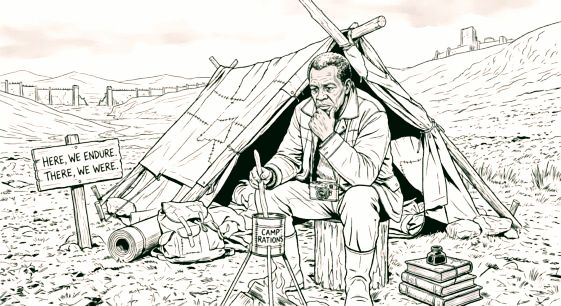
 Caesar Obong Ng'bong ocen
Chapter Twenty-Nine: The Zenith Confession
Peter Kaburu walked out of the room before anyone could stop him.
The business had ended badly.
Or perhaps it had ended exactly as Peter had expected it to.
For more than an hour, the conversation had moved between figures, properties, investments, old agreements and new opportunities. Peter’s uncle had spoken with the confidence of a man who had spent his entire life making large things move.
Money moved.
Vehicles moved.
People moved.
Governments moved.
Businesses appeared to rise and collapse according to decisions made by men who never stood in front of cameras.
Peter had listened.
At first.
Then his silence had changed.
I knew Peter well enough to understand that silence.
There was a silence he used when he was thinking.
There was another he used when he was angry.
And there was a third—a dangerous silence—which came when he had heard something that he could not forgive.
That was the silence he carried when he finally stood up.
“I have heard enough,” Peter said.
His uncle looked at him.
“Sit down.”
“No.”
“Peter.”
Peter laughed once, bitterly.
“You have spent your whole life telling people where to sit.”
The room became still.
I looked from Peter to his uncle.
The old man did not react immediately. He simply watched Peter with the same calm expression he had maintained throughout the business discussion.
But Peter was no longer interested in his calmness.
“Everything with you is business,” he continued. “Every relationship. Every friendship. Every favour. Every problem.”
“Peter—”
“No.”
His uncle fell silent.
Peter pointed toward the table.
“Even this. You call it business.”
His uncle leaned back in his chair.
“And what would you call it?”
Peter stared at him.
“Control.”
For the first time, the old man’s eyes changed.
Only slightly.
But I saw it.
Peter turned away before his uncle could answer.
He walked toward the door.
“Where are you going?” his uncle asked.
Peter stopped but did not turn around.
“Away from this room.”
Then he opened the door and walked out.
The sound of his footsteps moved along the corridor.
Nobody followed him.
For several seconds, I remained where I was, uncertain whether I should go after my friend.
Peter’s uncle remained seated.
He looked toward the open door.
Then he said quietly:
“He was always going to leave.”
I looked at him.
“You expected that?”
“Yes.”
“Why?”
He turned slowly toward me.
“Because he has always been more difficult to control than I expected.”
The words remained in the room.
I thought of Peter’s anger.
Then I thought of everything I had seen in the previous months.
The refugee settlement.
The men who had appeared at Samuel’s house.
The warnings.
The vehicle.
The fuel card.
The mysterious assistance that had followed us.
The feeling that, somewhere behind every decision, there was another person who already knew what we were about to do.
I looked back at the old man.
“You know something about Peter that I don’t.”
He smiled.
“I know many things about Peter that you don’t.”
“Then perhaps you should tell me.”
The old man leaned back.
The business discussion had disappeared.
Something else had taken its place.
“You are Obong pà Obong,” he said. “You have travelled with him. You have seen him at his best and at his worst.”
“Yes.”
“You have seen what happens when he believes somebody has betrayed him.”
I remained silent.
The old man looked toward the door again.
“You believe I betrayed him too.”
“I know you were involved in things that damaged his life.”
“Damaged his life.”
The old man repeated the words as though examining them.
“That is a polite way of saying it.”
“Then say it differently.”
He nodded.
“I interfered.”
“That is still polite.”
A faint smile crossed his face.
“You do not like me very much.”
“I don’t know you well enough to like or dislike you.”
“That is a good answer.”
“But I know what control can do to people.”
His smile disappeared.
“So do I.”
The old man stood and walked slowly toward the window.
He pulled the curtain aside.
Morning light entered the room.
Outside, Peter was nowhere to be seen.
“He thinks I have always controlled him,” the old man said.
“Did you?”
“Yes.”
The answer came without hesitation.
I looked at him.
He continued staring through the window.
“I am a very old man now, Obong pà Obong.”
He paused.
“I have reached what I call the age of extinction.”
I said nothing.
“When a man becomes old, he begins to understand that everything he spent his life building was temporary. The money. The influence. The houses. The people who once stood whenever he entered a room.”
He turned around.
“They disappear.”
The room was silent.
“I have lived my entire life through control and manipulation.”
He said it almost calmly.
There was no attempt to hide it.
“That is what the world of big money can do to a man. You begin by protecting yourself. Then you protect your business. Then you protect your name.”
He smiled bitterly.
“And eventually you protect everything except the people who matter.”
I watched him carefully.
He walked back toward his chair but did not sit.
“You learn to arrange things.”
His voice had become quieter.
“You learn which doors must open and which must remain closed. You learn who can be trusted and who must be watched. You learn that information is more valuable than friendship.”
He paused.
“And after many years, you begin to believe that everything can be controlled.”
He looked directly at me.
“Even people.”
I thought of Peter.
“Even your own family?”
The old man smiled faintly.
“Especially your own family.”
There was no pride in the answer.
Only exhaustion.
I waited.
He sat down.
Then he said:
“Peter was different.”
I leaned forward.
“In what way?”
“He did not want the life I lived.”
“What life?”
“The one you saw this morning.”
He gestured toward the table where the business papers still lay.
“Numbers. Accounts. Companies. Deals. Influence.”
He looked toward the documents.
“Peter had no patience for it.”
I thought about that.
“He became a journalist.”
“Yes.”
“And that disappointed you?”
“No.”
The old man looked at me.
“It saved him.”
I frowned.
“What do you mean?”
Peter’s uncle lowered his eyes.
“Peter did not have to follow my footsteps.”
His fingers moved slowly across the arm of the chair.
“That was one thing I understood about him early.”
The old man paused.
“At nine years old, it was my idea to send him to military school.”
I looked at him.
“Peter was nine?”
“Yes.”
“Why?”
“Discipline.”
The answer came quickly.
Then he corrected himself.
“Partly.”
I waited.
“I wanted structure around him. I wanted him to become strong. I wanted him to understand rules without becoming a prisoner of them.”
“That sounds contradictory.”
“My entire life has been contradictory.”
He smiled faintly.
“By sixteen, he had graduated alongside the other students.”
“And you were proud.”
The old man looked up.
“Very.”
For the first time, something almost tender entered his voice.
“He was brilliant.”
I said nothing.
“Not simply intelligent.”
He paused.
“Brilliant.”
The old man leaned forward.
“You knew that?”
“I knew Peter was intelligent.”
“You did not know how early.”
I remained silent.
The old man looked toward the window.
“By the age of five, Peter was already different from other children.”
“In what way?”
“He understood things quickly.”
“Many children do.”
“Yes.”
“But Peter did not merely understand.”
The old man’s eyes became distant.
“He questioned.”
I almost smiled.
That sounded like Peter.
“He would hear an answer and immediately search for the weakness inside it. He wanted to know why. Not what. Why.”
The old man shook his head slowly.
“By five, there were already assessments.”
“What kind of assessments?”
“Intelligence assessments.”
I looked at him.
“What did they show?”
He hesitated.
Then:
“Approximately two hundred.”
I stared at him.
“Two hundred?”
“Or higher, depending on the assessment.”
The old man smiled.
“It was an extraordinary result.”
“And you believed it?”
“I did not need the paper to tell me.”
His voice became softer.
“I watched him.”
I remained silent.
Peter’s uncle continued.
“He was my favourite.”
The sentence came too easily.
I looked at him.
“Your favourite?”
“Yes.”
“You speak about him as if—”
I stopped.
The old man looked at me.
“As if what?”
I did not answer.
He smiled.
“You will understand.”
That sentence unsettled me.
He rose again and walked toward a cabinet at the far end of the room.
When he opened it, I saw several old boxes.
He removed one carefully.
Dust covered the lid.
He placed it on the table.
“What is that?” I asked.
“History.”
He opened it.
Inside were photographs.
Black-and-white photographs.
Old documents.
Letters.
I stood and moved closer.
The first photograph showed a group of men standing beside a vehicle.
Another showed a child.
Another showed a younger version of Peter.
I stared at it.
“He was always photographed,” the old man said.
I looked at him.
“Why?”
He smiled.
“Because photography runs in the family.”
I returned my attention to the photographs.
“Whose family?”
The old man did not answer immediately.
Instead, he removed another picture.
This one was much older.
“Have you heard of Kisinyiri?” he asked.
“No.”
“You should.”
“Why?”
“Because history sometimes begins with people whose names have almost disappeared.”
I waited.
“Kisinyiri was part of Peter’s lineage.”
“Peter’s lineage?”
“Yes.”
The old man placed the photograph on the table.
“His family history goes further back than he knows.”
I looked at the image.
“And Kaburu?”
The old man smiled.
“That name did not begin where Peter believes it began.”
“What do you mean?”
“There were sons.”
He paused.
“Not all of them were recognized.”
I understood.
“A bastard son?”
The old man nodded.
“One of them carried the name forward.”
“And that was Kaburu?”
“Yes.”
I looked again at the photographs.
The story was becoming complicated.
Kisinyiri.
Kaburu.
The old family line.
Peter’s name.
Then the old man removed another photograph.
A man stood holding a camera.
The photograph was damaged around the edges.
“Who is that?” I asked.
“Kaburu Senior.”
I looked closely.
“He was a photographer?”
“One of the best.”
The old man sat down.
“There are people who believe history is written by the people who carry guns.”
He looked at the camera in the photograph.
“But sometimes history belongs to the person carrying this.”
I remained silent.
“Kaburu Senior understood that.”
He told me of the old stories surrounding the Lake Turkana region and of a time when foreign forces moved through parts of East Africa believing military strength was the final language of power.
“Kaburu Senior did not fight with the barrel,” he said.
“Then how did he fight?”
The old man touched the photograph.
“With the truth.”
I looked at him.
“With photography.”
His eyes were fixed on me now.
“He understood that a camera could preserve what powerful people wanted erased.”
The words reminded me of Peter.
A journalist.
A man who recorded things.
A man who asked questions.
A man who repeatedly found himself in danger because he refused to leave certain stories alone.
“You gave Peter his first camera,” I said.
The old man smiled.
“Yes.”
“Why?”
He looked toward the old photograph.
“Because I thought he should continue something that had already begun.”
I understood.
Or thought I did.
“You wanted him to become a photojournalist.”
“I wanted him to see.”
The old man paused.
“That was the beginning of my problem.”
I looked at him.
“What problem?”
“Once Peter learned how to see, I could no longer control what he would see.”
The words were almost a confession by themselves.
The old man lowered his head.
“I gave him the camera.”
His voice was barely above a whisper.
“And later, I spent years keeping him on his heels.”
“What do you mean?”
“I kept him moving.”
“Why?”
His expression hardened.
“To protect him.”
I remembered Peter’s words.
Control.
“You keep using that word.”
“Because it is true.”
“Or because it is convenient?”
The old man looked at me for a long time.
“Both.”
I sat down.
“Who were you protecting him from?”
The old man returned to his chair.
“My enemies.”
I said nothing.
“My business enemies. Political enemies. People who believed that knowing me gave them the right to know everyone connected to me.”
He paused.
“And people who would have used Peter to reach me.”
“So you kept him away.”
“Yes.”
“Why?”
The old man closed his eyes.
“Because being known as the son of S. P. Owere could have been a privilege.”
He opened his eyes.
“Or a death sentence.”
I stared at him.
The room became completely silent.
He had said the words naturally.
Too naturally.
I thought perhaps I had misunderstood him.
I looked toward the door through which Peter had left.
Then back at the old man.
“What did you say?”
Peter’s uncle did not answer.
I stood.
“Being known as the son of S. P. Owere?”
He lowered his head.
For the first time that morning, he looked afraid.
Not afraid of me.
Afraid of the truth.
“Who is S. P. Owere?” I asked, though suddenly I believed I already knew.
The old man looked at me.
“Simon Peter Owere.”
I felt something inside the room change.
“No.”
He nodded slowly.
I thought of Peter.
His uncle.
The man he called uncle.
The man who had watched him.
The man who had sent him to military school.
The man who had given him his first camera.
The man who knew about his intelligence at the age of five.
The man who knew details of his life that no ordinary uncle should have known.
I looked at the old man again.
“You are speaking about him like—”
He closed his eyes.
I stopped.
A long silence followed.
Then the old man opened his eyes.
“I have spent most of my life arranging things,” he said.
I could barely breathe.
“Arranging businesses. Arranging people. Arranging information. Arranging what the world knew and what it did not know.”
He looked toward Peter’s door.
“But there is one arrangement I made that I have regretted every day of my life.”
I did not speak.
“Peter was raised by John Owino.”
I nodded slowly.
“Yes.”
“John Owino was my brother.”
The room began to turn inside my mind.
“And Peter?”
The old man swallowed.
“Peter was raised under my guidance.”
I stared at him.
“Why?”
His voice broke.
Only slightly.
Because of a lifetime of discipline, the break almost disappeared.
But I heard it.
“Because I believed that was the safest way to protect him.”
I stepped closer.
“You are not his uncle.”
The old man did not answer.
I felt the truth approaching.
All the pieces.
The intelligence.
The military school.
The camera.
The surveillance.
The control.
The protection.
The strange mixture of pride and guilt.
I looked at him.
“You are his father.”
Simon Peter Owere closed his eyes.
When he spoke, his voice was no longer the voice of the businessman.
No longer the voice of a man who controlled companies and people.
It was the voice of someone who had carried a secret for too long.
“Yes.”
The word was almost nothing.
But it changed everything.
“Yes,” he said again.
I could not move.
Outside, somewhere beyond the walls of the house, Peter Kaburu was walking alone.
Unaware that, in the room he had abandoned in anger, the man he had called his uncle had finally stopped hiding behind the word.
Simon Peter Owere looked at me.
“He is my son.”
The confession had reached its zenith.
Not money.
Not business.
Not power.
Not the long history of control and manipulation.
A son.
A father.
And an old man who had spent his entire life protecting the one secret that had destroyed his right to be called by the name he wanted most.
Father.
For a long time, neither of us spoke.
Then I remembered something.
Peter’s son.
The child.
The resemblance John Owino had once acknowledged.
The family stories.
The questions surrounding Kisinyiri.
I looked back at Simon Peter Owere.
“And the DNA?”
The old man nodded.
“DNA does not understand secrecy.”
The room was silent.
“It confirmed what had been hidden.”
He reached into the box again.
This time he removed a sealed document.
He placed it on the table between us.
“Peter Kaburu is my biological son.”
I looked at the document.
Then at the old man.
“And John Owino knew?”
“Yes.”
“He knew all along?”
The old man nodded.
“He knew.”
I looked toward the door.
Peter was gone.
For the first time since the conversation began, I felt sorry for Simon Peter Owere.
Not because I believed his wealth had made him innocent.
Not because control and manipulation could be forgiven simply because they came from fear.
But because I finally understood that I was not sitting before a brutal man who had enjoyed destroying another man’s life.
I was sitting before a broken man.
A man who had spent his entire life at the centre of power and discovered, when age finally caught him, that all his influence could not give him the simplest thing a father could desire.
His son’s respect.
He had controlled businesses.
He had controlled information.
He had controlled people.
He had kept Peter close enough to watch and far enough to remain hidden.
But he had failed to control the one consequence that mattered most.
Peter had grown into a man.
And the man he had grown into did not know that the person he had spent his life calling uncle
was the father who had been standing beside him all along.
This post was created with our nice and easy submission form. Create your post!
Written by
Caesar Obong Ng'bong Ocen is a Ugandan writer whose work traverses narrative fiction, cultural memory, and moral inquiry. Drawing on African cosmologies, and reflective storytelling, his writing engages with issues of power, identity, faith, and the human condition within post‑conflict societies. His series blends political realism with interior psychological struggle, articulating the tensions between duty and conscience, tradition and modernity, exile, redemption. Obong Ng'bong's work bridges literary and social worlds: it interrogates African historical and political realities while exploring philosophical and ethical questions that resonate across disciplines. His narratives are grounded in cultural authenticity and moral depth, making them relevant to both literary and humanistic inquiry. He also mentors emerging writers and contributes to dialogue on African storytelling traditions and their place in contemporary literature.
Did this story move you? Every gift goes directly to Caesar Obong Ng'bong ocen — writers on Muwado earn from reader appreciation, not algorithms. Even $1 makes a difference.





Muwado weekly chart
Get Africa’s top 10 stories every Thursday
No account needed — just your email.
Want to follow Caesar Obong Ng'bong ocen and get notified every time they publish?
Create a free Muwado account →