

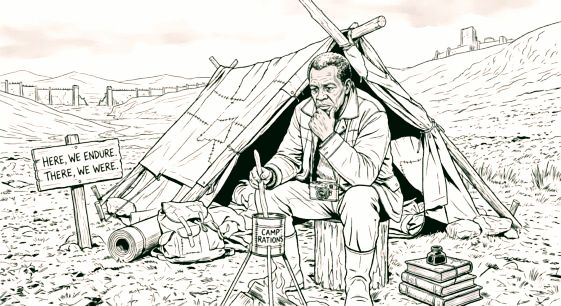
 Caesar Obong Ng'bong ocen

Chapter Twenty-Four: Counterstrike
Forty-Eight Hours Later
The discussion in Samuel’s house ended in disagreement.
Peter and I wanted to drive ourselves to Kampala. We did not want to be taken in the men’s vehicle, and we certainly did not want to surrender what little control remained to us.
The four men disagreed.
They wanted us to go with them.
Not as passengers.
As something to be delivered.
They never used the word abduction, but it hung in the room anyway.
There was something unsettling about the way they watched us. They were close enough to take us, yet maintained a peculiar distance, as though an invisible boundary existed between them and us.
I could not explain it.
Neither could Peter.
The argument continued until night began thinning toward morning.
Eventually, the men appeared to give up.
Or perhaps they had simply decided that patience would serve them better than force.
Before dawn, they left the settlement without us.
Their old, dark Land Rover had been parked away from the main path, where nobody would notice it leaving. Mud covered its doors. The windscreen carried the pale scars of countless journeys.
The driver climbed in and turned the key.
“Kwikikiki… took… giu-giu-giu… vruuu…”
The engine coughed, shuddered, then settled into a rough mechanical growl.
For several seconds, nobody spoke.
The man who had spoken to us inside Samuel’s house sat beside the driver, watching the settlement through the windscreen.
“You should have taken them,” the driver said.
The passenger did not look at him.
“They will come.”
“And if they don’t?”
“They will.”
The driver shifted into gear.
The Land Rover moved.
In the back, the other two men sat beside each other. One still had a cut across his cheek from the struggle at Samuel’s door. The other kept his eyes closed.
Samuel’s house disappeared behind them.
Then the shelters.
Then the cooking fires.
Then the settlement itself.
The road opened toward the highway.
They were heading toward Kampala.
None of them noticed the figure standing beneath a tree at the edge of the settlement.
I did.
Or at least, I thought I did.
I was standing beside Peter when something passed through me.
It was not pain.
Not exactly.
It was pressure.
A sudden compression inside my chest, as though an invisible hand had closed around my heart.
I stopped.
Peter turned.
“What is it?”
I could not answer.
The pressure disappeared.
Then returned, sharper.
A flash entered my mind.
A road.
Wet asphalt.
A white line vanishing beneath tyres.
A vehicle moving too fast.
Something stationary beside the road.
Then—
darkness.
I blinked.
The refugee settlement returned.
Peter was staring at me.
“What did you see?”
“I don’t know.”
“You saw something.”
“I saw a road.”
“Which road?”
“I don’t know.”
He stepped closer.
“Obong.”
“I said I don’t know.”
He studied my face.
Then his expression changed.
“You felt them.”
“Who?”
“The men.”
I wanted to deny it.
But somewhere beyond the settlement, something had already begun.
I could feel it—not as a voice, not even as an image anymore, but as an echo travelling toward us through a distance I could not measure.
Then Peter became still.
His eyes lost focus.
“Peter?”
He did not answer.
“What is it?”
His breathing changed.
Then he looked at me.
“I saw them.”
“Saw who?”
“The men.”
“What did you see?”
He looked toward the road.
“Their vehicle was approaching Lyantonde.”
My chest tightened again.
“And then?”
“They collided with a stationary wagon.”
I stared at him.
“A wagon?”
“Stationary beside the road.”
His voice had become distant.
“Their vehicle hit it.”
The pressure inside my chest returned.
For a moment, neither of us spoke.
Then I whispered:
“It’s as you have said.”
Peter turned toward me.
“I saw that too.”
“The wagon?”
“Yes.”
“The impact?”
“Yes.”
“The vehicle rolling?”
He nodded.
I looked toward the mountains.
Mist lay across them like smoke.
Neither of us understood what had happened.
But we had both seen something that had not happened yet.
Not a memory.
Not a story.
An event.
Somewhere beyond the settlement.
Somewhere on the road to Kampala.
Then, far away, a horn screamed.
And everything went silent.
We did not tell Samuel.
We did not tell anyone.
We barely spoke about it between ourselves.
What could we have said?
That we had seen four men we were not travelling with collide with a stationary wagon hundreds of kilometres away?
That we had seen it before anyone had told us?
That Peter and I had somehow seen the same thing?
Neither of us knew whether we had witnessed the future or something else entirely.
And beneath that uncertainty was a more frightening question.
Had we caused it?
So we kept silent.
The first day passed.
The men did not return.
The second day began.
Still, we said nothing.
Peter spent most of his time writing in his notebook. I watched the road whenever I heard an unfamiliar engine.
Every passing vehicle made me wonder.
Every distant horn brought the vision back.
Wet asphalt.
The wagon.
The impact.
The rolling vehicle.
The silence afterward.
By the second evening, I had almost convinced myself it had been a dream.
Then Samuel entered carrying his telephone.
He closed the door behind him.
Peter looked up from his notebook.
“What happened?”
Samuel placed the telephone on the table.
“I have news.”
“From Kampala?” Peter asked.
Samuel nodded.
“What kind of news?”
He looked at both of us.
“The men who came for you.”
Peter’s fingers stopped moving.
“What about them?”
“Their vehicle crashed.”
The blood seemed to leave my body.
Peter looked at me.
Samuel continued.
“Near Lyantonde.”
Neither of us spoke.
“They collided with a stationary wagon.”
The room seemed to shrink.
Peter lowered his eyes.
I stared at the floor.
Samuel noticed.
“What?”
Neither of us answered.
“When?” Peter finally asked.
“Two days ago.”
My heart began beating harder.
“One of them died,” Samuel continued. “Two were injured.”
“And the man who spoke to us?”
“Alive.”
Peter exhaled slowly.
Samuel looked from him to me.
“You two are acting strangely.”
Peter shook his head.
“We’re fine.”
Samuel did not believe him.
“Do you know something?”
Peter looked at me.
I looked back at him.
For forty-eight hours, we had carried the same impossible secret.
Now the outside world had confirmed it.
“We saw it,” Peter said.
Samuel frowned.
“Saw what?”
“The accident.”
Samuel stared at him.
“What do you mean?”
Peter looked at me.
I spoke quietly.
“We saw it before it happened.”
Samuel sat down slowly.
“You were here.”
“Yes.”
“The whole time?”
“Yes.”
“Then how?”
Neither of us had an answer.
Peter opened his notebook.
He looked at what he had written two nights earlier.
Lyantonde.
Stationary wagon.
Impact.
Roll.
He closed it.
Samuel watched him.
“Why didn’t you tell me?”
Peter looked at him.
“Because we didn’t know what it meant.”
I added:
“And we were afraid.”
Samuel’s eyes narrowed.
“Afraid of what?”
I looked at my hands.
“That we might have caused it.”
No one spoke.
Outside, a child laughed.
Somewhere farther away, someone called another person’s name.
Ordinary life continued.
But inside Samuel’s little house, something had changed.
The accident was no longer a vision.
It was a fact.
And the fact had arrived forty-eight hours after we had already seen it.
Three days later, Peter’s uncle collapsed.
The news came through a telephone call Samuel received from one of his contacts in Kampala.
Peter’s uncle had developed a strange weakness in both legs.
At first, his family thought it was exhaustion.
Then he could no longer stand.
Doctors examined him. Tests were performed. Scans were taken. Specialists were consulted.
Nothing explained the sudden deterioration.
His mind remained clear.
His speech remained normal.
His heart was functioning.
Yet his legs refused to carry him.
He could feel them.
He could move his toes.
But when he tried to stand, they gave way.
The doctors called it unexplained.
Peter called it something else.
He said nothing.
He sat in Samuel’s chair and stared at the floor.
I watched him for several seconds.
“Peter.”
He looked up.
“What?”
“Do you remember your uncle?”
His expression changed.
“What about him?”
“When you went to see him.”
He said nothing.
“You prayed for him.”
“Yes.”
“You wanted him healed.”
“I did.”
I hesitated.
“Do you remember what you were thinking about while you prayed?”
He frowned.
“What do you mean?”
“The accountant.”
His face became still.
“The man with the muscle atrophy in both legs.”
Peter looked away.
“I remember him.”
“You were thinking about him when you went to your uncle?”
“Yes.”
“How strongly?”
Peter was silent.
“Very strongly.”
“Why?”
“Because I couldn’t understand it.”
“The accountant?”
“Yes. His legs had stopped working, but the doctors couldn’t explain why. I kept thinking about him.”
“And then you went to your uncle.”
“Yes.”
“And prayed for him.”
Peter nodded.
“Did you touch him?”
“Yes.”
“What happened?”
He looked at his hands.
“My hands were hot.”
“Hot?”
“Burning.”
A cold sensation moved through me.
“What else?”
“I felt something moving.”
“Where?”
“Through my arms.”
“Into him?”
“I don’t know.”
“Peter.”
He looked at me.
“Did you feel the pain leaving you?”
“No.”
“Did you feel it entering him?”
His face tightened.
“I don’t know.”
I lowered my voice.
“Then what if you didn’t transfer healing?”
Peter stared at me.
“What are you saying?”
“What if you transferred the pain?”
He stood abruptly.
“No.”
“I’m not saying you meant to.”
“No.”
“I prayed for him.”
“I know.”
“I wanted him healed.”
“I know.”
His voice cracked.
“Then don’t tell me I hurt him.”
“I don’t know that you did.”
“Then why are you asking?”
“Because we don’t understand what is happening to us.”
He looked at me.
Neither of us spoke.
“Think about the timing,” I said.
Peter’s face hardened.
“My uncle became ill after I prayed for him.”
“And the accountant?”
“Was already ill.”
I nodded.
“Exactly.”
He stared at me.
“What are you suggesting?”
“I don’t know.”
“That isn’t what your question sounds like.”
I looked toward the doorway.
“Maybe the ability isn’t simply about removing pain.”
Peter said nothing.
“Maybe pain can move.”
His eyes widened slightly.
“From one person to another?”
“I don’t know.”
“And if that’s true?”
“Then we need to know where it goes.”
Peter sat down again.
His hands were trembling.
“I never wanted this.”
“I know.”
“I only wanted him to get better.”
“I know.”
He stared at his palms.
“What if I caused it?”
The question came quietly, almost like a confession.
I did not answer immediately.
Then I said:
“Maybe you didn’t.”
Peter looked at me.
“Maybe?”
“We don’t know enough yet.”
“But if I did…”
His voice faded.
“If I can transfer pain without knowing it, then how do I know what I’m doing to people?”
That question stayed in the room.
Outside, rain began tapping against the roof.
Peter looked at me again.
“And what about you?”
“What about me?”
“You heal.”
I said nothing.
“What if your healing isn’t what we think it is either?”
For the first time, I had no answer.
The room seemed to become smaller.
The rain grew heavier.
Perhaps we had never truly understood what happened to us in the cave.
We had called it healing because people became better.
But perhaps healing was only one expression of something much larger.
Something that did not distinguish neatly between healing and harm.
And if pain could travel—
perhaps distance was no longer protection.
Perhaps neither of us was safe from the other.
Nor was anyone else.
Six days later, the second man fell.
His name was known throughout Kampala.
A businessman.
A philanthropist.
A man who owned hotels, warehouses, transport companies and properties whose ownership structures were complicated enough to make ordinary people stop asking questions.
He had attended meetings where our disappearance had been discussed.
He had financed people who considered the Cave Men of God a threat.
He had publicly condemned what he called religious fraud.
Privately, according to information Peter had gathered, he had wanted us removed.
He had called the healing phenomenon dangerous.
He had called Obong a liability.
He had called Peter a journalist who had forgotten the price of asking questions.
Then, one morning, while eating breakfast, the businessman dropped his cup.
His right hand stopped responding.
He tried to stand.
His right leg collapsed.
His wife screamed.
He had suffered a stroke.
An ambulance carried him to hospital.
Doctors worked.
Machines monitored him.
Specialists came and went.
His family demanded answers.
They had money.
They had connections.
They had influence.
But money could not make his hand close.
Connections could not make his leg move.
Influence could not make his mouth speak properly.
For the first time in his life, the businessman discovered that there were things power could not purchase.
Then, one evening, a doctor stood beside his bed.
“There is someone who may be able to help.”
The businessman looked at him.
“Who?”
The doctor hesitated.
“You know him.”
The businessman stared.
“Who?”
The doctor lowered his voice.
“The Cave Man of God.”
The room became silent.
His wife looked at the doctor.
“What did you say?”
“There is a man who has reportedly restored movement in people whose conditions doctors could not explain.”
The businessman shook his head.
“No.”
The doctor said nothing.
“No.”
The businessman tried to raise his hand.
It would not move.
The doctor continued.
“He is believed to be outside Uganda.”
The businessman stared at the ceiling.
“But if he can be brought here—”
The businessman slammed his functioning hand against the mattress.
“No.”
The man he had wanted eliminated.
The man whose reputation he had tried to destroy.
The man whose disappearance had been discussed in rooms where his name was spoken as though he were an inconvenience.
Now that man might be the only person capable of making him walk again.
For the first time, the businessman understood the cruelty of the situation.
He did not need to find the Cave Man of God.
He needed him.
The news reached the refugee settlement that evening.
Peter and I were sitting with Samuel.
The telephone lay on the table.
Nobody spoke.
Then Peter asked:
“Who told him?”
Samuel looked at him.
“The doctor.”
“No.”
Peter shook his head.
“Who told the doctor?”
Samuel’s eyes narrowed.
“That is the question.”
I looked at the maps covering Samuel’s wall.
The red lines.
The ports.
The roads.
The borders.
The routes.
Suddenly, everything looked different.
The accident.
Peter’s uncle.
The businessman.
Three events.
Three lives.
One direction.
Us.
Peter stood.
“What if they’re not attacks?”
I looked at him.
“What do you mean?”
“What if they’re consequences?”
Samuel’s face became unreadable.
“Consequences of what?”
Peter looked at me.
I did not answer.
Samuel followed his gaze.
For several seconds, nobody moved.
Then Samuel walked to the wall.
His finger traced one of the red routes.
“Three hundred sacks disappear,” he said quietly.
Nobody interrupted him.
“They don’t disappear randomly.”
His finger moved.
“They disappear along a route.”
He looked at us.
“A person disappears.”
Another movement.
“He is moved along a route.”
His finger reached Kampala.
“A businessman becomes sick.”
His finger stopped.
“And suddenly the same man who wanted someone eliminated discovers that he needs that person alive.”
Samuel stepped back.
“That is not coincidence.”
Peter asked:
“Then what is it?”
Samuel looked at him.
“I don’t know.”
For once, the man who had spent seventeen years reading numbers had no answer.
Outside, the rain began again.
That night, something happened to me.
I was asleep when I felt someone touch my shoulder.
I opened my eyes.
Nobody was there.
The room was dark.
Peter slept on the other side.
Then I heard a voice.
Not outside.
Inside.
A man’s voice.
Weak.
Angry.
Afraid.
Help me.
I sat up.
Peter woke immediately.
“What happened?”
I could not speak.
The voice came again.
Help me.
I closed my eyes.
For a moment, I saw a hospital room.
A man lying in a bed.
A paralysed hand.
A frightened face.
Then the vision disappeared.
I opened my eyes.
Peter was watching me.
“Who was it?”
“The businessman.”
Peter became still.
“You saw him?”
“Yes.”
“Was he awake?”
“I don’t know.”
“What did he say?”
I looked at my hands.
“He asked for help.”
Peter stared at me.
Neither of us spoke.
Then he whispered:
“This is changing.”
I knew what he meant.
The healing had once seemed to require proximity.
A hand.
A body.
A person standing before me.
Now distance seemed meaningless.
I could feel suffering without touching the person who carried it.
And if I could feel it—
perhaps I could reach it.
That frightened me more than anything the four men had done.
Because the system had spent years learning how to find us.
Now we were beginning to discover that we could find it too.
The following morning, Peter came to me carrying his notebook.
He opened it.
On the first page, he had written three entries:
The four men.
His uncle.
The businessman.
He drew a line between them.
Then another.
And another.
Samuel watched him from across the room.
“You are building another map,” he said.
Peter shook his head.
“No.”
He looked at the red lines on Samuel’s wall.
“I’m building a counter-route.”
Samuel stared at him.
Something shifted inside me.
Not anger.
Not fear.
Something colder.
Determination.
For months, we had run.
We had crossed roads, borders, towns and settlements.
We had slept in places where nobody knew our names.
We had accepted food from strangers.
We had watched people search for us.
We had believed survival meant staying ahead.
But survival had taught us something.
A route could be reversed.
A system could be studied.
A hunter could become a target.
And a man who had spent his life believing himself untouchable could suddenly discover what it meant to need the mercy of the person he had condemned.
Peter closed his notebook.
“We stop running.”
Samuel looked at him.
“And do what?”
Peter looked at me.
I knew the answer before he spoke.
“We fight back.”
Outside, the mountains disappeared behind another curtain of rain.
Somewhere far away, a businessman lay unable to walk.
Somewhere else, Peter’s uncle lay trapped inside a body that no longer obeyed him.
And somewhere near Lyantonde, a damaged Land Rover rested beside the wreckage of a stationary wagon.
Forty-eight hours before Samuel told us about it, Peter and I had already seen it.
We still did not know how.
We still did not know whether we had caused it.
But another possibility had begun to take shape.
Perhaps the cave had not given us a gift.
Perhaps it had opened something.
Something that did not distinguish cleanly between healing and harm.
Something that responded to thought, intention, fear and suffering.
If pain could travel, then distance was no longer protection.
If suffering could be felt across hundreds of kilometres, then the world itself had become smaller.
And if we could reach the people who were trying to destroy us—
then perhaps they were no longer beyond our reach.
Peter closed his notebook.
I looked at him.
For months, we had survived by staying ahead of the people hunting us.
Now the direction had changed.
The hunters were beginning to need the hunted.
The powerful were beginning to fear the powerless.
And the men who had once believed that killing us would solve their problem were slowly discovering the cruelest possibility of all:
they might need us alive.
This post was created with our nice and easy submission form. Create your post!
Written by
Caesar Obong Ng'bong Ocen is a Ugandan writer whose work traverses narrative fiction, cultural memory, and moral inquiry. Drawing on African cosmologies, and reflective storytelling, his writing engages with issues of power, identity, faith, and the human condition within post‑conflict societies. His series blends political realism with interior psychological struggle, articulating the tensions between duty and conscience, tradition and modernity, exile, redemption. Obong Ng'bong's work bridges literary and social worlds: it interrogates African historical and political realities while exploring philosophical and ethical questions that resonate across disciplines. His narratives are grounded in cultural authenticity and moral depth, making them relevant to both literary and humanistic inquiry. He also mentors emerging writers and contributes to dialogue on African storytelling traditions and their place in contemporary literature.
Did this story move you? Every gift goes directly to Caesar Obong Ng'bong ocen — writers on Muwado earn from reader appreciation, not algorithms. Even $1 makes a difference.




Muwado weekly chart
Get Africa’s top 10 stories every Thursday
No account needed — just your email.
Want to follow Caesar Obong Ng'bong ocen and get notified every time they publish?
Create a free Muwado account →