

 Caesar Obong Ng'bong ocen

Collision at Bugolobi Silver Springs Hotel
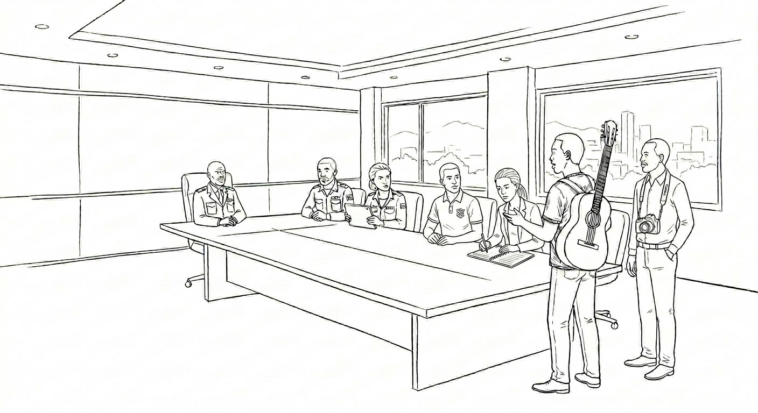
It was somewhere along Nakawa–Luzira Road, inside Silver Springs Hotel in Bugolobi, where I had invited the storyteller of the General O series to meet with the surviving team.
I expected him to come as a storyteller.
Instead, he arrived as a musician.
He stepped into the room with an acoustic guitar slung over his shoulder, suited and booted, calm as if he had walked into a performance rather than a confrontation. There were no files in his hands, no recording devices, no visible intent to defend himself—only presence.
And that presence unsettled everyone.
It was the first sign that this meeting would not follow any known script.
In fact, it did not feel like a meeting.
It felt like a collision.
As always, I, Peter Kaburu, stood at the center of it.
A journalist. A cameraman. A man who had crossed an invisible line long before this night.
Beside me stood Caesar Obong Obong Ocen—storyteller, musician, observer of truths others feared to hold. To those who had never seen him, he might have appeared harmless. To those who had read his work, he was something else entirely.
Across the polished table sat the remnants of a unit that once operated beyond visibility.
Maggie.
Drake.
Mary.
Felix.
And at the head, General Okello.
Their faces were carved by years of secrecy. Their silence was heavier than accusation.
It was Drake who broke it.
“I am very disappointed in you, Mr. Cameraman.”
His voice cut clean through the room.
“And who is this clown?” he continued, his eyes fixed on Caesar. “Why is he here? What does he want?”
I opened my mouth to respond, but Drake raised his hand sharply, silencing me before I could speak.
“No,” he snapped. “You will listen first.”
He leaned forward, his tone tightening.
“Do you even understand the weight of leadership? Of being assigned the right to take another man’s life in order to protect what must be protected?”
He didn’t wait for an answer.
“Do you understand what it means to control a weapon? To hold authority over chaos? Or have you thought—just for a second—about the consequences of giving that kind of power to someone who does not understand restraint?”
His voice rose.
“A lack of control turns a soldier into a madman.”
The room tightened around his words.
“AFANDEEE!”
Maggie’s voice snapped in, sharp and cutting.
“Have you lost it this fast?” she demanded. “He is only a musician. What more can he do apart from playing songs that fill hearts with joy?”
Drake turned toward her slowly, his expression corrosive.
But before he could respond, Felix intervened.
“This,” Felix said firmly, “is a collapse of professional conduct.”
His tone was controlled, but his eyes were not.
Mary spoke next, quieter but no less resolute.
“This is not just a mistake,” she said. “It is a risk. One that could ripple far beyond anything we can contain.”
Their words layered over each other, building pressure.
The room was no longer silent.
It was boiling.
I stepped forward.
“This gentleman,” I said, steadying my voice, “is not just a storyteller. Not just a musician.”
I glanced at Caesar briefly, then back at them.
“He has stood beside me.”
Silence returned, but it was no longer passive.
“When I was face to face with death, he documented my pain,” I continued. “He understood what the camera sees beyond the surface. He understood the cultural identity we carry—as armed men and women, as protectors, as individuals buried under command.”
Drake scoffed, but I did not stop.
“If the nation needs truth,” I pressed, “why must we hide it? Why must we lie to ourselves and wait for a whistleblower—someone beyond our control—to expose us maliciously?”
My voice hardened.
“Why not tell it ourselves?”
The temperature in the room shifted.
Not downward.
Deeper.
General Okello had not spoken.
Until now.
His voice came slowly, controlled, heavy with something far beyond anger.
“You have caused damage,” he said.
Not loudly.
But with weight.
“Not just operational damage,” he continued, his eyes fixed on me. “You have broken trust.”
Each word landed with precision.
“You took what was classified,” he said, “and placed it into uncertainty.”
I held his gaze.
“It is not uncertainty,” I replied. “It is truth.”
The room resisted the word.
Then Caesar spoke.
Calmly.
“Truth,” he said, “is what keeps people remembered.”
It was a simple statement.
But it shifted everything.
The attention in the room moved.
From me—
To him.
Maggie reached for her tablet.
“What if,” she said quietly, “the truth is already out?”
She turned the screen toward the table.
“There is something you all need to see.”
She opened a platform.
Muwado.
And there it was.
A growing series of published stories.
Detailed.
Structured.
Unmistakably real.
“Operation Subsurface Silence,” Maggie read.
Her voice trembled slightly.
“Behind enemy lines… detailing how General Okello survived what should have been a fatal encounter.”
She paused.
No one spoke.
“Operation Eagle Talon,” she continued. “A mission where advanced coordination made him appear almost… untouchable.”
Drake shifted in his seat.
Maggie scrolled.
“The Night Walker.”
Mary leaned forward.
“And… the Pubunngu mission.”
That name landed differently.
Heavier.
Maggie began reading excerpts.
Descriptions.
Movements.
Decisions.
Details that could not have been guessed.
Could not have been imagined.
Could only have been known.
When she finished, the silence that followed was no longer tense.
It was undeniable.
General Okello turned toward me slowly.
“Mr. Cameraman,” he said.
There was anger in his voice.
But something else, too.
Disappointment.
“You made a fool out of our trust.”
I did not respond.
“You took training,” he continued. “Access. Sensitive information. Even my own MOSA codes.”
He leaned back slightly.
“And you gave them to a storyteller.”
His eyes moved to Caesar.
“A storyteller,” he repeated, “with no proven understanding of weight. Or consequence.”
Then—
unexpectedly—
he smiled.
Just slightly.
“I am proud of you,” he said.
The room froze.
“That you documented everything,” he continued, “with the right person.”
No one spoke.
“None of us realized,” he added, “that we were being used as tools by the very system we served.”
The shift was complete.
But the discomfort remained.
Because Caesar did not fit.
Not in that room.
Not in that structure.
He carried no rank.
No code.
No allegiance.
Only a guitar.
And that, somehow, made him more dangerous than all of them.
General Okello’s composure broke.
“Why?” he demanded.
“Why bring him here?”
I stepped forward again.
“I did not bring him to expose you,” I said. “I brought him because what we call operations… are realities.”
I let the words settle.
“Realities that deserve to be seen.”
Drake shook his head.
“Betrayal,” he muttered.
Felix nodded in agreement.
Mary said nothing.
Caesar spoke again.
“What I received,” he said, “was not just information.”
He paused.
“It was truth.”
His voice remained calm.
“And truth,” he added, “does not survive in silence.”
That was the moment.
The exact moment.
When they all understood.
Through Muwado—
The world already knew.
General O was no longer hidden.
No longer contained.
No longer theirs alone.
The anger in the room began to change.
Not disappear.
Transform.
Days later, they would discover something else.
The stories had not stopped.
They had multiplied.
New titles appeared.
Echoes of Subsurface Silence.
The Night Walker Files.
Eagle Talon: Unsealed.
Each one deeper.
Sharper.
More complete.
Maggie paused on one particular extract.
A bush mission.
A chaotic extraction.
Heavy lashes.
Pain.
Survival.
She read it silently at first.
Then she smiled.
A rare, disbelieving smile.
“This is impossible,” she whispered.
But she read it aloud anyway.
When she finished, she shook her head slowly.
“It feels,” she admitted, “as if he was actually there.”
No one corrected her.
Because no one could.
Later, in a closed briefing, General Okello addressed the team.
He did not dismiss the work.
He acknowledged it.
“Peter Kaburu did not destroy us,” he said.
The room remained still.
“He redirected the truth.”
A pause.
“He gave it to someone who ensured it would never be buried again.”
It was not easy for them to accept.
But it was impossible to deny.
Caesar Obong Obong Ocen had done something irreversible.
He had transformed secrecy—
Into permanence.
The confrontation that began with anger dissolved slowly.
Into realization.
On the final night, in the same room where everything had unraveled, General Okello stood before the window overlooking Bugolobi.
The city stretched beyond him.
Unaware.
Uninvolved.
Yet already part of the story.
He spoke without turning.
“The world knows General O,” he said.
Not as a question.
As a fact.
“Not because we revealed ourselves,” he continued.
“But because someone outside our silence understood us.”
He turned slightly.
“Peter Kaburu,” he said, “did not destroy this unit.”
Another pause.
“He opened the door.”
The weight of his words settled fully this time.
No resistance.
No argument.
“General O does not end,” he said finally.
“It becomes story.”
And with that—
He walked out.
No secrecy remained.
No control to reclaim.
The series did not end with disappearance.
It ended with understanding.
And then—
It moved beyond them.
THE EPILOGUE
Weeks later, the noise had settled.
But the story had not.
Across platforms, the series continued to circulate.
No longer as revelation—
But as memory.
Studied.
Debated.
Shared.
Far beyond Kampala.
Caesar Obong Obong Ocen stopped writing.
Some said he returned fully to music.
Others believed he pursued sound therapy, building something quieter, more internal.
A different kind of truth.
He did not stop because there was nothing left to say.
He stopped because everything that needed to exist—
Already did.
Peter Kaburu disappeared from official structure.
No confirmation.
No record.
Only speculation.
Reassignment.
Removal.
Silence.
But his role had already been sealed.
Not in files.
In story.
Within the remnants of the team, silence returned.
But it was not the same silence.
Maggie no longer searched for errors.
She read to understand.
Drake stopped resisting the narrative.
He began studying it.
Mary no longer questioned whether truth should be told.
Only how it should be carried.
Felix—
once the most vocal—
became the most observant.
And General Okello—
He never spoke publicly about that night again.
But in one final closed briefing, long after the exposure, he said:
“Control is not lost when secrets are revealed…”
A pause.
“It is lost when they begin to belong to everyone.”
No one responded.
Because by then—
They all understood.
General O no longer belonged to them.
It belonged to those who had read it.
And somewhere beyond systems…
Beyond command…
Beyond even the storyteller himself—
The story continued.
Not as an operation.
But as memory.
This post was created with our nice and easy submission form. Create your post!
Written by
Caesar Obong Ng'bong Ocen is a Ugandan writer whose work traverses narrative fiction, cultural memory, and moral inquiry. Drawing on African cosmologies, and reflective storytelling, his writing engages with issues of power, identity, faith, and the human condition within post‑conflict societies. His series blends political realism with interior psychological struggle, articulating the tensions between duty and conscience, tradition and modernity, exile, redemption. Obong Ng'bong's work bridges literary and social worlds: it interrogates African historical and political realities while exploring philosophical and ethical questions that resonate across disciplines. His narratives are grounded in cultural authenticity and moral depth, making them relevant to both literary and humanistic inquiry. He also mentors emerging writers and contributes to dialogue on African storytelling traditions and their place in contemporary literature.
Did this story move you? Every gift goes directly to Caesar Obong Ng'bong ocen — writers on Muwado earn from reader appreciation, not algorithms. Even $1 makes a difference.






Muwado weekly chart
Get Africa’s top 10 stories every Thursday
No account needed — just your email.
Want to follow Caesar Obong Ng'bong ocen and get notified every time they publish?
Create a free Muwado account →