

 Caesar Obong Ng'bong ocen

The evening sun settling over the Kampala skyline, as seen from Arena Pub in Nsambya, carries a quiet beauty. That is where I usually sit—sipping my cold Dark bitter sweet Guinness beer, while plotting my next article for sale, or perusing through literary journals and critiquing margins. That is my kind of world, a world shaped by writing, reading and leisure. A creative storyteller’s world.
These habits have always been part of me, from way back in time, and i do not like bragging about any of my gadgets but what you should know they are costly and very expensive to maintain that is why I always carry them along and besides that, they are money making tools, my Old laptop, a Toshiba tacra, an old apple iPad air 2 and my signature is an old Canon camera, a black and green pens are my favorite. And then there is one other gadget I carry everywhere, without quite knowing why—a compass. It appears everywhere: on my diary, on my watch, on my tripod. And still, I keep another one in my pocket. Why I carry a compass is not important. What matters is that I always know where I am standing, even when I pretend not to.
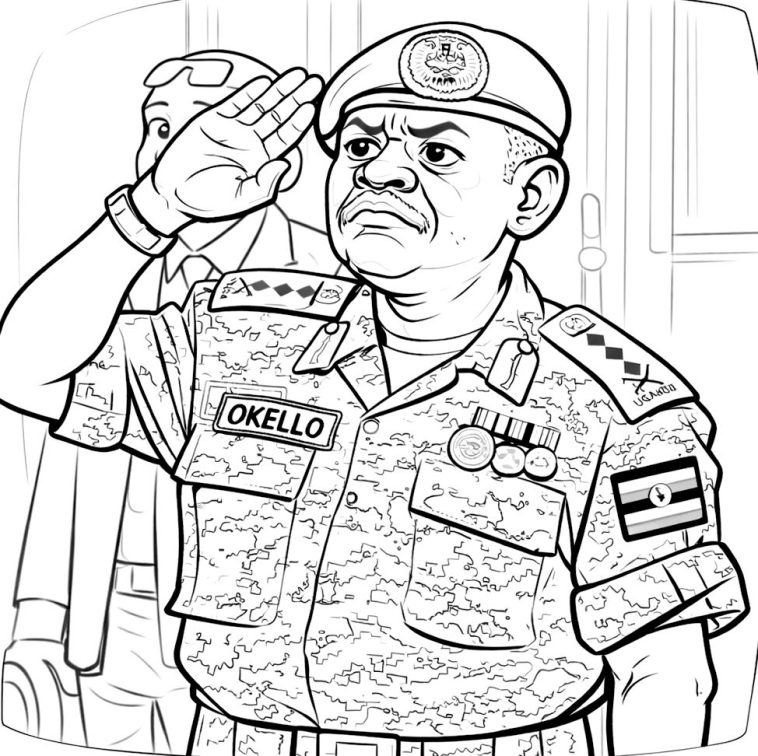
It was that habit that attracted a friend of mine—Major Felix Okello, son of Pastor Okello, a renowned evangelist born and raised in this part of the world, a man who knows well the terrain of this country and is well conversant with the different languages spoken in this part of the country.
Felix and I began sharing beers, which, was actually a mistake. We don’t drink and insult at the same time but anyway i did just that. Insulting and sharing a table with a man trained to kill is a big mistake unless you are tired of living this sweet country call home. i am not saying this because i am afraid of he or she but how about if the ghost that follows such men never truly rests; it can return without warning. A neck can be broken and later explained as protecting the state after all they are considered to be the property of the state.
Relax. That is a joke. I can already see some of you stiffening.
When Felix was Kelvin—dressed in plain civilian clothes—he was approachable, even pleasant. That was the man I drank with. That was the man who laughed easily. And that was when our debate erupted.
“Are you bulletproof?” he asked me once. “Do you know that I am trained to kill?”
Those were his words. He had been abroad for a long time, but his arrogance toward people like me—bloggers, TikTokers, Facebookers, or those social media fanatic and journalist trained or untrained—had not softened. If anything, distance had sharpened it and groomed it to hatred beyond imagination.
“Am not immortal or allergic to death and so are you, aren’t you?” I answered, “but why should we always waste the life that is supposed to put food on our table?” i do not know why i said these words but it made me feel uneasy and he could notice the trembling from my hand as i tried to swallow more dark liquid into my alimentary canal.
“you must be hangry. when did you last had a proper meal mr camera man?” He questioned me and smiled the way men smile when they believe history is on their side.His chick bone protruding out with more sip of the hamber golden liquid, Nile special bear to which i coined a definition to him. Never Intimidate Luo Elders… it actually sounded real.
As the dark Guinness settled warmly in my head, the arguments softened but never disappeared. We spoke of soldiers and civilians, of law and power. He insisted that a soldier on duty was not an officer of the law but the law itself, free to remove life if he wished. I told him that if all armed men decided to shoot the untrained, there would be no state left to protect. A failed stat i coined the tarm while looking him straight in the face.
“And without soldiers,” he asked, “will your loving state survive?”
That question stalled me. I scratched my head, feeling the alcohol blur the sharpness of my thoughts. Finally, I said the truth as gently as I could: that a soldier needs a civilian, and a civilian needs a soldier—to protect his life, his belongings, and the idea of tomorrow.
Felix nodded. Or perhaps Kelvin did. The names slipped easily now, as if they belonged to the same uniform worn inside out.
We ordered food—pork ribs, because roasted meat travels well with beer. I had always preferred pork. That was when Drake barged in, sudden and unapologetic, like a fly attacking a fresh heap of dung.
He reached for my ribs without asking, scanned the newspapers, misread a headline, corrected himself, and laughed. Soon enough, as with all ordinary men of youthful age, the interrogation drifted to women and football, as if beer, women, and football were one language spoken differently.
While we were still enjoying our Guinness at Arena Mall, Drake spoke again, almost lazily, as if commenting on the weather. He said there were roaches in the system. what ever he ment God forbid this man was not my kind of man and what was he doing where youth were, he was not my friend and he was fit enough to be my grandfather yet he was now gulping my beer without shame.
I had no idea what he talking about, what would rochet being in a system help me with, and whoever told him that i like music lied. so if rochet had eaten the sound system the bar would buy another one what is wrong with that? and if rochet was some political term, what was i to do with he or she for I was not a politician and had never tried to be one. Politics had always repelled me. I hated it with all my heart. To me, it was a dirty room where everyone pretended not to see what crawled along the walls.
Everything began to unfold around 7:45 p.m., the hour when tired civil servants drift back to their homes. On a normal evening, traffic thickens from Clock Tower to Kabalagala—engines groaning, horns arguing like old men. But this night was different. The city felt alert, as if it had paused to listen.
Drake was on it again. Once a spy, always a spy. Despite his age—and the physical limitations one might mistake for weakness—he had been working quietly all along. To my surprise, he had recruited men and women with visible disabilities, disguising them as beggars and garbage collectors. People the city had learned not to see. People no one ever questioned.
From the counter where we sat, phones began to vibrate softly, one after another. That was when I noticed it: Drake slipped on his sunglasses.
I didn’t understand why a man would hide his eyes in the dark.
Perhaps it was the Guinness, thick and patient in my blood, dulling the edges of reason. Perhaps it was instinct. But it occurred to me then that the darkness was not outside at all—it was something already awake, already moving, carried calmly behind those lenses.
Drake finally opened his mouth again, not to whisper or code, but to speak plainly, the way elders do when they want everyone to understand and still leave room for denial. He called for the waiter and bought us another round. The dark Guinness arrived, steady and unhurried. The room tilted slightly as I lifted my glass, sound softening into a distant hum.
Drake smiled and said, “When termites eat the roof, the house does not fall at once. It waits for the rain.”
Felix—Kelvin—nodded. I laughed, not because it was funny, but because the proverb had landed where facts could not. We drank. For a brief moment, Arena felt warm again, familiar. Home.
But even as the beer settled in my blood, I knew this much: when a man speaks in proverbs instead of warnings, the storm has already chosen its hour
Drake was a mole in the system, and these men were eating away mother africa through the game of espionage, i came to understand that from where we were sitting, the whole down town as well as railway station was vividly seen, perhaps it was the reason why kelvin and Drake were there. In fact they were on duty while i was drinking my pain away, they were absorbing knowledge after all mother africa was what these men were nibling away from page to page…
This post was created with our nice and easy submission form. Create your post!
Written by
Caesar Obong Ng'bong Ocen is a Ugandan writer whose work traverses narrative fiction, cultural memory, and moral inquiry. Drawing on African cosmologies, and reflective storytelling, his writing engages with issues of power, identity, faith, and the human condition within post‑conflict societies. His series blends political realism with interior psychological struggle, articulating the tensions between duty and conscience, tradition and modernity, exile, redemption. Obong Ng'bong's work bridges literary and social worlds: it interrogates African historical and political realities while exploring philosophical and ethical questions that resonate across disciplines. His narratives are grounded in cultural authenticity and moral depth, making them relevant to both literary and humanistic inquiry. He also mentors emerging writers and contributes to dialogue on African storytelling traditions and their place in contemporary literature.
Did this story move you? Every gift goes directly to Caesar Obong Ng'bong ocen — writers on Muwado earn from reader appreciation, not algorithms. Even $1 makes a difference.





Muwado weekly chart
Get Africa’s top 10 stories every Thursday
No account needed — just your email.
Want to follow Caesar Obong Ng'bong ocen and get notified every time they publish?
Create a free Muwado account →