

 Asha Mirriam

The liberation of South Africa in 1994 was celebrated far beyond its borders. Across the continent, Africans regarded the fall of apartheid as a collective victory, achieved not only through the courage of South Africans but also through decades of political, diplomatic, and economic support from independent African states. Countries that could scarcely afford the burden nonetheless contributed resources, hosted exiles, trained activists, and isolated the apartheid regime in international forums. South Africa emerged from this struggle carrying immense symbolic weight: it was expected to embody the ideals of human dignity, equality, and Pan-African solidarity.
Three decades later, that legacy is under severe strain.
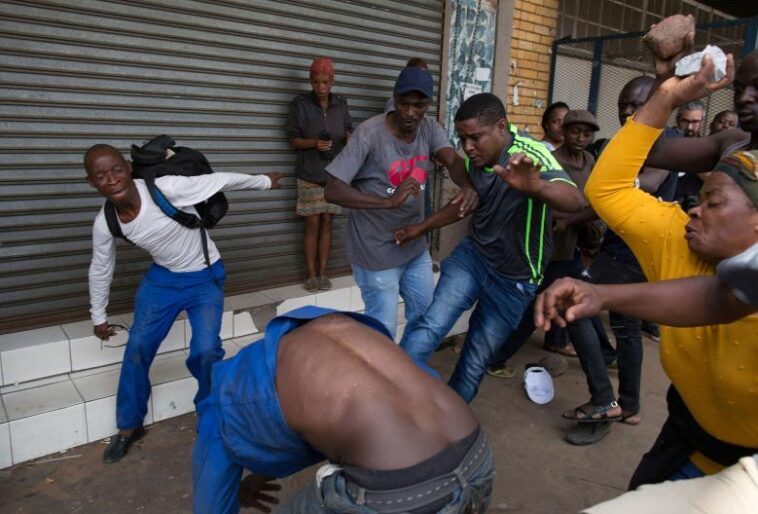
South Africa continues to confront legitimate challenges related to migration, unemployment, public service delivery, and economic stagnation. No serious observer disputes the state’s right to regulate its borders, process asylum applications, or remove individuals who do not possess legal status. Every sovereign nation exercises that authority. The crisis emerges when immigration enforcement ceases to be the responsibility of institutions and instead becomes the domain of street movements, vigilante groups, and angry crowds.
The distinction is fundamental. A constitutional democracy determines legal status through laws, courts, and administrative procedures. A mob determines legal status through suspicion, prejudice, and force.
In recent years, South Africa has increasingly witnessed the consequences of allowing that distinction to erode. Communities have experienced waves of anti-immigrant violence in which individuals are targeted not because of proven legal violations but because of accents, languages, surnames, or assumptions about their origins. The result is not merely hostility toward migrants. It is the breakdown of the rule of law itself.
The tragic death of Nhlamulo Sambo illustrates the danger with devastating clarity. During anti-immigrant unrest in Mossel Bay in May 2026, the eighteen-year-old South African student was reportedly pulled from a house and stabbed to death after vigilantes identified him as a foreigner. Yet Sambo was not a foreign national. He was a South African citizen from Limpopo. His alleged offense was speaking Xitsonga in a community where another language predominated. In the eyes of the crowd, linguistic difference became sufficient evidence of foreignness.
His death exposes a reality that many discussions of xenophobia fail to acknowledge. Once people begin deciding who belongs based on language, appearance, or cultural markers, xenophobia quickly mutates into something broader and more dangerous. It becomes a form of internal tribalism capable of consuming citizens and non-citizens alike. The target may initially be the migrant. Eventually, anyone who appears different becomes vulnerable.
The assault on Bernice Diana Akuffo reveals another dimension of the crisis. A Ghanaian entrepreneur who had spent two decades building a life and business in Johannesburg, Akuffo was brutally attacked inside her workshop because of her nationality. Her story demonstrates that legal residence, economic contribution, and years of community integration do not necessarily shield individuals from anti-foreigner violence. The issue is no longer whether someone has respected the law. The issue becomes whether a crowd chooses to recognize their humanity.
Defenders of anti-immigrant vigilantism frequently point to unemployment, poverty, and pressure on public services as explanations for such violence. South Africa’s economic difficulties are indeed severe. Persistent unemployment, inequality, infrastructure challenges, and slow economic growth have generated widespread frustration. These realities deserve serious policy attention.
However, economic hardship alone cannot explain xenophobic violence.
If poverty automatically produced anti-foreigner attacks, many African countries would display similar patterns. Yet across the continent, states facing significant economic constraints continue to host large migrant and refugee populations without recurring campaigns of mob violence.
Uganda offers an instructive example. Kampala is home to substantial communities of Eritrean, Ethiopian, Somali, Congolese, South Sudanese, and other foreign nationals. In neighborhoods such as Kansanga, Kabalagala, and Kisenyi, migrants have established businesses, places of worship, restaurants, and social networks alongside Ugandan residents. Uganda itself faces economic pressures, youth unemployment, governance challenges, and competition for limited resources. Nevertheless, these conditions have not produced a recurring culture in which crowds patrol streets searching for individuals to attack based on accent or nationality.
This comparison does not suggest that Uganda is free from social tensions or migration-related challenges. No country is. Rather, it demonstrates an important principle: economic hardship may contribute to public frustration, but it does not inevitably lead to xenophobic violence. Societies make choices about how they respond to pressure. Governments make choices about how they enforce immigration laws. Citizens make choices about whether to channel grievances through democratic institutions or through vigilantism.
The decisive difference is not the existence of migration. It is the response to migration.
A useful illustration can be found in a security operation conducted in Bukoto, Kampala, in April 2026. During the operation, Ugandan immigration authorities arrested numerous undocumented foreign nationals from a residential complex. The significance of the operation was not the number of arrests but the method by which they were conducted.
The enforcement process remained entirely under state control. Uniformed officers carried out the operation. Detainees were transferred to immigration facilities for screening. Authorities distinguished between different categories of individuals rather than treating everyone as a criminal. Legal procedures followed. Courts became involved. Deportation orders were issued through established administrative mechanisms. Landlords who violated relevant regulations also faced consequences.
Reasonable people may debate specific aspects of immigration policy. They may disagree about detention procedures, deportation practices, or legal standards. Yet the operation demonstrated a critical democratic principle: the state maintained a monopoly over the use of force.
No civilian groups were empowered to identify suspects. No mobs conducted interrogations. No crowds determined guilt based on language or appearance. Immigration enforcement remained an institutional process governed by law.
This is ultimately the lesson South Africa must confront. The question is not whether immigration should be regulated. The question is who possesses the authority to regulate it.
When governments fail to manage migration effectively, public frustration naturally increases. Yet ineffective governance does not justify transferring state powers to self-appointed vigilantes. The moment crowds assume responsibility for identifying, judging, and punishing alleged foreigners, constitutional government begins to yield to arbitrary power.
The consequences extend beyond individual acts of violence. They damage social cohesion, undermine investor confidence, weaken regional relationships, and erode a country’s moral authority. They also carry profound diplomatic costs.
For many Africans outside South Africa, the current situation is particularly painful because it appears to contradict the spirit of Pan-African solidarity that once defined the anti-apartheid struggle. Citizens from countries that supported South Africa’s liberation now watch fellow Africans face intimidation, assault, and exclusion within the continent’s most industrialized economy. This perception has strained relations and generated growing criticism from governments, civil society organizations, and ordinary citizens across Africa.
The response from continental institutions reflects this concern. African human rights bodies have increasingly condemned xenophobic violence and called for stronger protections. Governments have raised the issue through diplomatic channels. What was once viewed primarily as a domestic problem is increasingly being discussed as a continental challenge affecting the credibility of African integration itself.
This development is significant because South Africa occupies a unique place in the African imagination. For decades, it represented a powerful symbol of resistance against racial oppression. Its constitutional framework became a model admired throughout the world. Expectations for South Africa have always been unusually high precisely because its democratic transition carried such profound moral significance.
That legacy is not beyond repair. South Africa remains home to vibrant civil society organizations, courageous journalists, constitutional institutions, and millions of citizens who reject xenophobia. The country’s future is not predetermined. Yet preserving its democratic achievements requires a firm rejection of the idea that crowds can exercise powers reserved for the law.
The central issue is therefore not immigration. Every state possesses the right to determine who may enter, remain within, or depart from its territory. The central issue is whether those decisions will be made by institutions accountable to law or by individuals accountable only to anger.
The killing of Nhlamulo Sambo offers a stark warning. When a society permits mobs to decide who belongs, the distinction between citizen and foreigner becomes dangerously fragile. Eventually, belonging is no longer determined by legal status but by the prejudices of whoever happens to hold power in the street.
South Africa once stood as a beacon of freedom for an entire continent. The challenge before it today is not simply to manage migration more effectively. It is to reaffirm a foundational democratic principle: that human dignity, citizenship, and justice must be protected by law rather than surrendered to the passions of a crowd.
The future of Pan-African solidarity may depend on that choice.
This post was created with our nice and easy submission form. Create your post!

Written by
Asha Mirriam is a creative writer passionate about African story telling, social justice and emotionally rich narratives
Did this story move you? Every gift goes directly to Asha Mirriam — writers on Muwado earn from reader appreciation, not algorithms. Even $1 makes a difference.






Muwado weekly chart
Get Africa’s top 10 stories every Thursday
No account needed — just your email.
Want to follow Asha Mirriam and get notified every time they publish?
Create a free Muwado account →