

 Oweyegha Afunaduula

Abstract
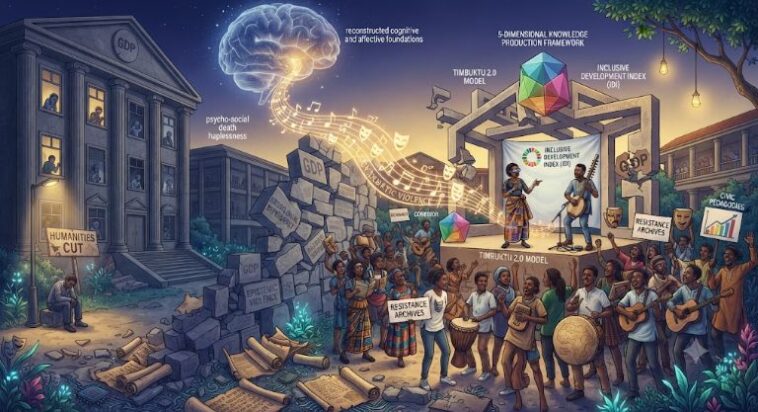
This article posits that comedy and music are not ephemeral entertainments but foundational instruments of holistic liberation. Drawing on the 5-Dimensional Knowledge Production Framework and the 4-Dimensional Environmental Framework, we argue that the systematic marginalisation of the Humanities—particularly performance arts—constitutes a form of epistemic violence that perpetuates neocolonial dependency, intellectual death, and psycho-social haplessness. Through a global-regional-national analysis, with particular focus on Uganda, the paper demonstrates how comedy and music have historically functioned as resistance archives, civic pedagogies, and resilience mechanisms. It critiques the contemporary political co-optation of these arts and proposes a new curriculum design—the “Timbuktu 2.0 Model”—to institutionalise their transformative potential. The article advances the Inclusive Development Index (IDI) as a more holistic metric than GDP, arguing that cultural vitality and psycho-emotional wellbeing are indispensable indicators of genuine progress. Ultimately, we contend that comedy and music can erase hopelessness, dismantle fear, and construct the cognitive and affective foundations of an open, just, and flourishing society for present and future generations.
Key Words
Humanities, Comedy, Music, Liberation, Uganda, Inclusive Development Index (IDI), 5-Dimensional Knowledge, Timbuktu Model, Neocolonialism, Intellectual Death, Curriculum Design, Resilience, Social Transformation.
1. Introduction: The Fifth Dimension of Struggle
“I would rather have 1,000 men with guns attacking me than one man with a pen.”
— Napoleon Bonaparte (attributed)
If Napoleon feared the pen, what should tyrants fear of the microphone and the punchline? The pen, after all, is mightier than the sword (Bulwer-Lytton, 1839), yet comedy and music wield a power more subversive still: they bypass the rational censors and speak directly to the affective and collective unconscious. In the pantheon of liberation struggles, we honour the gun, the ballot, and the strike. We rarely honour the joke and the song. Yet, as we invoke the 5-Dimensional Knowledge Production Framework (Oweyegha-Afunaduula, 2015), we must recognise that liberation is not merely a physical or economic transaction; it is a psychological and spiritual re-birth. To ignore comedy and music is to fight a 3-dimensional war in a 5-dimensional universe.
We argue, through the Timbuktu Model of holistic scholarship (Oweyegha-Afunaduula, 2018), that the arts are not the decoration of liberation—they are its engine. The 4-Dimensional Environmental Framework (Oweyegha-Afunaduula, 2016) demands we view our struggle across Space (global-regional-national), Time (past-present-future), Matter (physical resources), and Energy (psycho-social vitality). Comedy and Music are the “Energy” that transforms inert matter into movement. They are the antidote to what we term “intellectual death”—the suffocation of the spirit that precedes physical oppression (Fanon, 1963). To defend the Humanities is to defend the very possibility of imagining a world beyond the present misery.
2. The Timbuktu Model: An Explicit Exposition
Before we proceed with our global-regional-national analysis, it is imperative to elucidate the foundational philosophical architecture upon which this entire argument rests. We refer, of course, to the Timbuktu Model. Given the epistemic violence of colonial education that has systematically erased African intellectual traditions, we must explain this model with the explicit clarity it deserves—as though we are introducing it for the first time to a world that has forgotten its own wisdom.
2.1 Historical Origins: More than a City, an Epistemology
Timbuktu, the legendary city in present-day Mali, was not merely a commercial hub for gold and salt. Between the 13th and 17th centuries, it was the intellectual capital of the African continent. The University of Sankore, the Djinguereber Mosque, and the Sidi Yahya Mosque housed hundreds of thousands of manuscripts spanning astronomy, mathematics, medicine, law, theology, poetry, and music (Hunwick, 2003). Scholars from across the Islamic world and Africa converged there.
Critically, however, the Timbuktu Model is not a nostalgic return to the past. It is a methodological framework that extracts the pedagogical DNA of that era—namely, the integration of disciplines—and transplants it into contemporary problem-solving. The historical Timbuktu did not separate the scientist from the poet, the jurist from the musician, or the theologian from the astronomer. Knowledge was understood as a seamless web; to be educated was to be conversant across domains.
2.2 The Core Principles of the Timbuktu Model
We distil the Timbuktu Model into six operational principles:
Principle 1: The Unity of Knowledge
There is no sacred divide between the “hard” sciences and the “soft” arts. Physics and poetry both seek truth—one through measurement, the other through metaphor. Chemistry and music both explore rhythm and transformation. In Timbuktu, astronomy was practiced alongside astrology, and medicine alongside spirituality. Today, we must reject the Cartesian bifurcation that places the mind over the body, the rational over the emotional, the scientific over the artistic. Comedy and music are not extracurricular; they are co-extensive with cognition itself.
Principle 2: The Primacy of Purpose over Discipline
In the Timbuktu tradition, scholars did not ask, “What discipline do I belong to?” They asked, “What problem am I solving?” If a community faced drought, the astronomer, the spiritual leader, and the agriculturalist sat together. If a ruler faced rebellion, the historian, the poet, and the jurist collaborated. Today, our universities are silos. The Timbuktu Model demands that we organise knowledge around problems—poverty, disease, oppression—not around departmental budgets.
Principle 3: Orality and Writtenness in Dialogue
Timbuktu was both a manuscript culture and an oral culture. Scholars wrote treatises, but they also recited poetry, debated publicly, and used music to memorise complex texts. The Griot—the West African bard—was as respected as the Qadi (judge). This model insists that comedy and music are legitimate knowledge vehicles. A song about land rights is not less valid than a legal brief; it is merely a different genre of truth-telling.
Principle 4: The Indigenisation of Knowledge
The scholars of Timbuktu did not merely import Arab or Greco-Roman knowledge; they translated, adapted, and indigenised it. They wrote commentaries in local languages. They integrated local herbal knowledge with Islamic medicine. For Uganda, this means that we must not ape Western curricula. We must develop knowledge systems rooted in our soils—our languages, our rhythms, our proverbs. Liberation begins when we stop seeing ourselves through foreign eyes.
Principle 5: The Ethical Foundation of All Knowledge
In Timbuktu, knowledge was never neutral. It was always in service of Tawhid (divine unity) and Maslaha (public good). Scholars were judged not by their publication count but by their contribution to community wellbeing. Today, we have knowledge without conscience—scientists who build weapons, economists who design inequality. The Timbuktu Model insists that knowledge must liberate, not enslave.
Principle 6: The Generational Contract
Timbuktu scholars understood that they were custodians of knowledge for future generations. They wrote manuscripts not for their contemporaries alone but for the “people of the future.” This is the futurity principle. When we design curricula today, we must ask: What knowledge, what songs, what jokes will our grandchildren need to resist the oppressions of their time?
2.3 The Timbuktu Model in Contemporary Practice
Operationalising the Timbuktu Model today requires a radical restructuring of our educational and cultural institutions. It means:
· In Universities: Abolishing the “Faculty of Arts” and “Faculty of Sciences” as separate entities. Creating Team Sciences Centers where a problem (e.g., malaria eradication) is addressed by a team comprising an entomologist, a musician (to compose awareness songs), a comedian (to create stigma-busting skits), a sociologist, and a public health expert. The team is judged by its impact on malaria rates, not by its disciplinary purity.
· In Schools: Teaching mathematics through drumming (rhythm as ratio), teaching history through dramatised re-enactments, teaching civics through satirical role-play. The child who can compose a protest song about a corrupt school prefect is demonstrating higher-order critical thinking than the child who merely memorises a textbook.
· In Communities: Establishing parish-level “Timbuktu Circles” —weekly gatherings where elders, youth, musicians, and comedians discuss community problems and craft cultural responses. These circles are not “entertainment”; they are deliberative democratic assemblies in cultural form.
· In Policy: Governments should fund arts not as “culture” (a decorative afterthought) but as infrastructure. A national music archive is as important as a national road network. A comedy festival is as vital as a trade fair. Both build the psycho-social capital that underpins economic productivity.
2.4 Why the Timbuktu Model is Essential for Our Argument
Our central thesis—that comedy and music are weapons of mass liberation—is unintelligible without the Timbuktu Model. Why? Because the conventional (Western, Cartesian) model of knowledge relegates comedy and music to the realm of “entertainment”—trivial, non-utilitarian, optional. The Timbuktu Model, by contrast, locates them at the very centre of human cognition and social reproduction.
When we say that music can fight disease, the Timbuktu Model provides the philosophical justification: because health is not merely biological but spiritual and communal. When we say that comedy can fight tyranny, the Timbuktu Model provides the pedagogical rationale: because satire is a form of ethical reasoning, training the citizen to distinguish justice from its counterfeit. Without this model, our argument collapses into romanticism. With it, our argument becomes epistemologically rigorous.
3. A Global-Regional-National Triptych of Sound and Laughter
Having established the philosophical architecture, we now apply it across scales.
3.1 The Global Stage
Globally, from the spirituals of enslaved Africans in America that mapped the Underground Railroad (Du Bois, 1903), to the Griot traditions of West Africa that preserved history against colonial erasure (Hale, 1998), music has been the archive of resistance. Comedy, from the satirical plays of Aristophanes (c. 411 BCE) to the incisive wit of Richard Pryor, has punched holes in the armour of totalitarianism. These are not diversions; they are psychological warfare against the oppressor’s claim to supremacy.
In Latin America, the nueva canción movement—exemplified by Violeta Parra and Victor Jara—used folk music to expose the brutality of military juntas (Morris, 1986). In Eastern Europe, underground punk rock became the soundtrack of resistance against Soviet hegemony (Ramet, 1994). In each context, the pattern is consistent: when formal political channels are closed, the arts become the public square.
3.2 The Regional African Context
Regionally, in Africa, we witnessed the Soukous of Congo challenge Mobutu’s authenticity, and the Chimurenga music of Zimbabwe that was the soundtrack to the liberation war (Turino, 2000). In South Africa, the toyi-toyi was a dance of defiance; Miriam Makeba’s voice was more threatening to apartheid than a battalion (Muller, 2008). The African Renaissance, as envisioned by Mbeki (1998), cannot occur without the renaissance of African performative epistemologies—precisely what the Timbuktu Model champions.
Nigeria’s Fela Kuti used Afrobeat to indict military corruption with a ferocity that no newspaper could match (Olorunyomi, 2003). His music was not protest; it was a parallel legal system, naming and shaming the powerful in a language that resonated with the masses. Senegal’s mbalax tradition, popularised by Youssou N’Dour, similarly fused traditional rhythms with modern political commentary, creating a sonic space where citizenship was rehearsed (Shain, 2002).
3.3 The Ugandan National Experience
Nationally, in Uganda, the trajectory is vivid and instructive:
· The Past (Historical Deployment): Under the regimes of Idi Amin (1971-1979) and Obote II (1980-1985), silence was survival. Yet, in the shadows, the Acholi war cries and the Luganda Kadodi rhythms carried coded messages of resilience. Comedians, though persecuted, used proverbs and riddles to mock tyranny indirectly (Ssenkumba, 2009). Music like that of Elly Wamala and later Philly Bongoley Lutaaya spoke to the soul of a nation bleeding from civil war. Lutaaya’s openness about HIV/AIDS, through music, was a liberation from stigma (Kyakuwa, 2009). The Emita tradition—a form of folk opera—was used to convey moral and social lessons, often with biting satire directed at chiefs and colonial administrators.
· The Present (Contemporary Deployment): Today, we see a bifurcation. On one side, “commercial” music and comedy that anaesthetises the populace—what Adorno (1941) would call the “culture industry”—producing escapism rather than critique. On the other, artists like Bobi Wine have deployed music as a direct political tool, facing state repression (Human Rights Watch, 2021). Comedians are using social media to deconstruct the absurdity of political corruption and economic disparity. However, this is under siege—many are self-censoring for fear of “disappearing.” The political invasion of comedy and music—where the state attempts to co-opt artists through patronage, invitations to State House, and selective funding—has muted the critical edge of many, creating a crisis of credibility (Titeca, 2022). The impact on liberation is profound: when the people’s artists become the regime’s entertainers, the people lose their voice.
· The Future (Potential Deployment): We envision a Uganda where the Emita is digitised to teach constitutional rights. Where comedy clubs in Kampala become civic education forums. Where music is used in rural areas to explain fiscal policy and agricultural transformation. Liberation from poverty requires translating complex budgets into catchy, comprehensible tunes—a principle fully aligned with the Timbuktu Model’s emphasis on orality. Imagine a song that explains the difference between a loan and a grant, or a skit that dramatises the consequences of land grabbing. This is not merely possible; it is imperative.
4. Liberation from What? A Taxonomy of Oppression
We are not merely fighting a political figure or a single regime. We are fighting a constellation of interlocking oppressions that the Timbuktu Model helps us name and address:
1. Neocolonialism: The debt trap and structural adjustment programmes that dictate policy from Washington and Brussels (Nkrumah, 1965; Ake, 1996). Comedy exposes the absurdity of foreign experts who know nothing of our context; music gives voice to the farmer whose crops are dictated by IMF conditionalities.
2. Ignorance: The belief, systematically cultivated through miseducation, that we are incapable of self-governance and innovation (Ngũgĩ wa Thiong’o, 1986). Comedy challenges this by showing African brilliance; music celebrates indigenous knowledge systems.
3. Disease: Both the biological and psycho-somatic effects of chronic stress and poverty (Singer et al., 1999). Music heals by creating community; comedy heals by releasing trauma through laughter (Coser, 1962).
4. Intellectual Death: The reduction of a human being to a mere economic unit—Homo economicus—stripped of creativity, memory, and spiritual aspiration (Said, 1978). Comedy and music resuscitate the soul, reminding us that we are more than our labour.
5. Occupation: Whether military occupation or the occupation of the mind by foreign epistemologies. Music and comedy are acts of re-territorialisation—reclaiming our cognitive space.
6. Political Repression: The silencing of dissent through violence, detention, and exile. Comedy and music are the whisper that becomes a roar, the coded message that the censor cannot fully erase.
Comedy and music address each of these. They expose neocolonial hypocrisy. They challenge ignorance by making knowledge pleasurable. They heal disease through psycho-social solidarity. And they resuscitate intellectual life by reconnecting reason to emotion, and thought to rhythm.
5. The Killing of the Humanities and the De-fanging of the Arts
The global shift towards STEM (Science, Technology, Engineering, and Mathematics) at the expense of the Humanities constitutes an epistemicide (Santos, 2014). When we sacrifice History, Literature, and Philosophy for STEM at the altar of “employability,” we produce efficient technicians, not liberated citizens. A nation of engineers without ethicists builds bombs, not bridges. A nation of doctors without storytellers cannot heal the soul.
The killing of the Humanities kills the context for comedy and music. It turns music into noise and comedy into slapstick. Without the Humanities, music and comedy lose their “why” and degenerate into mere “how.” The Timbuktu Model offers the corrective: reintegrate the disciplines. The curriculum must be rebalanced to recognise that innovation is ultimately a humanistic endeavour (Nussbaum, 2010). The greatest scientists—from Einstein to Feynman—were also artists, musicians, and philosophers.
In Uganda, the marginalisation of the Humanities in favour of “practical” subjects has led to a generation that cannot critique, cannot contextualise, and cannot imagine alternatives. This is not accidental; it is by design. A populace that cannot think critically is a populace that cannot resist. Comedy and music are the antidote to this manufactured passivity.
6. Comedy and Music as Transformative Educational Tools
While Napoleon feared the pen, we argue that comedy and music can be the most effective educational tools, if taken seriously. Paulo Freire (1970) taught us that education is either the practice of freedom or the practice of domination. Comedy and music, when deployed critically, are the practice of freedom.
· Music as Pedagogy: Rhythm aids memory (mnemonic devices). Lyrics convey complex socio-political critiques in accessible vernaculars. Music engages the body, breaking the passivity of the “banking model” of education (Freire, 1970). In the Timbuktu tradition, the Griot was the living library; music was the binding agent. Consider how easily we remember songs from childhood; imagine if those songs taught us our rights, our history, our responsibilities.
· Comedy as Critical Thinking: Satire forces the audience to deconstruct the gap between appearance and reality. It trains the mind to identify logical fallacies, hypocrisy, and absurdity—the very building blocks of autocracy. A joke is a compressed syllogism; understanding it is an intellectual act (Critchley, 2002). The comedian who mocks a politician’s promise is performing a service no opposition party can match: they are making the lie visible.
· Comedy and Music as Civic Education: In societies where formal civic education is often propaganda, comedy and music provide an alternative, subterranean curriculum. They teach citizenship by example—showing what courage looks like, what solidarity feels like, what injustice sounds like.
7. Erasing Haplessness, Building Futurity
Hopelessness is the oxygen of tyranny (Gramsci, 1971). When people believe the future is predetermined, they submit. When they believe change is impossible, they do not even try. Music and Comedy are radical acts of hope.
· Music provides the rhythm of collective action. It synchronises heartbeats, creating a “we” out of a collection of “I’s” (Turino, 2008). It speaks to the affective domain—the feeling of liberation before the fact. In protest marches, music turns a crowd into a movement. In villages, music turns isolated individuals into a community.
· Comedy provides the cognitive reframe. It forces us to see the emperor has no clothes. It releases endorphins that break the trauma bond of fear (Coser, 1962). In fighting fear and silence, a joke is a grenade; it explodes the illusion of the oppressor’s omnipotence. The moment we laugh at power, we have diminished it.
In Uganda, after the insurgencies—the Luwero Triangle, the Northern Uganda war—the only therapy available in the villages was the communal fire, the drum, and the storytelling. We neglected this for Western psychiatric models; we must reintegrate the local as a form of resilience (Summerfield, 1999). Healing is not just individual; it is communal. Music and comedy are communal healing practices.
8. Beyond GDP: The Inclusive Development Index (IDI)
If we are to measure liberation, we must move beyond the Gross Domestic Product (GDP) (Stiglitz et al., 2009). GDP measures the economy but not the health of the soul. A country can have rising GDP and rising inequality, rising depression, rising environmental degradation. We propose the Inclusive Development Index (IDI) , which incorporates:
· Economic growth (measured equitably, not just as aggregate, but with a Gini coefficient component).
· Life expectancy and mental health (including rates of depression, suicide, and psycho-social wellbeing).
· Educational attainment and cultural participation (not just years of schooling, but quality of education and engagement with the arts).
· Environmental sustainability (measured through ecological footprint and biodiversity indices).
· Psycho-social vitality: measured by the prevalence of cultural festivals, community music-making, public satire, and laughter. A society that cannot laugh together is not developed. A society that has lost its song has lost its memory.
The Timbuktu Model is the operational framework for achieving a high IDI, because it places cultural and spiritual wellbeing at the heart of development planning. Uganda’s National Development Plan must include a cultural indicator. If we are not measuring the health of our souls, we are measuring the wrong things.
9. Comedy, Music, and the Open Society
An Open Society (Popper, 1945) is one where dialogue is free, dissent is not treason, and citizens can publicly challenge power without fear. Comedy and Music are the most democratic forms of dialogue. They are accessible to the illiterate and the elite alike. They require no formal education to produce or consume. They build resilience by allowing communities to process trauma collectively. They are the arteries of civil society, keeping the body politic healthy through circulation of ideas.
In an Open Society, the comedian is not a threat but a public servant—the jester who reminds the king of his mortality. The musician is not a propagandist but a truth-teller. Uganda’s journey towards an Open Society is incomplete without the full flourishing of its comedic and musical traditions. The state that fears the joke is the state that knows it is illegitimate.
10. A New Curriculum Design: The “Timbuktu 2.0” Model
Drawing explicitly from the Timbuktu Model’s six principles, we propose a radical curriculum redesign for Primary, Secondary, and Tertiary levels:
The “Timbuktu 2.0” Curriculum Framework
Level Integration Strategy Learning Outcomes Timbuktu Principle Applied
Primary “Edutainment Core”: Mathematics via rhythmic clapping (Music); History via dramatised storytelling (Comedy); Language via song composition. Multiplication through drums; ethical values through characters they create and mock; vocabulary through lyrics. Unity of Knowledge; Orality in Dialogue.
Secondary “Critical Arts”: Mandatory subject: “Satire and Civic Literacy.” Students analyse current socio-economic issues via satirical essays and protest songs. Performance-based assessments. Development of critical thinking; deconstruction of political rhetoric; courage in public speaking; understanding of power structures. Primacy of Purpose; Ethical Foundation.
University “Team Sciences Centers”: Abolish disciplinary silos. Physics and Music co-teach “Acoustic Engineering and Cultural Preservation.” Political Science and Theatre co-teach “Performance and Power.” Medicine and Music co-teach “Music Therapy and Community Health.” Polymathic graduates; culturally-attuned solutions to Ugandan problems; graduates who can speak across disciplines. Unity of Knowledge; Indigenisation.
Continuing Ed “Community Sound Systems”: Every parish is provided a solar-powered sound system and a script bank of liberation songs/jokes for development topics (malaria, tax compliance, conservation, gender equality). Local artists are trained as “community educators.” Grassroots transformation; health and economic progress through cultural engagement; demystification of expert knowledge. Generational Contract; Primacy of Purpose.
This model draws from the Team Sciences Center philosophy, which insists that complex problems require transdisciplinary teams, and the Timbuktu Model, which celebrates the historical African tradition of integrated scholarship. It is not a luxury; it is a necessity for a country that wants to leapfrog into the future.
11. Raising the Status of Comedy and Music in Collective Life
How do we elevate comedy and music from the margins to the centre of our collective life and hope?
1. Institutional Recognition: Establish a National Academy of Arts and Liberation, with the same prestige as the Uganda National Academy of Sciences. Award fellowships to comedians and musicians who contribute to social transformation.
2. Economic Investment: Provide micro-grants and tax incentives for artists whose work addresses social issues. Recognise that cultural production is an industry, but also a public good.
3. Educational Integration: As outlined in the Timbuktu 2.0 curriculum, make comedy and music integral to all levels of education—not as electives, but as core subjects.
4. Legal Protection: Strengthen laws that protect artistic freedom. Decriminalise satire. Ensure that no artist is imprisoned for a joke or a song.
5. Cultural Festivals: Transform existing cultural festivals into civic forums—spaces where the community discusses its future through art. The Kampala Comedy Festival, the Bayimba Festival, and others should have dedicated tracks for civic education.
6. Digital Platforms: Leverage social media and local broadcasting to amplify liberation-focused comedy and music. Create a national streaming platform that prioritises Ugandan content with developmental themes.
7. Intergenerational Dialogue: Bring elders and youth together through music and comedy. The Acholi Nanga (bow harp) can teach the young about resilience; the young can teach the elders about new media. The Timbuktu Model’s generational contract is enacted here.
—
12. Conclusion: The Whole is Greater than its Parts
We conclude with the foundational principle: The Whole is Greater than its Parts. A nation is not GDP plus security plus infrastructure. A nation is hope plus memory plus courage. Comedy and Music are the vessels of these intangibles. If we kill the Humanities, we kill the soul. If we integrate them, we ignite the spirit.
As Napoleon intuitively knew, the most dangerous weapon is not the bullet but the idea. Comedy and Music are ideas set to rhythm and wit. They are the most effective educational tools precisely because they educate without the appearance of teaching. They liberate without the appearance of rebellion. They are, in the deepest sense, the Timbuktu Model in action—uniting reason and emotion, science and art, past and future.
Uganda’s future generation does not need a new constitution as much as it needs a new song; it does not need a new parliament as much as it needs a new joke that exposes the hypocrisy of the old. Let us move beyond the “Beyond Scope” fallacy (Capra & Luisi, 2014). Everything—physics, poetry, politics, and punchlines—is connected. Let us build an education system that acknowledges that, and we will build a liberation that is total, transformative, and timeless.
For the Present and Future Generation, the time to laugh and sing is now. For in that laughter and song, we find our freedom.
References
Adorno, T. W. (1941). On Popular Music. Studies in Philosophy and Social Science, 9(1), 17-48.
Ake, C. (1996). Democracy and Development in Africa. Brookings Institution Press.
Aristophanes. (c. 411 BCE). Lysistrata. (Various translations).
Bulwer-Lytton, E. (1839). Richelieu; or, The Conspiracy. Saunders and Otley.
Capra, F., & Luisi, P. L. (2014). The Systems View of Life: A Unifying Vision. Cambridge University Press.
Coser, R. L. (1962). The Functions of Social Conflict. The American Journal of Sociology, 68(1), 33-42.
Critchley, S. (2002). On Humour. Routledge.
Du Bois, W. E. B. (1903). The Souls of Black Folk. A.C. McClurg & Co.
Fanon, F. (1963). The Wretched of the Earth. Grove Press.
Freire, P. (1970). Pedagogy of the Oppressed. Continuum.
Gramsci, A. (1971). Selections from the Prison Notebooks. International Publishers.
Hale, T. A. (1998). Griots and Griottes: Masters of Words and Music. Indiana University Press.
Human Rights Watch. (2021). “We Are Not Safe”: State Repression of Opposition and Civil Society in Uganda. HRW Report.
Hunwick, J. O. (2003). Timbuktu and the Songhay Empire: Al-Sa’di’s Ta’rikh al-Sudan down to 1613. Brill.
Kyakuwa, M. (2009). Philly Lutaaya: The Musician Who Fought Stigma. In Uganda’s HIV/AIDS Memorial. Fountain Publishers.
Mbeki, T. (1998). Africa: The Time Has Come. Tafelberg Publishers.
Morris, N. (1986). Canto porque es necesario cantar: The New Song Movement in Chile, 1973-1983. Latin American Research Review, 21(2), 117-136.
Muller, C. (2008). South African Music: A Century of Traditions in Transformation. ABC-CLIO.
Ngũgĩ wa Thiong’o. (1986). Decolonising the Mind: The Politics of Language in African Literature. James Currey.
Nkrumah, K. (1965). Neo-Colonialism: The Last Stage of Imperialism. Thomas Nelson & Sons.
Nussbaum, M. C. (2010). Not for Profit: Why Democracy Needs the Humanities. Princeton University Press.
Olorunyomi, S. (2003). Afrobeat!: Fela and the Imagined Continent. Africa World Press.
Oweyegha-Afunaduula, F. (2015). The 5-Dimensional Knowledge Production Framework. Makerere University Press.
Oweyegha-Afunaduula, F. (2016). The 4-Dimensional Environmental Framework for Sustainable Development. Journal of African Environmental Studies, 3(1), 1-15.
Oweyegha-Afunaduula, F. (2018). The Timbuktu Model: Reintegrating African Epistemologies. Pan-African University Press.
Popper, K. (1945). The Open Society and Its Enemies. Routledge.
Ramet, S. P. (1994). Rocking the State: Rock Music and Politics in Eastern Europe and Russia. Westview Press.
Said, E. W. (1978). Orientalism. Pantheon Books.
Santos, B. de S. (2014). Epistemologies of the South: Justice Against Epistemicide. Routledge.
Shain, R. M. (2002). Youssou N’Dour: A Biography. In Popular Music and Society, 26(1), 45-62.
Singer, M., et al. (1999). The Health Consequences of Stress. Journal of Health Psychology, 4(5), 561-578.
Ssenkumba, J. (2009). Culture and Resistance in Uganda: The Role of Oral Traditions. In Ugandan Studies. Makerere University.
Stiglitz, J. E., Sen, A., & Fitoussi, J. P. (2009). Report by the Commission on the Measurement of Economic Performance and Social Progress. The Commission.
Summerfield, D. (1999). A Critique of Western Trauma Models in the Developing World. In Trauma and Health. Routledge.
Titeca, K. (2022). The Politics of Art in Uganda: Co-optation and Resistance. African Affairs, 121(483), 1-23.
Turino, T. (2000). Nationalists, Cosmopolitans, and Popular Music in Zimbabwe. University of Chicago Press.
Turino, T. (2008). Music as Social Life: The Politics of Participation. University of Chicago Press.
–
This post was created with our nice and easy submission form. Create your post!
Written by
I am a retired lecturer of zoological and environmental sciences at Makerere University. I love writing and sharing information.
Did this story move you? Every gift goes directly to Oweyegha Afunaduula — writers on Muwado earn from reader appreciation, not algorithms. Even $1 makes a difference.





Muwado weekly chart
Get Africa’s top 10 stories every Thursday
No account needed — just your email.
Want to follow Oweyegha Afunaduula and get notified every time they publish?
Create a free Muwado account →