

 Tema Innocent

In the shadow of Mount Elgon, where mist clings to the ridges like ancestral breath and the soil is both a blessing and a curse, two nations stood on the edge of calamity. The rains came in late October 2025—not the gentle kind that nourishes crops, but the kind that awakens the mountain’s fury. Landslides thundered down the slopes, swallowing homes, dreams, and lives. But what followed was not just a natural disaster—it was a revelation of political will, or the lack thereof.
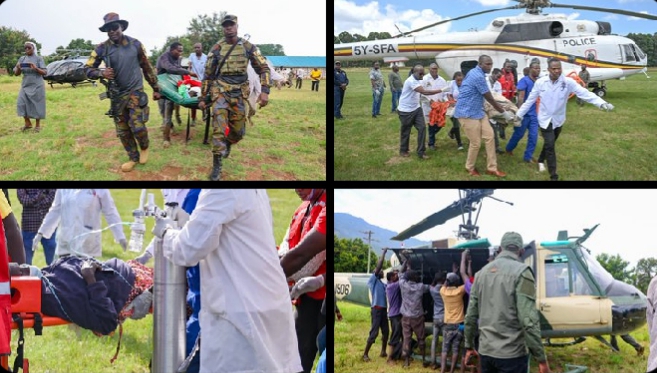
On the Kenyan side, in Elgeyo Marakwet County, the village of Chesongoch bore the brunt of nature’s wrath on November 1. At least 22 lives were lost, 29 people vanished beneath the mud, and 21 more were injured. But even before the sun rose, the air was filled with the roar of helicopters. President William Ruto’s government moved with urgency. Military trucks rumbled in, ambulances wailed through the night, and floodlights pierced the darkness as soldiers and medics clawed through the debris. The President tweeted condolences and updates, his words backed by action. Government spokesperson Isaac Mwaura addressed the nation from Eldoret Airstrip, flanked by governors and aid workers. Donations flowed. Hope flickered.
Across the invisible border, in Uganda’s Sebei sub-region—Bukwo, Kapchorwa, and Kween districts—the same mountain wept. In Chesower sub-county, four homesteads were buried. At least 15 people died, more than 15 were missing, and thousands were displaced. But here, there were no choppers. No convoys. No floodlights. Only silence, broken by the cries of villagers digging with hoes, sticks, and bare hands. The same soil that had once fed them now demanded their loved ones in return.
Daniel Kibet, a journalist born of this soil, could not stay silent. His viral thread on X (formerly Twitter) became the voice of a people abandoned. He posted side-by-side images: Kenya’s military-led rescue contrasted with Uganda’s barefoot villagers knee-deep in mud. “Kenya has deployed significant resources,” he wrote. “In Sebei, it’s the community members largely searching for the missing people. We are on our own!”
The internet erupted.
“Uganda we are still far… see Kenya,” one user lamented. “In Uganda we are rescued by Red Cross in reflectors and sometimes they are swept also.” Another added, “Come to Uganda where it’s the community to rescue their people… choppers are used to carry VIPs.” Kibet tagged President Yoweri Museveni directly: “Your colleague, President Ruto really cares for his people… Your potential voters are dying in Sebei but you are silent.”
The silence from State House was deafening.
Adding further depth to the outcry, sports journalist and advocate Tema Innocent (@temainnocent21)—known for his work with UNICEF Uganda and as an independent researcher—quoted Kibet’s thread, amplifying the stark disparities in disaster response. His quote post read, “You’re 100% perfect. The Choppers are only seen when high profile personalities are involved,” a biting indictment of Uganda’s disaster priorities. By sharing Kibet’s visuals and narrative, Tema extended the reach to his followers, blending sports storytelling with social advocacy to underscore how neglect exacerbates climate-driven tragedies.
Tema’s post reached a different audience—sports fans, youth advocates, and policy watchers. He shared a Kenyan doctor’s plea from the Chesongoch side, where medics worked under military protection and with government support. “Kapkugo is suffering because government here has literally neglected them,” Kibet replied to a Kenyan user. The contrast was no longer just visual—it was visceral.
In Uganda, the Red Cross did what it could. Volunteers in reflective vests braved the mud, but they lacked the equipment, the manpower, and the backing of the state. In Kenya, the military led the charge. In Uganda, the people led themselves.
As the days passed, the divide deepened. Kenyan survivors received tents, food, and medical care. Ugandan families buried their dead with no national mourning, no presidential address, no emergency fund. The only thing that crossed the border freely was outrage.
Some Ugandans began to question their citizenship. “We need to be added to Kenya and quit this 3rd class country,” one post read. Others called for accountability. “Ministers know their roles in Kenya. In Uganda, it’s about who brings more votes.”
The landslides exposed more than just loose soil—they unearthed the rot of neglect. Mount Elgon has long been vulnerable. Experts have warned for years about the dangers of farming on steep slopes, of cutting down trees without replanting, of ignoring early warning systems. But warnings without action are like seeds on rock—they never take root.
In Kenya, the tragedy became a moment of national unity. In Uganda, it became a mirror of discontent.
Daniel Kibet’s thread, amplified by Tema Innocent and others, became more than a cry for help—it became a digital movement. Hundreds of reposts, thousands of engagements, and a growing chorus of voices demanded change. They weren’t just mourning the dead—they were mourning the absence of leadership.
By the end of the week, the rains had eased, but the wounds remained open. In Chesongoch, survivors began rebuilding with government support. In Sebei, families waited—for aid, for answers, for acknowledgment.
And still, the President of Uganda remained silent.
In the end, the story of the 2025 Elgon landslides was not just about mud and rain. It was about the value of a citizen’s life, measured not in words, but in action. It was about two nations, one mountain, and the chasm between them.
Because in times of disaster, leadership is not about who speaks first—it’s about who shows up.
This post was created with our nice and easy submission form. Create your post!
Written by
A sports Journalist with RabSports Uganda, Advocate for Children’s Rights and Youths, Amazing Storyteller with DW Akademie and UNICEF, Independent Researcher, Student at Muni University
Did this story move you? Every gift goes directly to Tema Innocent — writers on Muwado earn from reader appreciation, not algorithms. Even $1 makes a difference.





Muwado weekly chart
Get Africa’s top 10 stories every Thursday
No account needed — just your email.
Want to follow Tema Innocent and get notified every time they publish?
Create a free Muwado account →