

 Oweyegha Afunaduula

Abstract
This article critically examines Uganda’s contemporary tree‑planting programmes, arguing that despite ostensibly “green” rhetoric they accelerate biological desertification – the progressive simplification and functional collapse of forest ecosystems (Fairhead & Leach 1996; Oweyegha‑Afunaduula 2003). Drawing on historical ecological evidence from the Basoga people and other Ugandan communities (Whyte 1997; Gombya‑Ssembajjwe 2005), combined with contemporary case studies of Mabira Forest (Nabanyumya et al. 2019), Bugoma Forest Corridor (Byaruhanga & Nampindo 2015; Uganda Wildlife Authority 2019), and Kalangala District (Kayanja & Byarugaba 2001), the article demonstrates how colonial and neocolonial forestry paradigms have systematically erased natural forests and displaced millennia‑old Traditional Ecological Knowledge (TEK). The article further exposes how Uganda’s 1995 Constitution (Republic of Uganda 1995), imperial presidency, politicised agriculture (Banana & Gombya‑Ssembajjwe 2000), global biofuel industries, and carbon trading mechanisms (Cavanagh & Benjaminsen 2014; Lang 2013) have perpetuated biological desertification. It concludes by arguing that future forests exist underground – as extensive seed banks preserved over millennia – yet no programmes exist to restore them (Hamilton 1984), while foreign firms continue extracting and patenting Uganda’s native genetic heritage (Shiva 2016).
Keywords: Biological desertification, Traditional Ecological Knowledge, natural forests, Basoga, Eucalyptus, imperial presidency, seed banks, Uganda
1. Introduction
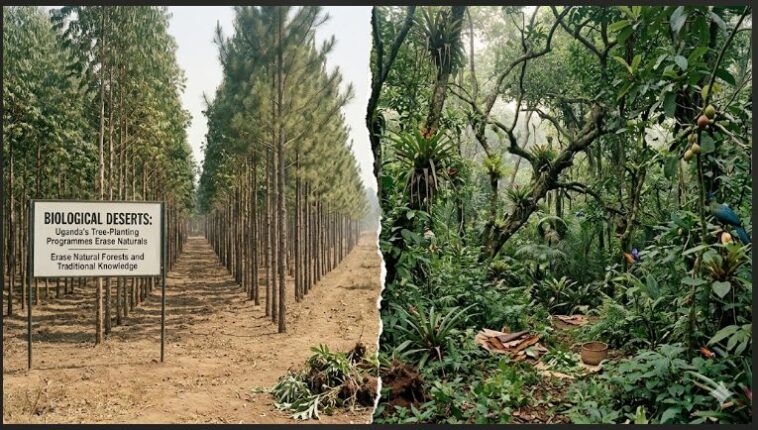
For the greater part of their history, the peoples of the Uganda territory lived in what may be called a unity of interconnectedness and interdependence with natural forests. This was not a romantic relationship but a practical, spiritual, and ecological one (Berkes 2018). Natural forests were not understood as “apart from” humanity and other beings – animate or non‑animate. Rather, they constituted the very fabric through which life was sustained, meaning was derived, and continuity was assured (Gadgil & Berkes 1991). Today, when you travel through Busoga, you will see hills awash with green vegetation. However, if you get nearer to such a hill, you will be greeted by its silence—no birds, no butterflies, biologically impoverished. This is the price of choosing Eucalyptus and Cypress, in place of natural forest.
For millennia, the human energy system of more settled peoples was absent without the natural forest (Norgaard 1994). The forest provided ecological infrastructure – water cycles, soil fertility, climate regulation, biodiversity habitat, and cultural anchoring – without which settled agriculture and permanent dwellings could not have emerged. There was, in the fullest sense, unity, interconnectedness and interdependence between evolving human settlements and the natural forest (Oweyegha‑Afunaduula 2015).
Today, that unity has been fractured. In its place stands a landscape of biological deserts: vast monocultures of Eucalyptus, Cupressus and Cassia that the Ugandan government and its international partners misleadingly call “forests” (World Rainforest Movement 2015). This article seeks to document how this transformation occurred, why it constitutes biological desertification, and what is being lost – not only in terms of species but in terms of knowledge systems, ethical frameworks, and future possibilities.
2. The Basoga Worldview: Ecological Unity Before Disruption
2.1 Naming as an act of ecological affirmation
Among the Basoga of eastern Uganda, as among many Ugandan communities, the naming of children using the names of trees and animals was never merely ornamental (Whyte 1997). When a child was named Mugavu (after Albizia coriaria), Nkima (monkey), or Mpologoma (lion), the community was affirming a fundamental truth: human identity is embedded within a wider web of life (Gombya‑Ssembajjwe 2005). These names served as constant reminders that humanity’s flourishing is inseparable from the flourishing of the forest and its inhabitants.
Clan systems among the Basoga perpetuated this ecological consciousness across generations. Each clan had totems – often trees, animals or birds – that were protected and revered. To harm one’s totem was to harm oneself. This was not superstition; it was an empirically grounded understanding of ecological interdependence, encoded in social structure and transmitted without written texts (Berkes 2018).
2.2 The life‑death cycle as ecological continuity
The Basoga, like the nomadic pastoral communities of a few decades back, did not bury their dead in the manner practiced today – with all the expensive glory of wooden and plastic coffins, and dead bodies treated with chemicals to prevent bacterial decomposition (Oweyegha‑Afunaduula 2015). The contemporary funeral industry prevents the body from returning to nature what it consumed and stored during life.
The Basoga buried their dead ecologically. The body was placed at the base of the Ficus natalensis tree – Omugaire in Lusoga, Omutuba in Luganda. Under bacterial action the body would decompose. When rains fell – and they were then more regular and frequent than today – water flowing down the stem would wash released nutrients into the soil, where the tree’s roots would absorb them for photosynthesis (Whyte 1997). The tree, in effect, transformed death into life.
After decomposition was complete, and after foxes and wild dogs had consumed the bones, only the skulls would remain because their shape made consumption difficult. These skulls would then be buried in the topsoil behind dwelling places. Over a very long time, the skulls would lose their calcium, which would become part of the soil through erosion. Nothing was lost. The nomadic pastoralist communities, for their part, would move away, leaving the dead to be consumed by wild animals – predators, birds of prey and bacteria. The mother life‑death cycle never lost anything (Oweyegha‑Afunaduula 2003).
3. Traditional Ecological Knowledge (TEK) and Women’s Biotechnology
3.1 The forest as domesticator
Living in close proximity to natural forests meant the Basoga could obtain everything they needed to make life livable – mostly from the forests themselves (Gombya‑Ssembajjwe 2005). Women, through their traditional biotechnological industry, claimed domestic plants from the forest and also domesticated animals. They harnessed medicines for an effective healthcare system and managed the environment wisely (Oweyegha‑Afunaduula 2015). This traditional biotechnology included selection and propagation of food crops from wild relatives, fermentation technologies, medicinal extraction protocols, and soil fertility management through organic matter cycling.
3.2 Shifting cultivation as natural pest management
Through shifting cultivation, women planted crops amongst other plants in the ecotones – the transition zones between forest and cleared land – within forests (Fairhead & Leach 1996). This was a natural crop protection system against pests. The mechanism worked as follows: when a pest species evolved to locate its preferred cultivated crop growing in dense, monocultural stands, it relied on chemical or visual cues specific to that crop. In the ecotone system, however, the cultivated crop was intermingled with dozens of other plant species. This chemical and visual “noise” disrupted the pest’s host‑location ability. In contemporary agronomy, this principle is called “associational resistance” or “resource concentration hypothesis” – but the Basoga women had understood and applied it for centuries before Western science articulated it (Gadgil & Berkes 1991).
3.3 Clan‑based environmental governance
Associated Traditional Ecological Knowledge was perpetuated from generation to generation by the Basoga within their clans. Clan‑based environmental management and conservation systems operated within evolving agroecological systems (Gombya‑Ssembajjwe 2005). Each clan had sacred forest groves where extraction was prohibited, rotational farming schedules managed collectively, water source protection protocols, and seasonal hunting and gathering restrictions. These were not abstract environmental policies but lived practices, enforced through social sanctions, ritual obligations, and collective memory (Berkes 2018).
4. The Colonial Rupture: Beginning of Biological Desertification
4.1 Extraction and erasure
The coming of colonial human‑land interactions initiated the process of disconnecting and displacing traditional energy tapping from natural forests (Hamilton 1984). The colonialists cut hardwoods – particularly mahoganies, ironwoods and podos – and sustained a process of shipping them to Great Britain, where many homes and institutions still display them today. The British ship‑building industry made extensive use of these Ugandan hardwoods (Howard 1991).
The new Uganda Railway tapped the hardwoods as sources of fuel to sustain the trains. This practice continued well into the early 1970s (Oweyegha‑Afunaduula 2003). The railway, celebrated as an engineering achievement, was simultaneously an ecological catastrophe – a linear scar across the landscape that consumed forests as fuel.
4.2 Defining biological desertification
Biological desertification is the process by which a biologically complex, functionally integrated ecosystem is progressively simplified, losing species diversity, structural complexity, ecological functions and regenerative capacity – ultimately becoming incapable of supporting the web of life it once sustained (World Rainforest Movement 2015). Unlike classical desertification (the expansion of arid landscapes), biological desertification can occur in high‑rainfall areas. A Eucalyptus plantation receiving 1,500 mm of annual rainfall is a biological desert if it supports fewer than ten plant species, lacks a functioning understory, suppresses natural regeneration, and cannot sustain the vertebrate and invertebrate communities of a natural forest (Cavanagh & Benjaminsen 2014).
4.3 Mechanisms of colonial biological desertification
The colonialists initiated biological desertification through multiple means (Hamilton 1984; Howard 1991):
· Introduction of exotic plantations: Eucalyptus (from Australia), Cupressus (from North America and the Himalayas), and Cassia (from tropical America) were planted to replace harvested hardwoods – selected not for ecological fit but for rapid growth and timber properties (World Rainforest Movement 2015).
· Mining: Mineral extraction opened forests to fragmentation and degradation.
· Monoculturalisation of agriculture: Replacement of diverse shifting cultivation systems with single‑crop plantations (cotton, coffee, sugar, tea) simplified landscapes dramatically (Fairhead & Leach 1996).
· Urbanisation: Colonial towns were established as forest clearings, creating permanent islands of human settlement that disrupted wildlife corridors.
· Infrastructure: Road and railway construction fragmented forests, creating edges that invited further degradation (Scott 1998).
Colonial tree‑planting programmes thus fuelled forest ecosystem simplification, not restoration (Oweyegha‑Afunaduula 2003).
5. The Great Lie: Plantations as “Forests”
The claim that plantations of hot‑desert Eucalyptus and cold‑desert Cupressus constitute “forests” is a colonial legacy that spilled into the neocolonial era (World Rainforest Movement 2015). A forest, in ecological terms, is a complex, multi‑layered, self‑sustaining community of native trees, understory plants, fungi, microorganisms, animals and their intricate relationships. A plantation is none of these things (Shiva 2016).
A Eucalyptus plantation is even‑aged and even‑structured, genetically uniform (often clonal), lacking in understory biodiversity, allelopathic (suppressing other plant growth), hydrologically destructive (exceptionally high water consumption), and soil‑degrading (leaf litter is slow to decompose and chemically inhibitory). Yet such plantations are counted as “forested land” in national statistics and international carbon accounting. This is not measurement error; it is systematic deception (Cavanagh & Benjaminsen 2014).
5.1 The carbon trade deception of the last 40 years
The greatest lie of the last 40 years concerns carbon trading (Lang 2013). Ugandans have been duped by both their government and foreign firms, who have laid the path for further biological desertification well into the future.
The mechanism works as follows (Cavanagh & Benjaminsen 2014; Lang 2013):
1. A foreign carbon trading firm identifies natural forest land in Uganda.
2. The government, with presidential approval, allocates this land to the firm.
3. The firm clears the natural forest and establishes a Eucalyptus or Pinus plantation.
4. The firm claims carbon credits based on carbon sequestered by the plantation.
5. These credits are sold to polluting industries in Europe and North America.
6. The firm profits; the polluters claim “carbon neutrality”; Uganda loses a natural forest.
The perversity is staggering. A natural forest, which sequesters carbon and maintains biodiversity, water cycles and TEK, is replaced by a biological desert that sequesters less carbon over the long term, supports almost no native biodiversity, and destroys local livelihoods (World Rainforest Movement 2015). The Eucalyptus and Cupressus plantations now spreading across Uganda are not for ecological renewal, continuity and complexification but for simplification within the context of the global economy. They are the instruments of continuing biological desertification (Oweyegha‑Afunaduula 2003).
6. Contemporary Drivers of Biological Desertification
6.1 The Uganda Constitution 1995
The Uganda Constitution 1995 (Republic of Uganda 1995), despite its progressive language on the environment in the National Objectives and Directive Principles of State Policy, has paradoxically facilitated biological desertification (Oweyegha‑Afunaduula 2003; Tukahirwa 2002). Several provisions have been interpreted or operationalised in ways that undermine natural forest conservation:
· Land ownership provisions: Recognition of land as a commodity has enabled large‑scale land acquisitions that displace customary tenure systems – systems that often embedded sustainable forest management (Banana & Gombya‑Ssembajjwe 2000).
· Presidential powers: The Constitution’s strong executive provisions have enabled what this article terms the Imperial Presidency – a president who can, with minimal legislative or judicial constraint, allocate forest land for industrial, agricultural or infrastructural projects (Oweyegha‑Afunaduula 2003).
· Decentralisation provisions: Devolution of forest management to district authorities has, in many cases, resulted in weaker protection because district governments prioritise short‑term revenue over long‑term conservation (NEMA 2018).
6.2 The Imperial Presidency and natural forest erasure
The Imperial Presidency has played a direct role in erasing natural forests through:
· Mabira Rain Forest: The attempted giveaway of 7,100 hectares of Mabira Forest Reserve to a sugar corporation in 2007 was stopped only by sustained public protest. However, incremental degradation continues (Nabanyumya et al. 2019).
· Bugoma Forest Corridor: Despite court orders, land in the Bugoma Forest Corridor has been allocated to sugarcane growing, fragmenting one of Uganda’s most important remaining forest ecosystems (Byaruhanga & Nampindo 2015; Uganda Wildlife Authority 2019).
· Kalangala District natural forests: The rainforests of the Ssese Islands have been systematically replaced with oil palm plantations under a deal between the Ugandan government and a Malaysian corporation (Kayanja & Byarugaba 2001).
6.3 Politicisation of agriculture
Agriculture in Uganda has been thoroughly politicised (Banana & Gombya‑Ssembajjwe 2000). Sugarcane, tobacco and now oil palm have been promoted not on agronomic or economic grounds but on political calculations – creating constituencies for ruling party loyalists, generating campaign financing, and signalling “development” to international partners (Oweyegha‑Afunaduula 2003). The connection with the global biofuel industry is critical. Sugarcane for ethanol and oil palm for biodiesel are promoted as “green energy” solutions but in reality are drivers of tropical deforestation (Shiva 2016).
6.4 Land giveaways and grabbing
Land giveaways operate at two levels (Tukahirwa 2002; NEMA 2018):
· Official: The Uganda Land Commission and the National Environment Management Authority (NEMA) have issued leases and allocations for forest land to corporations with presidential or ministerial backing.
· Individual: Local elites, often with political connections, acquire forest land for speculative purposes, converting it to plantations or selling it to foreign interests.
Examples include large‑scale sugar estates in Busoga sub‑region that have fragmented remaining natural forest cover; oil palm concessions in Kalangala that have replaced native rainforest (Kayanja & Byarugaba 2001); industrial parks on previously forested land; and the oil refinery site in Kabaale, Hoima District, which required clearing significant forest areas.
6.5 Siting of factories, airports and the oil refinery
The siting of industrial infrastructure has consistently prioritised convenience for developers over ecological integrity. The oil refinery in Hoima, the proposed Kabaale Industrial Park, and various airport expansion projects have all resulted in natural forest loss (NEMA 2018). These are not isolated incidents but a pattern: natural forests are treated as vacant land awaiting development (Oweyegha‑Afunaduula 2015).
6.6 Removal of natural forests with Eucalyptus and Cupressus
The most insidious driver is the deliberate replacement of natural forests with Eucalyptus and Cupressus plantations, justified in the name of “reforestation” or “commercial forestry” (World Rainforest Movement 2015). This is not reforestation; it is ecosystem conversion. A natural forest converted to Eucalyptus has lost 70‑90% of its native plant species, 80‑95% of its bird species (many of which are forest specialists), 90% of its insect diversity, its capacity to regenerate naturally, its hydrological regulation functions, and its cultural and TEK values (Hamilton 1984; Howard 1991).
7. Future Forests: What Lies Underground
7.1 The seed bank argument
Just as future freshwater is stored underground in aquifers, future forests are preserved in the ground too – as extensive seed banks accumulated over several thousand years (Hamilton 1984). The soil beneath a natural forest contains millions of seeds per hectare, representing generations of trees, shrubs, herbs and grasses. These seeds can remain viable for decades, even centuries, waiting for conditions that trigger germination (Fairhead & Leach 1996).
When a natural forest is cleared and replaced with Eucalyptus or Cupressus, this seed bank is destroyed. The chemical suppression, lack of light, alteration of soil structure, and absence of germination cues mean that the native forest cannot return (Oweyegha‑Afunaduula 2003). The seeds that could have restored the forest are lost.
7.2 No programmes for restoration
There are currently no programmes in place in Uganda to restore the native trees from these soil seed banks (NEMA 2018). Instead, planting of Eucalyptus and Cupressus continues in place of natural forests. The National Forestry Authority (NFA) and NEMA have no systematic programme for identifying and protecting existing soil seed banks, activating seed banks through ecological restoration techniques, propagating native trees for restoration planting, or phasing out Eucalyptus and Cupressus from natural forest areas (Oweyegha‑Afunaduula 2015).
7.3 Biopiracy: The theft of native seeds
The situation is even worse. The Ugandan government has allowed foreign firms to continue stealing our natural seeds to fill their seed banks – which they have patented and are selling to our farmers (Shiva 2016). These firms collect seeds from Uganda’s remaining natural forests, transport them to seed banks in Europe, North America and Asia, and then:
· Patent them: Genetic resources that evolved over millions of years in Uganda become the intellectual property of a corporation.
· Sell them back: Ugandan farmers who want to grow native trees must purchase seeds from foreign companies.
· Create terminal seeds: Some companies produce hybrid or genetically modified seeds that produce sterile offspring – forcing farmers to return to the company each season.
· Use them as political weapons: In the future, these corporations will use their control over seed genetic resources to force Uganda to accept dangerous policies favourable to their home countries (Shiva 2016; Oweyegha‑Afunaduula 2015).
This is biopiracy on an industrial scale, facilitated by Uganda’s own government.
8. Case Studies in Biological Desertification
8.1 Mabira Forest Reserve
Mabira Forest, covering approximately 300 km² in central Uganda, is the country’s largest remaining lowland tropical forest. It supports over 300 bird species, 200 butterfly species, and numerous primate populations including the rare red colobus monkey (Nabanyumya et al. 2019). In 2007, the Ugandan government attempted to degazette 7,100 hectares (approximately one‑quarter of the forest) for sugarcane plantation under the Mehta Group. The proposal was defeated by sustained civil society mobilisation – but the forest continues to be degraded through encroachment for agriculture along its edges, illegal timber harvesting, fragmentation by roads and power lines, and increasing pressure for “development” projects (Nabanyumya et al. 2019; NEMA 2018).
8.2 Bugoma Forest Corridor
Bugoma Forest in western Uganda is a vital habitat for chimpanzees and elephants. It forms part of a critical wildlife corridor connecting several protected areas (Byaruhanga & Nampindo 2015). Despite court orders protecting the forest, large areas of the Bugoma Forest Corridor have been allocated to sugarcane growing – destroying the corridor and isolating chimpanzee populations (Uganda Wildlife Authority 2019).
8.3 Kalangala oil palm plantations
The Ssese Islands of Kalangala District were covered in species‑rich rainforest. Under a deal between the Ugandan government and BIDCO (a Malaysian‑owned corporation), these forests have been systematically replaced with oil palm plantations (Kayanja & Byarugaba 2001). Local communities, who depended on the forests for fish breeding grounds, medicinal plants and building materials, have been displaced. The ecological consequences include loss of native forest biodiversity, water pollution from palm oil processing, soil degradation, and reduced fish catches in surrounding waters (Kayanja & Byarugaba 2001; NEMA 2018).
9. The Way Forward: Restoring the Unity
9.1 Recognition of TEK as valid knowledge
Traditional Ecological Knowledge is not folklore; it is empirical knowledge accumulated over centuries of observation, experimentation and transmission (Berkes 2018; Gadgil & Berkes 1991). It deserves recognition alongside Western scientific knowledge in environmental policy, forest management and conservation planning (Oweyegha‑Afunaduula 2015).
9.2 Moratorium on natural forest conversion
Uganda must declare an immediate moratorium on the conversion of any natural forest to plantation, agriculture or infrastructure (World Rainforest Movement 2015). This includes no new Eucalyptus or Cupressus plantations on natural forest land, no new sugarcane or oil palm on forest land, and no new industrial allocations in forest reserves.
9.3 Restoration ecology from seed banks
A national programme must be established to map and protect existing soil seed banks beneath degraded natural forests, develop propagation protocols for native tree species, establish community‑based nurseries for native trees, and restore natural forests using native species, not exotics (Hamilton 1984; Fairhead & Leach 1996).
9.4 Constitutional and legal reform
The Uganda Constitution 1995 should be amended to recognise the rights of nature and natural forests, prohibit the degazettement of forest reserves for industrial use, establish an independent Natural Forest Protection Commission with powers over the executive, and prohibit the patenting of Ugandan genetic resources by foreign entities (Republic of Uganda 1995; Oweyegha‑Afunaduula 2003).
9.5 Rejection of carbon trading fraud
Uganda must withdraw from carbon trading schemes that incentivise plantation establishment on natural forest land (Cavanagh & Benjaminsen 2014; Lang 2013). The global carbon market is not a solution to climate change; it is a mechanism for wealth transfer from the Global South to the Global North, dressed in green language.
9.6 Clan‑based forest management revival
The clan‑based environmental management systems that sustained Ugandan forests for centuries should be revived and integrated into formal governance structures (Gombya‑Ssembajjwe 2005; Berkes 2018). This means legal recognition of clan forest governance, transfer of forest management authority to clan councils where TEK is still held, and government support for clan‑led restoration efforts.
10. Conclusion
The tree‑planting programmes of Uganda, presented as environmental solutions, are in fact instruments of biological desertification. They erase natural forests, displace Traditional Ecological Knowledge, enrich foreign corporations and impoverish local communities (World Rainforest Movement 2015; Oweyegha‑Afunaduula 2003). The colonial logic that justified planting Eucalyptus and Cupressus has never been abandoned; it has simply been repackaged for the carbon trading era (Cavanagh & Benjaminsen 2014).
The Basoga understood something that contemporary environmental policy has forgotten: human beings are not separate from natural forests. The life‑death cycle, the naming of children after trees, the burial at the base of Ficus natalensis – these were not primitive superstitions but sophisticated expressions of ecological understanding (Whyte 1997; Oweyegha‑Afunaduula 2015). They knew that the forest gives and the forest receives, that death is not an end but a transformation, and that the web of life is continuous.
Future forests are not in the plantations being planted today. They are underground – in the soil seed banks accumulated over millennia (Hamilton 1984). They are in the TEK still held by elders in Busoga, Bugisu, Bunyoro and beyond (Gombya‑Ssembajjwe 2005). They are in the genetic diversity that foreign corporations are stealing and patenting (Shiva 2016).
The question is whether Uganda will continue on the path of biological desertification – or whether it will rediscover the wisdom that sustained its peoples and its forests for millennia. The choice is clear. The time to act is now.
Acknowledgements
This article is dedicated to the custodians of Traditional Ecological Knowledge in Uganda – the elders, the women farmers, the clan leaders – whose knowledge has been dismissed, marginalised and erased by colonial and neocolonial forestry paradigms. It is also dedicated to the natural forests of Uganda, which have given so much and received so little in return.
References
Banana, A. Y., & Gombya‑Ssembajjwe, W. (2000). Successful forest management in Uganda: The case of Budongo Forest Reserve. In C. Gibson, M. McKean, & E. Ostrom (Eds.), People and forests: Communities, institutions, and governance. MIT Press.
Berkes, F. (2018). Sacred ecology (4th ed.). Routledge.
Byaruhanga, A., & Nampindo, S. (2015). Biodiversity assessment of Bugoma Forest Corridor. NatureUganda.
Cavanagh, C. J., & Benjaminsen, T. A. (2014). Virtual nature, violent accumulation: The ‘spectacular failure’ of carbon trading at Lake Natron. Geoforum, 57, 219-228.
Fairhead, J., & Leach, M. (1996). Misreading the African landscape: Society and ecology in a forest‑savanna mosaic. Cambridge University Press.
Gadgil, M., & Berkes, F. (1991). Traditional resource management systems. Resource Management and Optimization, 8(3-4), 127-141.
Gombya‑Ssembajjwe, W. (2005). Traditional ecological knowledge and natural resource management in Uganda. Makerere University Press.
Hamilton, A. C. (1984). Deforestation in Uganda. Oxford University Press.
Howard, P. C. (1991). Nature conservation in Uganda’s tropical forest reserves. IUCN.
Kayanja, F. I. B., & Byarugaba, D. (2001). The impact of oil palm plantations on biodiversity in Kalangala District, Uganda. African Journal of Ecology, 39(3), 245-252.
Lang, C. (2013). Carbon trading: How it works and why it fails. Dag Hammarskjöld Foundation.
Nabanyumya, R., Musinguzi, P., & Banana, A. Y. (2019). Land use conflicts and forest degradation in Mabira Forest Reserve. Journal of Sustainable Forestry, 38(4), 345-362.
NEMA (National Environment Management Authority). (2018). State of the environment report for Uganda 2018. NEMA.
Norgaard, R. B. (1994). Development betrayed: The end of progress and a coevolutionary revisioning of the future. Routledge.
Oweyegha‑Afunaduula, F. (2003). Environment, development and the politics of participation in Uganda. Fountain Publishers.
Oweyegha‑Afunaduula, F. (2015). Traditional ecological knowledge and sustainable development: An African perspective. Lambert Academic Publishing.
Peloquin, C., & Berkes, F. (2009). Local knowledge, subsistence harvests, and social‑ecological complexity in James Bay. Human Ecology, 37(5), 533-545.
Republic of Uganda. (1995). The Constitution of the Republic of Uganda. Government of Uganda.
Scott, J. C. (1998). Seeing like a state: How certain schemes to improve the human condition have failed. Yale University Press.
Shiva, V. (2016). Biopiracy: The plunder of nature and knowledge. North Atlantic Books.
Tukahirwa, J. M. B. (2002). Policies and people: The politics of environmental management in Uganda. The Environmentalist, 22(1), 75-86.
Uganda Wildlife Authority. (2019). Protected area management plan for Bugoma Forest Reserve. UWA.
Whyte, S. R. (1997). Questioning misfortune: The pragmatics of uncertainty in eastern Uganda. Cambridge University Press.
World Rainforest Movement. (2015). Tree plantations: A green desert. WRM.
Correspondence: Oweyegha‑Afunaduula can be reached through independent scholarly networks focusing on Traditional Ecological Knowledge and natural forest conservation in Uganda.
Citation: Oweyegha‑Afunaduula, F.C. (2026). Biological deserts: How Uganda’s tree‑planting programmes continue to erase natural forests and associated traditional ecological knowledge. Independent Scholar Publication, Uganda.
This article is open access and may be shared, reproduced and cited with proper attribution. The author asserts the moral right to be identified as the creator of this work.
This post was created with our nice and easy submission form. Create your post!

Written by
I am a retired lecturer of zoological and environmental sciences at Makerere University. I love writing and sharing information.
Did this story move you? Every gift goes directly to Oweyegha Afunaduula — writers on Muwado earn from reader appreciation, not algorithms. Even $1 makes a difference.






Muwado weekly chart
Get Africa’s top 10 stories every Thursday
No account needed — just your email.
Want to follow Oweyegha Afunaduula and get notified every time they publish?
Create a free Muwado account →