

 Shadreck Chikoti

Do not be afraid of history. Historically, Thyolo district is a Mang’anja domain. Thyolo district was originally a Maravi settlement. 500 years before the arrival of European colonists or later 19th-century migrations, the verdant, rolling hills of the Shire Highlands were carved out, named, and spiritually sanctified by the ancient Maravi people. These early Bantu settlers, who established the expansive Maravi Confederacy by the 14th century, laid down the foundational culture, names, and ancestral roots that define Thyolo’s true pre-colonial history.
The name Thyolo (historically written by early Europeans as “Cholo”) directly reflects the geographical traits noticed by its original Maravi inhabitants.
The Linguistic Root
The name is derived from the proto-Chichewa/Nyanja word M’tolo, which means a bundle, a heavy load, or a mass of stones.
The Topography
The Maravi applied this name to the massive, rocky volcanic outcrops and dense, imposing hills, most notably Thyolo Mountain. To the early travelers tracking through the flatter plains of the Lower Shire Valley, the highlands ahead looked like a giant, heavy bundle or a fortress of stone rising out of the earth.
The Maravi Settlers and Social Structure
The original inhabitants of Thyolo belonged primarily to the core clans of the Maravi empire: the Banda and the Phiri, specifically the Mang’anja, who were a breakaway group of the Maravi. The Mang’anja, who are frequently conflated with or misclassified as Lomwe, continue to constitute the predominant ethno-social framework of the district. This historiographical error, however, is easily deconstructed, as the regional toponyms and patronyms of Chewa extraction, such as Mbeta, Chidyaonja, Changata, Phiri, Mankhwala, Nkhokwe, Mtambanyamba, Bvumbwe, Nanseta, Chimaliro, Kapichi, Thukuta, Nchilamwera and many others unequivocally trace their etymological and ancestral origins to the Maravi.
As these groups migrated southward from the main Maravi capitals such as Mankhamba and Manthimba, they split into various territorial leadership factions. In Thyolo, they established a highly organized, decentralized governance system overseen by local chiefs. They utilized a matrilineal social system where lineage and inheritance passed through the female line via the Mwene (female elders) and the Anankungwi (female initiators), a system that deeply integrated womanhood into both governance and spirituality.
Spirituality was the central pillar of Maravi life in Thyolo. While the political rulers (often of the Phiri clan) held administrative power, the religious architecture belonged to sacred, rain-making territorial cults.
The Rain Cults
The Maravi in the Shire Highlands worshipped a supreme, invisible creator God, known as Chauta, Namalenga, or Leza. Because Thyolo’s fertile soil and agriculture relied heavily on the seasonal rains, spiritual life centered around ensuring the favor of the heavens.
The Legend of Mbona
Thyolo was intimately tied to the widespread Southern Maravi cult of Mbona, a legendary, semi-divine rainmaker. According to oral histories, Mbona was a mortal man of the Banda clan blessed with miraculous powers to call down rain. Fleeing political jealousy from a Phiri chief (Lundu), Mbona fled through the Shire Highlands.
Sacred Shrines (Thandala)
Before his ultimate martyrdom in nearby Nsanje, Mbona and his disciples frequented the thick, indigenous forests of Thyolo Mountain. The Maravi designated specific, untouchable pockets of these forests as sacred rain shrines (Makhwiri or Kachere sites). In times of drought, designated elders would ascend Thyolo Mountain to offer sacrifices of black cloths, beer, and livestock to invoke Chauta through the spirit of Mbona.
Thyolo Mountain: Sacred Maravi Shrines
The Thyolo Mountain Shrine
The shrine located on Thyolo Mountain was officially recognized as a primary auxiliary shrine. While Kaphirintiwa was the epicenter, the Southern Maravi (the Mang’anja) required a localized point of contact to appease the spirits and summon rain for the fertile Shire Highlands.
Documented Shrines and Places of Worship
1. The Thyolo Mountain Sanctuary (Kachere and Makhwiri)
The most prominent place of worship was nestled deep within the indigenous primary rainforest at the peak of Thyolo Mountain.
The Ritual Practice: Early Bantu settlers used this site to offer sacrifices to the Almighty God, referred to as Chisumphi, Chauta, or Leza, through the mediation of ancestral spirits. Prayers were offered for rainfall during devastating droughts, for communal healing during pestilence, and in thanksgiving for bountiful harvests.
The Physical Space: This was not a brick-and-mortar structure, but a Kachisi (a sacred shrine) characterized by a clearing surrounded by ancient trees, most notably the sacred Kachere (wild fig) tree. The forest surrounding the shrine was strictly protected by taboo; no one was permitted to gather deadwood, harvest fruits, or disturb the wildlife, as doing so was considered sacrilegious to the spirits.
2. Chayankhula Rock (The “Speaking Rock”)
Located near the apex of Thyolo Mountain, this specific geological feature served as a localized oracle site.
The Structure: According to local oral traditions documented later, this massive stone is balanced naturally on three smaller base rocks, mirroring a traditional mafuwa (three-stone cooking hearth).
The Worship: Maravi priests and spirit mediums (Matsano) climbed to this rock to listen for supernatural echoes or tremors. It was believed that when the ancestors were pleased or sought to deliver a warning regarding incoming weather patterns, the rock would emit an internal acoustic echo, hence the name Chayankhula.
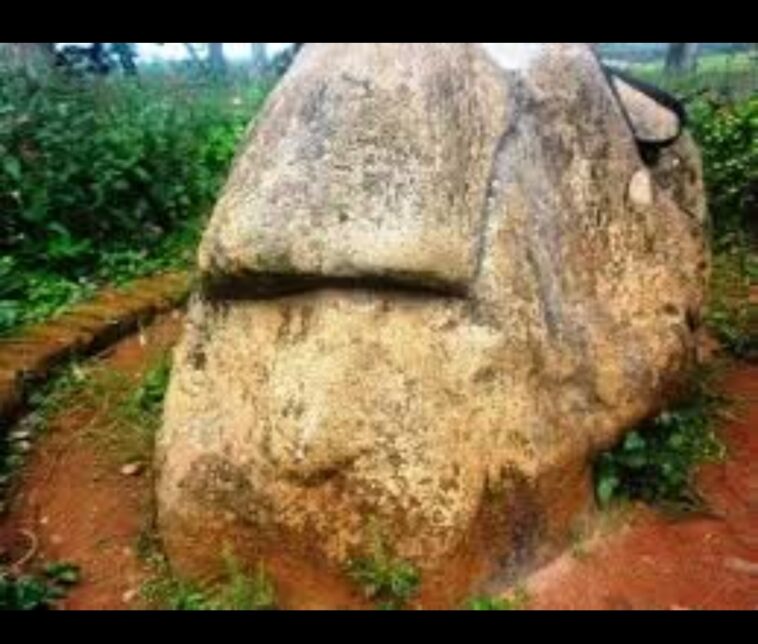
3. Mwala wa Nthunzi (The Rock of Shade/Smoke)
Situated along the foothills and transit routes connecting Thyolo to the Lower Shire plains, this massive boulder was another vital historic ritual site.
The Worship: Long before colonial infrastructure circumscribed it, Maravi travelers and regional chiefs utilized Mwala wa Nthunzi as an altar for offering libations (traditional beer, beads, and black cloth). It acted as a spiritual gateway for those ascending from the heat of the lower valleys into the sacred highlands.
This rock still stands to this day, though its history remains unknown to many. According to local lore, when the Thyolo road was being constructed, workers attempted to move the boulder. However, it is said that whenever they displaced it, they would return the following morning only to find it back in its original position. While this is regarded as mere myth, others also claim that it is impossible to whistle while walking around the rock; the whistle simply fades away on its own.
Today, while much of Thyolo has been transformed by vast agricultural landscapes, the remnants of the Thyolo Mountain Forest Reserve still preserve the exact ecological and spiritual footprint where the Maravi once communed with the divine.
The most vivid, firsthand accounts of the Thyolo shrines were recorded by the pioneer missionaries of the Universities’ Mission to Central Africa (UMCA), who arrived under the initial guidance of David Livingstone.
The Documentation of Cholo Mountain
In the early 1860s, UMCA missionaries first documented that the dense, primordial forests of “Cholo Mountain” (as they historically spelled Thyolo) were not mere wilderness, but strictly guarded Mang’anja religious reserves.
Traces of the Roots: Names and Places
Though the demographic landscape of Thyolo shifted in the late 19th and early 20th centuries, particularly with the influx of people fleeing tribal wars and Portuguese rule in Mozambique, the ancient Maravi blueprint remains permanently stamped on the district.
Toponyms
Rivers like the Thuchila and the Ruuo, as well as local hills, carry names coined from the Maravi dialect to describe the behavior of the water and terrain.
Chieftainships
The territorial jurisdiction of Traditional Authorities (TAs) in Thyolo, such as TA Changata, TA Nchilamwera, and TA Mphuka, track back to ancestral Maravi leadership titles. These lineages maintained the traditional judicial structures of the original Maravi kingdom.
Cultural Survivals
The Gule Wamkulu (the Great Dance), a spiritual and ritual masked dance performed by the Nyau secret society, originated entirely within the Maravi empire. While more covert in the southern highlands compared to central Malawi, the underlying philosophies of ancestral veneration and the spiritual transition of life taught by the Maravi are still preserved in the traditional ceremonies of Thyolo’s oldest villages today.
Through these deeply embedded geographic names, political lineages, and lingering reverence for the sacred highlands, Thyolo continuously honors its ancient identity as a cradle of Maravi civilization.
This post was created with our nice and easy submission form. Create your post!

Written by
Did this story move you? Every gift goes directly to Shadreck Chikoti — writers on Muwado earn from reader appreciation, not algorithms. Even $1 makes a difference.






Muwado weekly chart
Get Africa’s top 10 stories every Thursday
No account needed — just your email.
Want to follow Shadreck Chikoti and get notified every time they publish?
Create a free Muwado account →