

 Oweyegha Afunaduula

Abstract
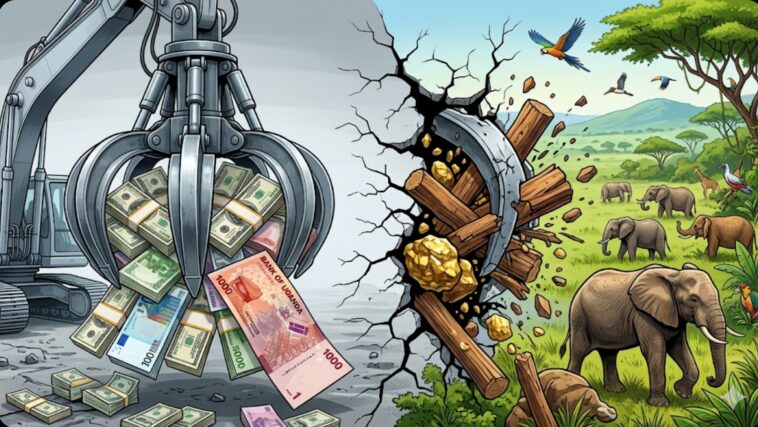
This article posits that the contemporary pursuit of money wealth, driven by a narrow, economistic mindset, is fundamentally “sterile”—it creates ephemeral value while systematically liquidating the very foundation of all enduring wealth: natural capital. Focusing on Uganda, this analysis redefines the pillars of the nation’s natural wealth, arguing that human, intellectual, social, and cultural capital are not separate from, but integral to, this foundation. It critiques the disciplinary, reductionist education system inherited from colonialism for creating a worldview that places humanity apart from nature, thereby legitimizing exploitation. The article concludes by proposing a radical paradigm shift: the abandonment of the archaic “university” model in favor of an Extraversity. This new institution, leveraging the transgressive power of the Internet and AI, is presented as the essential vehicle for fostering the holistic, interconnected, and ethical mindset required to protect Uganda’s natural wealth for present and future generations.
1. Introduction: The Sterility of a Monochrome Pursuit
Why characterize the pursuit of money wealth as “sterile”? Sterility, in a biological sense, implies an inability to reproduce, to generate life, or to sustain a system. When the singular, unidimensional pursuit of monetary accumulation becomes a society’s dominant goal, it exhibits a parallel sterility. It can generate immense wealth for a few, yet it fails to reproduce the essential conditions for societal flourishing. It consumes its own resource base, degrades the ecosystems upon which it depends, and undermines the social and cultural fabrics that give life meaning.
In Uganda, this sterile pursuit manifests as a dangerous myopia. The nation’s true wealth is not the balance of foreign reserves or the volume of mineral exports, but the intricate, life-sustaining systems that constitute its Natural Wealth. This wealth is being placed in peril by policies, actions, and mindsets that treat the environment as a mere collection of commodities to be extracted, rather than the very matrix of existence. This article argues that to save its natural wealth, Uganda must first confront the sterile logic of pure economism and then undergo a fundamental transformation in its philosophy of knowledge and education.
2. The Pillars of Uganda’s Natural Wealth: An Integrated System
Natural wealth is not a single entity but also a complex, interconnected system. Any attempt to devalue or erode one pillar weakens the entire structure. The pillars of Uganda’s natural capital are:
· Ecological Wealth: The fundamental processes—nutrient cycling, soul rest formation, climate regulation—that sustain life.
· Biological Wealth: The vast array of living organisms, from the microbes in the soil to the iconic mountain gorillas of Bwindi.
· Mineral Wealth: The geological endowment, including oil, gas, and metallic ores, which if extracted sustainably, can serve as a non-renewable resource for development.
· Land Wealth: The soil, landscapes, and terrestrial ecosystems that provide the foundation for agriculture, shelter, and cultural identity.
· Biodiversity Wealth: The variety of genes, species, and ecosystems, representing resilience and untapped potential for food security, medicine, and adaptation.
· Water Wealth: The source of the Nile, the Great Lakes (Victoria, Kyoga, Albert), and the vast network of wetlands that regulate water flow, purify water, and support fisheries.
· Food Chains Wealth: The complex energy flows from producers (plants) to consumers, which underpin food security and ecosystem stability.
· Web of Life Wealth: The intricate, non-linear interdependencies between all species, where the health of One is contingent on the health of the many.
· Ecosystems Wealth: The dynamic complexes of plant, animal, and micro-organism communities and their non-living environment interacting as a functional unit (e.g., forests, savannahs, wetlands).
· Plant Wealth: The forests, woodlands, and individual flora that provide oxygen, food, medicine, and habitat.
· Animal Wealth: The fauna, both domesticated and wild, that contribute to ecosystem function, culture, and livelihoods.
· Environmental Wealth: The sum total of our physical surroundings, which provide the context for all life and human endeavor.
Critically, this framework must be extended. Homo sapiens, a natural species that has co-evolved within Uganda’s ecosystems, is an integral part of this web. Therefore, the following are not external additions but integral pillars of natural capital:
· Human Capital: The health, knowledge, skills, and productive potential of the Ugandan people.
· Intellectual Capital: The collective wisdom, knowledge systems (including indigenous knowledge), and capacity for innovation.
· Social Capital: The networks of trust, reciprocity, and cooperation that enable communities to act collectively.
· Cultural Capital: The languages, traditions, spiritual values, and practices that shape humanity’s relationship with the natural world.
Excluding these four capitals from the definition of natural wealth is not an innocent oversight; it is a reflection of an exploitative and economistic mindset (Gudynas, 2011). It is a mindset that defines the environment as “what surrounds us,” thereby creating a false binary where humanity is separate from and superior to nature. This separation is an ideological tool that justifies the sacrifice of environmental rights, species rights, and the rights of future generations at the altar of short-term economic gains.
3. The Disciplinary Mindset: Education as a Tool of Separation
The roots of this destructive separation lie in the education system introduced during the colonial era and perpetuated to this day. This system is built on disciplinarity—the compartmentalization of knowledge into silos. It produces disciplinary graduates who are experts in a narrow field but are novices in complexity. They learn to see the world through a single lens: a forester sees a tree for its timber value; a geologist sees a mountain for its mineral deposits; an economist sees a wetland as an unproductive space awaiting development.
This reductionist approach fosters a mindset where individuals and professionals are trained to see themselves as apart from the natural world, empowered to manage it as a passive object. When faced with complex, interconnected problems like the degradation of the River Nile basin—a problem involving hydrology, biodiversity, farming practices, industrial pollution, urban development, energy policy, and regional diplomacy—the disciplinary mind rushes to simplify. It seeks simple solutions—a dam here, a fertilizer subsidy there—which, due to their lack of systemic understanding, often create new, more complex problems (Norgaard, 1994). Over the centuries since the Enlightenment, we have, in many ways, become experts in simplicity and novices in the very complexity that defines our greatest challenges.
4. The Path Forward: A Paradigm Shift Through Extraversity
The solution is not to tweak the existing system but to fundamentally change the way we educate, teach, and learn. We must subordinate the disciplinary model and embrace the team sciences: interdisciplinarity, crossdisciplinarity, transdisciplinarity, and, most importantly, extradisciplinarity.
This requires a conscious and deliberate mindset shift. We must move from an individual focus to:
- An Ecological Mindset that sees interconnectedness.
- An Ecosystem Mindset that understands functional wholes.
- An Environmental Mindset that respects planetary boundaries.
- An Agroecological Mindset that farms with nature, not against it.
- A Solidarity Mindset that links human well-being to the well-being of all life.
- A Holistic Mindset that integrates art, science, and humanities.
- A Conservation Mindset that prioritizes stewardship over exploitation.
This is not merely educational reform; it is a call for a major civilizational paradigm shift. It demands that we bridge the artificial gap between the arts, humanities, and sciences, and accept the fundamental premise that science is one, with three interconnected dimensions: the natural sciences, social sciences, and humanities. True understanding emerges from their synthesis.
To institutionalize this, we must have the courage to innovate a new language and new structures. We must move beyond the archaic concept of the “university”—an institution structured for disciplinary isolation—and embrace the concepts of the Interversity, Crossversity, Transversity, and Extraversity.
The Extraversity: Knowledge Without Boundaries
Of these, the Extraversity is the most vital for our era. The concept of the Extraversity transcends disciplines; it does not merely cross or integrate boundaries but operates as if they do not exist. It is a fluid, adaptive approach to knowledge creation that is fundamentally responsive to societal needs, not the preservation of academic fiefdoms (Gibbons et al., 1994).
The Extraversity is characterized by:
· Boundary-Pushing Thinking: It has no respect for the disciplines of the mind and practice, fostering critical thinking and alternative analysis.
· Problem-Solving as Its Core Mission: It is not about knowledge for knowledge’s sake, but about generating innovative solutions to complex problems like climate change, public health crises, and unsustainable development.
· Deep Collaboration: It facilitates synergistic partnerships between local communities, indigenous knowledge holders, researchers, and entrepreneurs. It recognizes that those who live closest to the land often possess the deepest wisdom about its care.
· Fostering Deep Connections: It connects diverse knowledge systems and wisdom traditions—from the time-tested agroecological practices of our ancestors to the power of AI-driven modeling—to create new understanding for the common good.
· Exposing Truth to Power: By promoting inclusivity and multiple perspectives, it challenges the authoritarian and marginalizing tendencies that can arise in siloed, exclusive institutions.
· Averse to Top-Down Development: It promotes collaborative knowledge management, recognizing that sustainable solutions are co-created with the communities they are meant to serve.
5. Leveraging Technology for a New Future
We are uniquely positioned to build the Extraversity because the tools for its creation are already here. The Internet and Artificial Intelligence (AI) are inherently extradisciplinary. They have already transformed how we analyze and solve problems, breaking down barriers between fields. AI can model the multivariate complexities of climate change, public health, and ecosystem dynamics in ways that were unimaginable a decade ago.
We can leverage these technologies to address our most wicked problems in innovative ways. But to do so, we must have the wisdom to use them within a framework that prioritizes the integrity of natural wealth. The Extraversity provides that framework, ensuring that our technological power is guided by an ecological, holistic, and ethical compass.
6. Conclusion: A Collective Mindset for a Perilous Century
The peril facing Uganda’s natural wealth is not inevitable. It is the direct result of choices—choices about what we value, how we define progress, and how we educate our people. The sterile pursuit of money wealth is a choice born of a reductionist, disciplinary worldview that sees nature as a resource to be exploited.
We have the opportunity to make a different choice. By embracing the concept of the Extraversity, we can begin to institutionalize a new collective mindset. We can create new categories of professionals and policymakers—future-ready thinkers who are not averse to complexity and who are equipped with the skills for multivariate analysis and systemic synthesis. They will be individuals who do not see themselves as apart from the natural world but as an integral, responsible part of it.
Postponing this transformation is a risk we cannot afford. The later we begin, the more degraded our natural wealth will become, and the harder it will be to restore the health of our ecosystems, our society, and our relationship with the web of life. It is time to abandon the university of the past and build the Extraversity for the future. The task is urgent, but the vision is clear. It is in this new, open, and interconnected institution that we will cultivate the wisdom needed to protect Uganda’s irreplaceable natural wealth for generations to come.
References
- Berkes, F. (2018). Sacred Ecology (4th ed.). Routledge.
- Capra, F., & Luisi, P. L. (2014). The Systems View of Life: A Unifying Vision. Cambridge University Press.
- Gibbons, M., Limoges, C., Nowotny, H., Schwartzman, S., Scott, P., & Trow, M. (1994). The New Production of Knowledge: The Dynamics of Science and Research in Contemporary Societies. SAGE Publications.
- Gudynas, E. (2011). Buen Vivir: Today’s tomorrow. Development, 54(4), 441-447.
- Mafeje, A. (1998). Anthropology and the dialectics of the African intellectual tradition. CODESRIA Bulletin, (1), 2-9.
- Makhoul, J., & Gagnon, P. (2020). From interdisciplinarity to extra-disciplinarity: A new imaginary for knowledge production. Issues in Interdisciplinary Studies, 38(1), 73-96.
- Mertens, D. M. (2020). Transformative research and the pursuit of social justice. In P. Leavy (Ed.), The Oxford Handbook of Qualitative Research (2nd ed.). Oxford University Press.
- Norgaard, R. B. (1994). Development Betrayed: The End of Progress and a Coevolutionary Revisioning of the Future. Routledge.
- Oweyegha-Afunaduula, F. (2017). The Environment and Development: A Ugandan Perspective. (This would be a placeholder for the author’s own foundational works).
- Pretty, J. (2002). Agri-Culture: Reconnecting People, Land and Nature. Earthscan Publications.
- Shiva, V. (2016). Staying Alive: Women, Ecology, and Development. North Atlantic Books.
- Wa Thiong’o, N. (1986). Decolonising the Mind: The Politics of Language in African Literature. Heinemann.
- World Commission on Environment and Development. (1987). Our Common Future (The Brundtland Report). Oxford University Press.
This post was created with our nice and easy submission form. Create your post!
Written by
I am a retired lecturer of zoological and environmental sciences at Makerere University. I love writing and sharing information.
Did this story move you? Every gift goes directly to Oweyegha Afunaduula — writers on Muwado earn from reader appreciation, not algorithms. Even $1 makes a difference.






Muwado weekly chart
Get Africa’s top 10 stories every Thursday
No account needed — just your email.
Want to follow Oweyegha Afunaduula and get notified every time they publish?
Create a free Muwado account →