

 Shadreck Chikoti

Do not fear your history. Also, history does not respect your emotions.
Names matter. They carry memory, history, and identity. Family names survive generations. They cross rivers, droughts, wars, migrations, disease, and the passing of centuries. A surname is rarely accidental. It carries roots, often stretching further back than we can imagine.
When we speak of the Maravi Kingdom, many people in Malawi, Zambia, and Mozambique are connected to it whether they realize it or not. If your family name sounds Chewa, Mang’anja, or Nyanja, chances are your roots are tied to the Maravi world, regardless of the region you come from today.
To understand the Maravi, we must travel north, into the heart of Central Africa, to present day Democratic Republic of the Congo.
The ancestors of the Maravi are believed to have come from the region historically known as Katanga, particularly from the cultural homeland of the Luba people, known as Uluba. Katanga, now part of southeastern Congo, is enormous, roughly the size of Spain. Within this region lies the Upemba Depression, a vast landscape of lakes, marshes, grasslands, and rivers. It was here that one of Central Africa’s most influential civilizations emerged: the Luba Kingdom, or Uluba.
Although there has not been enough modern research dedicated to tracing the exact origins of the Maravi, oral traditions have survived for centuries. Early Portuguese traders, missionaries, and colonial writers also left scattered records that point toward this Congo connection.
What makes the connection fascinating is not only migration itself, but the survival of names, traditions, political systems, and cultural ideas that still exist on both sides of Central Africa today.
The Luba Kingdom was one of the great pre colonial states of Africa. Long before European colonization, the people of Uluba had already developed complex systems of governance, spirituality, memory keeping, and trade.
The kingdom was ruled by a sacred king who was viewed not merely as a political leader, but as a spiritual guardian responsible for harmony, justice, and balance. This idea of sacred kingship was also an element of the Maravi political structure.
The Luba did not govern entirely through military force. Their empire depended on tribute and alliances. Local chiefs sent agricultural goods, fish, iron, and minerals to the royal capital, and the king redistributed wealth to maintain loyalty and peace. This resembles the relationship that later existed between the Kalonga of the Maravi and subordinate chiefs across the confederation.
The Luba also maintained a powerful institution of memory keepers known as the Bambudye. These elders preserved genealogies, laws, royal histories, and sacred traditions through oral storytelling and through memory boards called lukasa.
Even today, echoes of these names survive among Maravi descendants. The word Bambudye strongly resembles the Chewa word “Mbuye,” a term used to refer to an elder, guardian, or respected clan authority. Likewise, the word lukasa resembles “Likasa,” a term associated with memory and heritage.
The history of the Luba is preserved through a dramatic royal narrative.
According to tradition, the early kingdom was founded by a ruler named Kongolo Mwamba, who unified scattered clans in the Upemba Depression and established his capital at Mwibele. Kongolo was remembered as a powerful but feared ruler who governed through intimidation and military strength.
Even his name invites interesting comparisons. In Chichewa, words such as “kumwamba,” “wapamwamba,” and “zapamwamba” all relate to elevation, greatness, or being above. The title Mwamba carries similar associations of height, greatness, and reverence.
The fate of the kingdom changed with the arrival of a mysterious hunter named Mbidi Kiluwe. Unlike Kongolo, Mbidi Kiluwe was remembered as refined, wise, disciplined, and deeply knowledgeable in royal customs. Tradition says he refused to eat publicly before commoners because kingship itself was sacred.
Kongolo welcomed the stranger into his court, and Mbidi Kiluwe later married Kongolo’s sisters, Bulanda and Mabele. Once again, the names themselves sound familiar to modern Chewa ears: Mbulanda and Mabere.
Over time, Kongolo became jealous of Mbidi Kiluwe’s growing influence and feared he would take power. Sensing danger, Mbidi Kiluwe fled eastward, leaving behind his pregnant wives.
Bulanda later gave birth to a son named Kalala Ilunga.
Kalala Ilunga grew up in Kongolo’s court and became a celebrated warrior. He inherited his father’s charisma, intelligence, and spiritual authority. As he won military victories and gained popularity, Kongolo began to fear him.
There is another striking cultural parallel here. In many Central and Southern African traditions, succession often passed through nephews rather than sons, particularly through the maternal line. This pattern appears repeatedly in both Luba and Maravi traditions.
According to the epic, Kongolo eventually plotted to kill Kalala Ilunga. Warned of the danger, Kalala fled to join his father. Together they returned, defeated Kongolo, and overthrew the old order.
Kalala Ilunga then became the first sacred Mulopwe, the divine king of the Luba Empire. Unlike Kongolo’s harsh rule, Kalala established a more organized political system governed through nobles, alliances, and spiritual law. (also notice the name, Ilunga and compare it to olungama, olunga, meaning good, perfect or holy)
Every future Luba king was expected to prove descent from Kalala Ilunga in order to claim legitimacy.
One of Kalala Ilunga’s relatives, Chibanda Ilunga, later moved southward and helped establish the neighboring Lunda Kingdom. The Lunda adopted many Luba political ideas and eventually developed into another great Central African empire.
From this lineage emerged Yaav I a Yirung, later remembered as the first great Mwaant Yaav, a title later corrupted in European records into Mwata Yamvo. Under his leadership, the Lunda Empire expanded rapidly through conquest, tribute, and strategic marriages.
The structure of the Lunda confederation also resembles aspects of the Maravi system. Local rulers were allowed to retain authority over their territories as long as they acknowledged the supremacy of the central ruler and paid tribute to the capital.
Yet despite these similarities, it is important not to confuse the Maravi with the later Luba and Lunda imperial expansions.
The Maravi are older than many of these famous royal narratives.
The stories of Kalala Ilunga, Kongolo Mwamba, Chinyama, Kinguri, and Queen Lueji largely belong to the period between the sixteenth and seventeenth centuries.
Archaeological excavations at the ancient Maravi capital of Mankhamba, led by Malawian archaeologist Yusuf Juwayeyi, show that ancestors of the Chewa and Maravi had already settled around Lake Malawi between the thirteenth and fifteenth centuries, roughly between 1200 and 1480 AD.
This means the Maravi did not separate from the fully formed Lunda Empire of Mwata Yamvo, nor from the later imperial Luba state of Kalala Ilunga.
Instead, the ancestors of the Maravi appear to have left the Katanga Uluba region much earlier, during an older migration phase connected to the wider Bantu expansions across Central and Southern Africa.
The Maravi therefore emerged from Proto Luba or pre imperial Luba communities, carrying with them ancient systems of governance, sacred kingship, clan structures, oral memory traditions, and names that still echo across Malawi today.
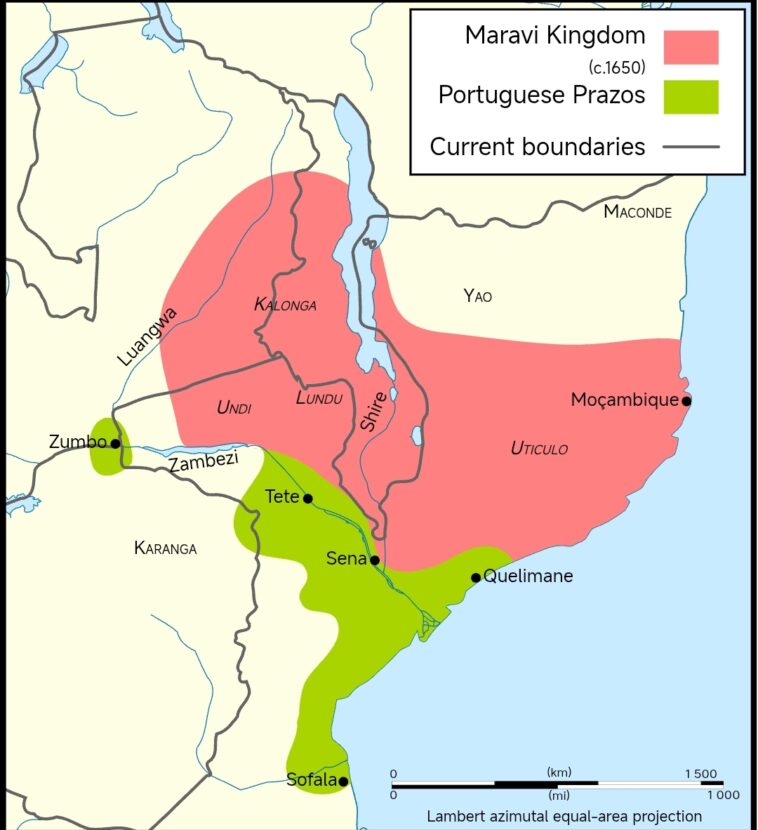
Centuries later, other groups such as the Bemba, Lunda, Tumbuka, and Lozi expanded southward in later migration waves. But by then, the Maravi had already established themselves around Lake Malawi, where they would eventually build one of the most influential kingdoms in the history of south central Africa.
Img – Wikimedia
This post was created with our nice and easy submission form. Create your post!

Written by
Did this story move you? Every gift goes directly to Shadreck Chikoti — writers on Muwado earn from reader appreciation, not algorithms. Even $1 makes a difference.






Muwado weekly chart
Get Africa’s top 10 stories every Thursday
No account needed — just your email.
Want to follow Shadreck Chikoti and get notified every time they publish?
Create a free Muwado account →