

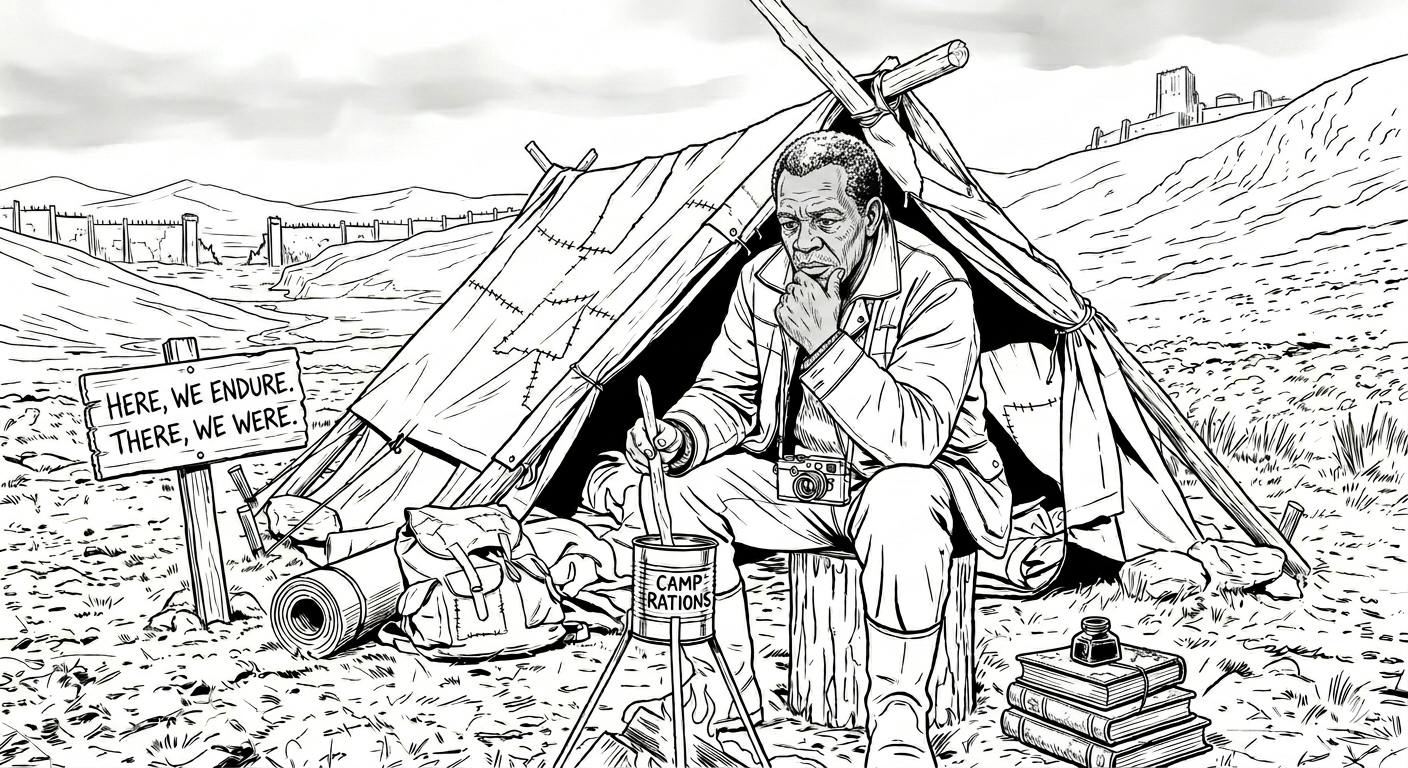
 Caesar Obong Ng'bong ocen

Chapter Four: A Network of Ghost Roads
I woke that morning inside a room that looked less like a bedroom and more like the preserved memory of a man who feared both history and forgetting.
The floorboards beneath me were polished old wood darkened by age and humidity. A single electric bulb hung from the ceiling, flickering weakly as if struggling against exhaustion. Beside the narrow bed stood a small lamp with a cracked yellow shade, its light still glowing from the previous night. Beyond it sat a heavy reading table cluttered with notebooks, camera lenses, photographic papers, old maps, rusted compasses, and sealed containers of undeveloped film stacked carefully beside one another like military archives.
Above the table, wooden shelves curved around the walls of the circular room. On them rested several old Yashica cameras, each arranged with ceremonial precision. Some looked functional. Others looked ancient enough to belong in a museum. Dust gathered on their metallic edges, but the lenses remained spotless.
Near the darker side of the room stood large glass jars filled with strange liquids. One contained a brown chemical solution that gave off the sour smell of vinegar mixed with iron. Another held a perfectly clear liquid. The scent drifting from that corner carried the sharp sting of ammonium. The smell visited my nostrils in intervals, never long enough for certainty.
Everything about the room felt deliberate. Nothing felt accidental.
At the center of the room rose a gigantic cylindrical pillar nearly four meters wide, stretching from the floor to the ceiling like the trunk of some enormous buried tree. The structure dominated the room so completely that all furniture curved around it respectfully.
For several moments I remained still on the bed, staring upward. My vision was blurred. My head pounded with the dull persistence of a hangover that refused to loosen its grip. Behind my eyes, pressure pulsed slowly like distant drums.
I sat up carefully. The room tilted. A wave of nausea passed through me. My mouth tasted bitter. I rubbed my face and tried to remember where I was. Nothing came. Not immediately.
The only sounds inside the room were the faint hum of electricity and the irregular clicking of insects somewhere within the walls. Outside, however, I could hear birds singing. Goats. Cows. Wind. The sounds carried the unmistakable rhythm of a village morning. But my mind resisted the conclusion.
The previous night existed only in fragments. Alcohol. Voices. A fire. Someone laughing. A story about tunnels. Then darkness.
I lowered my feet onto the floorboards and nearly stepped on a cluster of cigarette filters scattered beside the bed. I frowned. I did not remember smoking. Yet the evidence lay there in abundance. Some filters had been crushed violently underfoot. Others still held traces of lipstick.
My notebook rested open on the reading table. Immediately I became drawn toward it. At that moment the notebook felt more valuable than money. If memory had abandoned me, perhaps—traces of the previous discussion would be left in the note book. My head pounded violently.
The previous night’s waragi still moved through my veins like wild scorching desert heat. Every heartbeat pressed painfully against my skull. I sat up slowly, careful not to provoke the nausea twisting inside my stomach.
The room tilted slightly.
I lowered my feet onto the wooden floorboards and immediately noticed cigarette filters scattered beside the bed.
Not one.
Not two.
Dozens.
Some had been crushed violently beneath shoes. Others still carried traces of lipstick.
I frowned.
I did not remember smoking.
The room itself was circular.
That fact disturbed me immediately.
Nothing in rural eastern Uganda was built like this.
The walls curved inward with mathematical precision toward a gigantic cylindrical pillar rising at the exact center of the chamber. The pillar stretched from floor to ceiling, nearly four meters wide, its surface polished smooth by generations of hands.
Everything inside the room curved around it.
The bed.
The shelves.
The reading table.
Even the shadows themselves appeared to orbit the pillar respectfully.
Above the reading table rested old Yashica cameras arranged with ceremonial discipline. Some looked military. Others looked ancient enough to belong in museums.
Beside them sat sealed containers of undeveloped film.
Notebooks.
Maps.
Compass needles.
Photographic papers.
A rusted sextant.
And several large glass jars containing strange liquids.
One jar held a thick brown solution.
Another contained perfectly clear liquid reflecting the weak light from a flickering electric bulb overhead.
That sharp chemical smell came from there.
Developer fluid.
Darkroom chemicals.
The entire room felt less like a bedroom and more like a hidden archive built by paranoid historians.
I rubbed my face slowly and tried to remember where I was.
Nothing came immediately.
Only fragments.
Firelight.
Laughter.
Someone speaking Luo.
A discussion about tunnels.
Then darkness.
My notebook rested open on the reading table.
Instinct pulled me toward it immediately.
At that moment ink felt more trustworthy than memory.
I stood carefully and dragged my heavy body across the room toward the table beside the pillar. Halfway there I remembered that somewhere in my travelling bag rested both my smartphone and GPS tracker.
But for reasons I could not explain, the notebook felt more important.
The pages were filled with hurried shorthand notes written at strange angles.
Trade routes.
Border towns.
Tunnel measurements.
Names.
Dates.
Smuggling corridors.
One sentence had been underlined repeatedly until the paper itself nearly tore.
THE GHOST ROADS BEGIN AT OSOKULU.
Below it another phrase had been scribbled carelessly:
Nagongera was never a village.
It was a doorway.
I stared at the words for several moments.
Osokulu.
Nagongera.
Kisoko.
Kisumu.
Kogheni…
The names carried weight inside my skull even though memory refused to explain why.
Who exactly was Peter Kaburu?
And why had his story dragged me into this strange fortress disguised as a village home?
The bulb overhead flickered weakly once more before finally dying.
Darkness swallowed the room.
Then slowly morning light began leaking through hidden openings somewhere above the walls.
And suddenly the room came alive.
I froze.
Images appeared moving silently across the curved interior walls upside down.
Trees.
Goats.
Women carrying water basins.
Children running.
Smoke rising from cooking fires.
Everything inverted.
Everything alive.
For several seconds I genuinely believed I was hallucinating.
Then memory returned violently.
Camera obscura.
Pinhole optics.
The building itself functioned like a giant camera.
Whoever designed this structure understood light with terrifying precision. Tiny openings near the roof projected outside reality inward onto the walls, allowing anyone inside the chamber to observe the entire compound without ever being seen.
The realization sent coldness through my spine.
This was not ordinary architecture.
This was surveillance.
Defense.
Observation.
Possibly escape.
I moved closer toward the wall, staring at the inverted projections dancing silently across the interior surface.
Outside, upside down, I could see goats grazing beneath mango trees.
Women washing cassava.
A young boy chasing chickens with a stick.
Everything looked peaceful.
Yet the building surrounding me did not belong to peaceful people.
The grooves cut carefully into the floorboards confirmed that immediately.
Drainage channels.
Water routes.
I knelt beside the giant pillar.
From somewhere deep inside it came the faint sound of dripping water.
The pillar was hollow.
I placed my palm against it carefully.
Cold.
Solid.
Alive.
As morning light brightened further, more details emerged.
Symbols had been carved around the pillar’s circumference.
Arrows.
Measurements.
Directional markings.
One pointed toward point B which I made guessing as busia corridor
Another pointed upwards marked point T which then turned to be Tororo.
But there were many more plotting a like Osukuru, kameni, Nagongera, Kibimba on the other side of the puller a map existed of the area that I eventually understood as west budama.
Then there was another arrow pointed toward Kisumu.
A final marking pointed toward Malaba.
This was not decoration.
It was a map.
A hidden geographical system encoded directly into architecture.
My headache momentarily disappeared beneath curiosity.
Suddenly the building made sense.
This was not a house.
It was an entrance.
A node.
A gateway into something much larger hidden beneath the earth.
The Ghost Roads.
I moved toward the attached bathroom still struggling to understand the contradiction around me.
Ancient architecture.
Modern plumbing.
Village surroundings.
Advanced engineering.
Nothing aligned properly.
The bathroom itself resembled those found in middle-class hotels in Kampala.
Tiles.
Running water.
Proper drainage systems.
Someone had invested heavily into preserving this structure.
As I prepared to bathe, my foot struck something rolling across the floorboards.
A half-empty bottle of Uganda Waragi.
I stared at it for several moments before lifting it and swallowing several mouthfuls and headed straight for a cold morning shower which eventually regenerated my entire body, it seems from experience that alcohol hates water…
As I stepped out of the bathroom a last gulp of the alcohol burned downward through my chest like liquid fire.
Immediately memory sharpened.
Voices returned.
John Owino speaking about underground roads.
Oburu arguing drunkenly about invisible trade systems, which he argued that he once visited Kilembe and found a more advanced road stretching into eastern Congo, where the nyamuezi people trade food staff and sense motor bikes avoiding the revenue at the border post, Oburu said that the ones in Kilembe even has railway line built init to which everyone argued with a whoop! Silencing his lies to which even I felt that he had fried me with out onions and cooking oil, someone had also told him to learn how to educate his lies…
Then there was the talk of Peter Kaburu and General Okello.
Tunnel networks beneath sugarcane fields.
Cross-border smuggling during military crackdowns.
Everything rushed back simultaneously.
A knock sounded at the door.
“Breakfast is ready,” a woman’s voice announced from outside.
I dressed quickly.
Jeans.
Grey T-shirt.
Sandals.
Then I stepped outside into morning heat.
The compound stretched wide beneath giant mango and jacaranda trees. Chickens wandered freely between what looked like cooking stones but then this home also had a well built kitchen adjacent to the mango tree.
Goats grazed near woven fences. Beyond the homestead spread green fields interrupted occasionally by termite mounds and sugarcane plantations swaying gently beneath the wind.
Under one of the mango trees sat John Owino.
Shirtless.
Thin.
Severe.
A faded newspaper rested in his hands, I immediately recognised the headline Peter Kaburu Repts Ugandas
When he saw me approaching, he folded it carefully and gestured toward the seat opposite him.
Breakfast had already been arranged.
Steamed cassava.
Sliced mangoes.
Peanut and sesame paste.
Honey.
Sour millet porridge mixed with tamarind.
Milk tea.
Everything smelled rich enough to resurrect the dead.
John studied me silently before speaking.
“Do you know,” he asked slowly, “that my son Peter built roads no government could close?”
I remained silent.
The old man pinched off cassava and dipped it into peanut paste.
“Last night,” he continued, “you spoke about biography. But after more waragi your questions changed. Suddenly you wanted tunnel measurements. Trade routes. Underground chambers.”
He swallowed carefully before continuing.
“What exactly are you hunting, Obong ng’Obong?” the way how he pronounce my name meant he knew a lot about the lango people of Northern Uganda or he maybe could have fluently spoke the lango dialect.
There was no hostility in his voice.
Only caution.
The caution of a man who had survived dangerous history.
I lifted the calabash of millet porridge and drank slowly. The sourness revived my senses instantly.
“While Peter worked with General Okello,” I answered carefully, “he took photographs and I documented stories. That is how we survived. Pictures disappear without words.”
John nodded slowly.
“So it has been you all along,” he said quietly.
His eyes drifted toward the circular structure behind me.
“That building,” he continued, “is older than colonial borders.”
I turned immediately.
Morning light now revealed the structure fully.
It resembled a fortress buried halfway into the earth.
Circular.
Windowless.
Ancient.
Dangerous.
“The first tunnels began in Osokulu,” John said quietly. “Long before the British arrived. Long before Uganda and Kenya existed.”
My attention sharpened instantly.
“The tunnels?” I asked.
John nodded.
“The Ghost Roads.”
He leaned back beneath the mango tree and stared toward the sugarcane fields stretching beyond the compound.
“At first they were survival chambers,” he explained. “Slave raids. Cattle raids. Tribal wars. Villages needed places to hide grain, children, and elders during attacks.”
He pointed toward the ground beneath us.
“So they dug.”
The wind shifted softly through the mango branches above us.
“The earliest chambers were small,” he continued. “Hidden beneath kitchens and cattle enclosures. But later entire clans connected them underground.”
I listened carefully.
“The soil around Osokulu contains enough clay and laterite to support underground excavation,” John said. “That is why the first major systems began there.”
He drew circles on the wooden table using spilled millet grains.
“First came vertical shafts. Then chambers. Then ventilation tunnels disguised as anthills or shrines.”
His voice lowered.
“Eventually engineers appeared among them.”
“You mean builders?” I asked.
John shook his head immediately.
“No,” he corrected. “Engineers.”
The pride in his voice was unmistakable.
“They understood airflow. Weight distribution. Water pressure. Drainage.”
He pointed toward the giant circular structure.
“That pillar inside the chamber is hollow because air must travel continuously underground. Otherwise people suffocate.”
Suddenly everything connected inside my mind.
The drainage grooves.
The hollow pillar.
The hidden projections.
The circular design.
This structure was not primitive.
It was scientific.
John continued speaking.
“Ventilation shafts were hidden inside termite mounds. Some inside sacred trees. Others disguised as grain stores.”
I stared at him silently.
“During attacks,” he said quietly, “entire villages disappeared underground while enemies walked above them.”
A coldness moved through me.
Then the old man smiled faintly.
“Later traders discovered the same roads could move ivory, coffee, salt, gold, tobacco, and eventually weapons.”
His eyes narrowed.
“Then colonial borders arrived.”
He spat the words with visible disgust.
“The colonial masters controlled roads above ground. But they could not control the tunnel beneath the grounds.”
Silence settled heavily between us.
“The Nagongera systems expanded during Idi Amin’s years,” John continued. “Fear of the law made smuggling more lucrative and profitable.”
Then he corrected himself.
“No. Business made fear profitable.”
The statement lingered heavily beneath the morning heat.
Alcohol moved underground.
Fuel.
Medicine.
Military uniforms.
Even people.
Some tunnels stretched for kilometres interrupted by hidden chambers containing water reserves and storage rooms.
Others connected only short distances between safe compounds.
Entire invisible economies operated beneath official geography.
The Ghost Roads.
John lifted his cup slowly.
“The room you slept in,” he said quietly, “is one of the gateway structures.”
My pulse quickened immediately.
“Gateway?” I asked.
The old man nodded.
“The water chamber beneath the pillar controls multiple underground entrances.”
Before I could ask another question, a voice called from above us.
“Would someone open the chamber for me?”
Every hair on my body rose instantly.
We looked upward simultaneously.
Standing atop the circular structure dressed entirely in white stood Peter Kaburu.
Alive
Still
Watching us.
This post was created with our nice and easy submission form. Create your post!

Written by
Caesar Obong Ng'bong Ocen is a Ugandan writer whose work traverses narrative fiction, cultural memory, and moral inquiry. Drawing on African cosmologies, and reflective storytelling, his writing engages with issues of power, identity, faith, and the human condition within post‑conflict societies. His series blends political realism with interior psychological struggle, articulating the tensions between duty and conscience, tradition and modernity, exile, redemption. Obong Ng'bong's work bridges literary and social worlds: it interrogates African historical and political realities while exploring philosophical and ethical questions that resonate across disciplines. His narratives are grounded in cultural authenticity and moral depth, making them relevant to both literary and humanistic inquiry. He also mentors emerging writers and contributes to dialogue on African storytelling traditions and their place in contemporary literature.
Did this story move you? Every gift goes directly to Caesar Obong Ng'bong ocen — writers on Muwado earn from reader appreciation, not algorithms. Even $1 makes a difference.





Muwado weekly chart
Get Africa’s top 10 stories every Thursday
No account needed — just your email.
Want to follow Caesar Obong Ng'bong ocen and get notified every time they publish?
Create a free Muwado account →