

 Brian Oduti

I am walking along Waliggo Road on a Saturday morning, nearly 9 am. Walking fast, listening to music. I see a girl. She is speaking to me. I bend lower so I can hear. Her voice is faint. She repeats herself.
In the minutes before I hear what she is saying, I wonder: Is she asking for money? It is common in the city for strangers to ask for money for food and transportation. But this girl looks too neat. Moisturizer. Hair combed. Clean packpack. Clean clothes. She is maybe nine or ten years old.
When I turn down my music, Die With a Smile by Bruno Mars and Lady Gaga, I finally hear it. The young lady is asking me to help her cross the road.
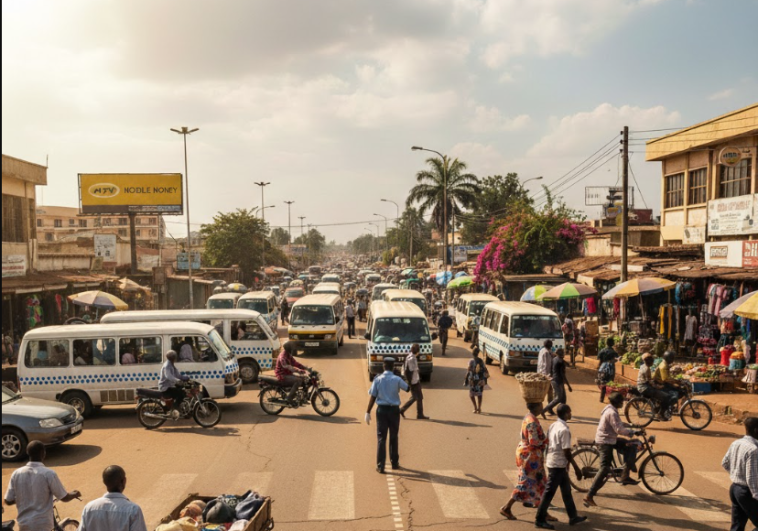
This is not a busy road today, on a Saturday morning. Fewer children are going to school. Many workers stay home on weekends. We live in a city where kids her age cross roads by themselves or in groups, on roads that are often unsafe for pedestrians. Some schools along busy roads employ staff in bright vests who carry green and red flags, waving to stop traffic so groups of children and parents can cross safely in the morning or evening.
Walking is the primary form of transportation in Uganda. Pedestrians represent at least 40% of fatalities from road accidents, according to Uganda Police. These are school children. Women. Informal workers.
The girl in the pink top’s little soft hand holds mine. We cross the road. For those sixty seconds, she holds tightly. I am her temporary social safety net, one that inadequate public infrastructure and weak rule of law have failed to provide for millions of citizens, including children like her. We cross swiftly. I return to my side, to my pavement, to my music.
Thoughts are still running through my mind. It is a privilege to have children go to school and back in ways they feel safe. The fact that the girl asked me means that even children understand how unsafe the roads are. People drive so fast and recklessly, especially in busy residential or commercial areas, without any regard for the safety of other road users. Adults, like her parents, perhaps used to help her cross. Now the girl in the pink top does it by herself this morning.
I walk and run around Kisaasi often. I pass the road outside Rochester Hotel. In the middle of the road near the hotel, I once saw the carcass of a dog. You could see it had been run over repeatedly, its fur stuck to the tarmac. This dog’s carcass means one thing about drivers in Kampala: no one respects what moves on these roads. I walk in neighbourhoods and there’s a smell. On closer look, it is a cat or dog crushed by a vehicle. Common sight. That carcass will stay on that road until it dries up, until cars drive up and down on it for days, for weeks, until it disappears by itself, or is washed away by rain or blown by wind. A month later, the road is as clean as if nothing had been killed there.
I reflect back to 2015 when I was attending a writing conference organized by Kahini and Writing Our World. Kahini is an American literary organization that published a magazine and organized writing workshops for storytellers in different countries, including Uganda. The workshop in Kampala had participants from several countries: Kenya, Nigeria, the US.
We had classes at Pan African Square, near Usafi Market and Clock Tower along Entebbe Road, one of the busiest roads in Kampala. During lunch breaks, we crossed to the Nakumatt supermarket about two hundred meters away to buy lunch, then returned to eat in the gardens of the square. I remember how long it took for the Americans to cross the road, compared to the Ugandan participants who navigated our busy and dangerous roads every day with ease. Within a split second, the Ugandans could cross, often running, during peak hours in the midst of speeding traffic. But the Americans were terrified. At some point we would wait five, ten minutes to cross. In some instances, we Ugandans had to hold the hands of the grown-up Americans and lead them across the road.
We have few pedestrian crossings. The few that exist, often the paint is faint. No one cares to repaint them. But their existence does not mean that motorists respect them. They drive as fast as they choose. And, speed limit signs which should remind us to care about each, if we even we might obey them, are rare in the city. Everyone seems in such a reckless rush that I wonder what the collective urgency is for. We ignore how this behaviour makes our safety depend on the split second it takes to brake before running into a human being.
Our lanes are rarely marked. This is how you cross a road: you cross one lane and then wait to cross into the other lane. To do this safer, you find one person waiting to cross, standing on the side of the road. More people join. They also want to cross. Safety in numbers. Another person stands by. Another one. Before you know it, you are five, six, seven people, all waiting to cross. And then there’s that chance, an opening, less traffic on the lane, a distant or slow motorist. That is your chance to run across. You hope that by the time you reach the middle of the road, the next lane has less traffic, or that the other drivers are kind enough to stop or slow down.
Many drivers do not slow down. They keep going as fast. There are drivers kind enough to stop. They do this for children. For women. Or because they have seen there’s a group that wants to cross. Our safety should not have to solely depend on the random kindness of motorists, but on rules backed by sanctions, applied in a consistent and predictable manner, by all road users.
This post was created with our nice and easy submission form. Create your post!

Written by
I write personal essays and short fiction set in Uganda. My work is informed by own experiences and how they fit within policy, memory, and the idea of home.
Did this story move you? Every gift goes directly to Brian Oduti — writers on Muwado earn from reader appreciation, not algorithms. Even $1 makes a difference.





Muwado weekly chart
Get Africa’s top 10 stories every Thursday
No account needed — just your email.
Want to follow Brian Oduti and get notified every time they publish?
Create a free Muwado account →