

 Aliker p'Ocitti
In this analytical piece, I try to look in between the lines on last week’s Handshake and what it could mean to Acholi.
If you are a short text reader, this is not your kind of ‘thing’ but if you love thinking, I am happy to hear what you think in the comments section. I hope you love it but if you hate it, I am happy to read what you hate in the comments section.
Saturday 14th March 2026 is likely to be chronicled in Acholi history as the day of the Gulu Golden Handshake.
On this day, Acholi under the umbrella of Rocco Paco organized a Homecoming Ceremony for one of its founders, Chief Justice (Emeritus) Alfonse Chigamoy Owiny Dollo to welcome him home as a private citizen from his commendable public service to Uganda.
Alfonse Chigamoy Owiny Dollo officially retired as the Chief Justice of Uganda on January 18, 2026, upon reaching the mandatory retirement age of 70.
He served as the head of the Judiciary from August 20, 2020, following his appointment to succeed Justice Bart Magunda Katureebe.
The Chief Guest for this function was President Yoweri Kaguta Museveni accompanied by numerous dignitaries from the Executive, Legislative and Judiciary arms of government.
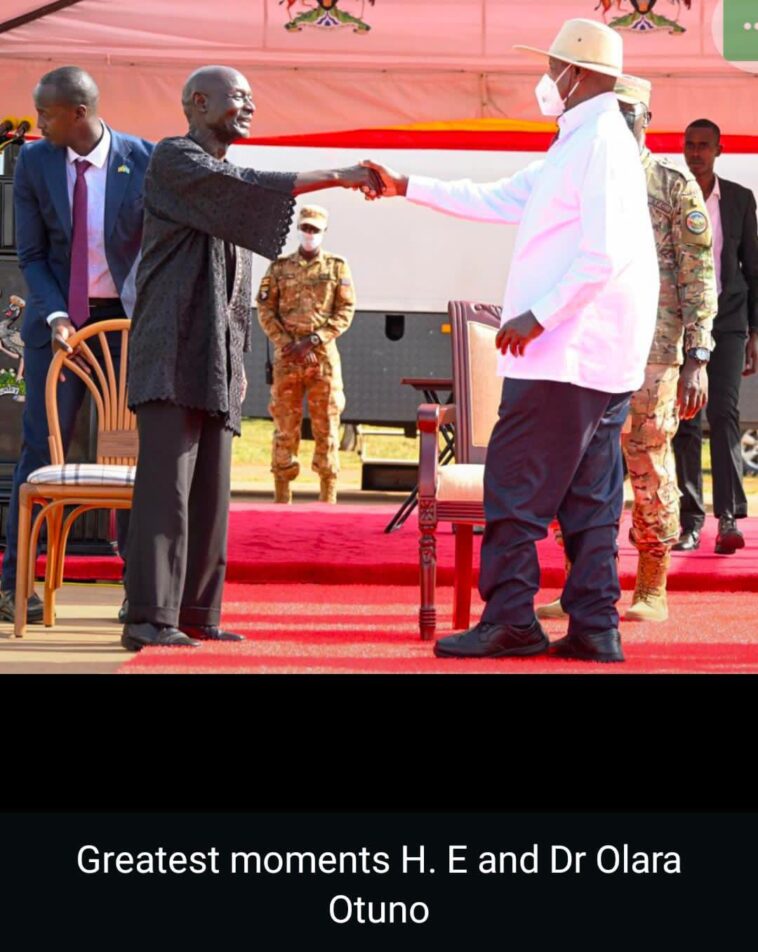
The highlight of this day was when Justice Dollo ushered in Ambassador Olara Otunnu to sit next to President Museveni as he sat on the opposite side.
Before taking his seat. Ambassador Olara Otunnu, beaming with his trademark smile, offered his hand for a handshake with President Museveni; and he happily shook Ambassador Olara’s hands like two old friends.
In the background was a chorus of voices jubilating to a moment they didn’t anticipate. The Master of Ceremony (MC) decorated the moment by yelling, “it is a historic moment, it is a historic moment” and urged that these political nemeses instantly take a photo.
Unless you are a stranger to the bittersweet relationship between President Museveni and Ambassador Otunnu; you can’t help but query the symbolic meaning of this well planned and well thought out handshake moment in the program.
This handshake raises fundamental questions: Why did the MC call it a historic moment? Why did the crowd jubilate over this handshake? Could it be Gulu’s Golden Handshake moment? If so, will it result in peace dividends?
To place to perspective the theory of a Golden Handshake; on March 9th, 2018, a political truce between then, Kenyan President Uhuru Kenyatta and the late Opposition leader, Raila Odinga was termed a Golden Handshake after the historic handshake ended intense political acrimony and ushered peace that reshaped Kenya’s political landscape.
Many keen observers from the school of experience in Museveni’s power play are reading in between the lines and trying to make meaning from the symbolic importance of this Handshake.
The timing of the event, immediately after the elections and retirement of sophiscated power brokers in Acholi in 2026 such as Justice Dollo and General Otema Awany as the country prepares for the much-anticipated political transition sends a signal of potential power play in the uniform footwork of President Museveni and Justice Owiny Dollo.
It may be important to note; not just Hon. Mao’s aspiration to become Speaker but his recent pompous media frenzy lifestyle and his power broker role in opposition politics.
While Gen. Otema Awany will also soon retire, just like Justice Dollo; Hon. Mao looks to be the only Acholi politician placing himself strategically in the intricacies of state power.
The recent rise of Hon. Mao with his generation of Acholi leaders in the National Resistance Movement (NRM) political playbook and the retirement of the old guards in Acholi who ushered in President Museveni’s regime in Acholi leaves pivotal questions: How can we build bridges between the South and the North? How do we position Acholi to get back to power in this transitional government?
To answer these questions in the context of the Handshake, one needs to use historical lenses to understand why this was not a normal handshake.
There are political observers with nostalgic feelings of their past government of Gen. Tito Okello Lutwa who feel betrayed by then leading politicians like Ambassador Olara Otunnu for the role they played in the Nairobi agreements.
Other schools of thought believe that the pioneers of President Museveni’s government in Acholi betrayed them. While they were toing the line of rebellion to the southern led hegemony; they were mobilizing against the northern resistance for personal gain as seen in their achievements today.
Hence, guilt makes them more emphatic and culpable in trying to fix the Acholi power dynamics today. Therefore, there is an urgent need to reconcile and use their treasured positions to improve the life of their people who have paid the price for the 20-year rebellion as they return to the community as private citizens.
So why is this symbolic handshake historical? What exactly excited the public about this handshake?
On 26th August 1985, during the maiden day for the Nairobi Peace Talks between then rebel leader Yoweri Kaguta Museveni of the National Resistance Army (NRA) and Uganda government delegation led by its Chairman, Col. Gad Wilson Toko; Museveni caused a stir in the conference hall when he entered and skipped everyone else except Dr. Paul Kawanga Ssemogerere, the Minister of Internal Affairs.
When a reporter asked Ms Getrude Njuba, one of Museveni’s then aides during the war and participating in the peace talks why Museveni refused to shake hands with the government delegation, she answered, “We feared that he could be poisoned.”
This by implication marked the beginning of a relationship of endemic distrust and perpetual political difference between Ambassador Olara Otunnu, as then Minister of Foreign Affairs, who was seated next to Dr. Paul Kawanga Ssemogerere.
On September 25. 1985 Cardinal Nsubuga, who had invited himself to the peace talks in Nairobi Peace Talks rightly predicted that the talks were headed to a collapse if the mistrust and dishonesty that characterized the peace talks from the beginning were not addressed.
President Museveni, reneged on these agreements after signing it and opted for war and overthrew the northern backed government of Gen. Tito Okello Lutwa on 26 January 1986.
Fast Forward. Ambassador Olara Otunnu opted for exile but joined the United Nations rising to become the Under -Secretary General and Special Representative for Children in Armed Conflict.In 2009, Ambassador Olara Otunnu returned home to Uganda after spending 23 years in exile in the United States of America (USA) and challenged President Museveni for the Presidency under the Uganda Peoples’ Congress (UPC) political party in 2011.
While this campaign was unsuccessful, Ambassador Olara Otunnu retreated to a private citizens’ life in Gulu. In December 20,2009 while attending the consecration of the new Anglican Bishop for Northern Uganda, Johnson Gakumba (now retired) at St. Philip in Gulu; President Museveni came face-to-face with Ambassador Olara Otunnu and again refused to shake the hands of Ambassador Olara Otunnu.
The New Vision, in a story reported by Mulondo Moses reported that Tamale Mirundi (R.I.P) then Presidential Secretary explained that Ambassador Olara Otunnu remained seated as President Museveni walked in during the ceremony making it difficult to offer him a handshake.
In 2011, Ambassador Olara Otunnu met President Museveni face-to-face and shook hands during the celebration to mark 100 years of the catholic church in Acholi breaking the ice that lasted 26 years.
The New Vision later interviewed Ambassador Otunnu and he called it, a Sign of Peace. As a leading critic of President Museveni, the handshake demonstrated, let ‘by-gones be by-gones.’
The two greatest political actors of their time seem to be burying the hatchet before their people and opting for dialogue and reconciliation.
President Museveni while addressing Acholi at Justice Owiny Dollo’s Homecoming Ceremony remarked that while Ambassador Olara Otunnu, many times love to take another direction, Rocco Paco founded by Justice Owiny Dollo and Ambassador Olara Otunnu has brought them together and they are now ‘speaking one language.’
Justice Owiny Dollo described this unique situation using a legal jargon, Consensus ad idem; a phrase he emphasized to mean the ‘meeting of minds.’ Justice Owiny Dollo reiterated this idea to imply the Acholi are now speaking the same NRM language as reflected in how they voted.
Therefore, why did the crowd jubilate and chant with joy? Could this handshake be the proverbial Golden handshake? Will it deliver the anticipated peace dividends they have waited for in decades? Only time will tell.
In early August 2002, Col. Toko in a press interview when asked why the Nairobi Peace Agreement flopped, replied, “The Mpororo of Southwestern Uganda say, Hawks and Eagles can never live together.
I do hope, he was wrong. The Hawk and Eagle seem to be living together NOW!
End.
This post was created with our nice and easy submission form. Create your post!

Written by
Did this story move you? Every gift goes directly to Aliker p'Ocitti — writers on Muwado earn from reader appreciation, not algorithms. Even $1 makes a difference.




Muwado weekly chart
Get Africa’s top 10 stories every Thursday
No account needed — just your email.
Want to follow Aliker p'Ocitti and get notified every time they publish?
Create a free Muwado account →