

 Caesar Obong Ng'bong ocen

It was 2 a.m.
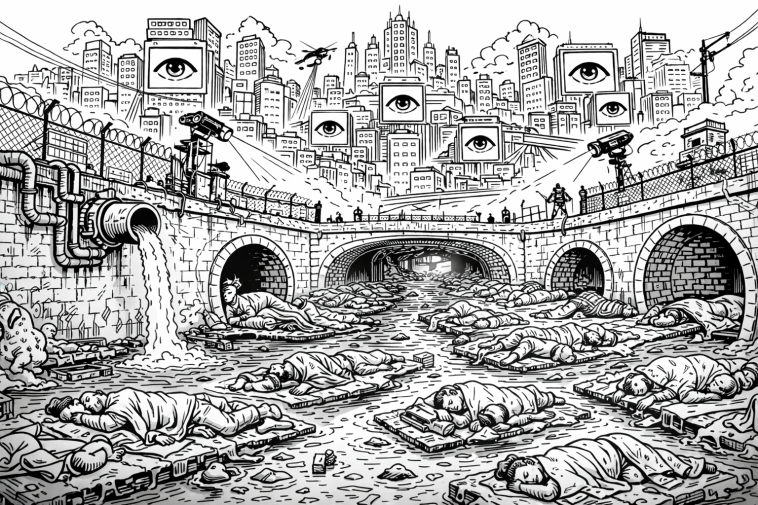
Beneath the breathing surface of Kampala, inside the abandoned arteries of the failed Nakivubo drainage project, Akello lay awake. Rain decided who lived and who drowned. She had learned the language of the air — the thickness before a storm, the metallic scent before the first drop, the distant tremor of thunder crawling over iron rooftops. Any drizzle meant an end. The water would surge without warning, swallowing blankets, memories, and sometimes bodies.
Her home was the unfinished underbelly of Nakivubo — a corruption-strangled project once announced with speeches and ribbon-cutting ceremonies. Funds had evaporated. Engineers reassigned. Audits buried. What remained was concrete and darkness. And in that darkness, the city’s discarded had built an Underground.
Akello, in her early seventies, lay with a stiff leg from a prison injury that never healed. Physically weakened but mentally unbroken, she had once registered with the authorities, marched with youthful bodies demanding reform, and believed the system could be corrected from within. They had been crushed. Not by bullets alone — but by something colder: technology few understood. Meetings anticipated before they occurred. Messages intercepted before they were sent. Movement mapped. Faces indexed. Hundreds were arrested. Hundreds sent to maximum security facilities for hard labor.
She had served her term. Released when age had neutralized her threat, not because she was forgiven. The system they had tried to reform had grown more sophisticated in their absence.
Beside her lay Farcil. Once he had worn tailored suits and moved through boardrooms with quiet authority. He was the son of Tumbo, a renowned businessman whose empire stood tall above ground even as its foundations were poured in compromise and quiet deals. Farcil had grown up inside corruption’s architecture. He knew which contracts were inflated. Which projects were ceremonial. Which signatures carried invisible blood. His rebellion had not been ideological — it had been confession.
Prison had bound him to Akello. Different generations, same awakening. Now he chose to sleep in the drainage channel, not from poverty but from clarity.
Above them, the city glittered with surveillance cameras — arrays of lenses scanning pedestrians, vehicles, and movement patterns. Algorithms interpreted heat, motion, and reflection, flagging anomalies instantly. The system had been designed for security, for efficiency, for prevention. It had evolved into something else. Prevention became suspicion. Suspicion became accusation. Accusation became pre-emptive punishment. Men were detained for patterns they fit, for digital correlations, for risks predicted but not realized. Evidence became probability. Probability became guilt. All attributed, in whispered corridors of power, to a doctrine engineered by a shadowed strategist known only as General O. The city did not wait for crimes anymore. It anticipated them. And anticipation justified everything.
At 2:17 a.m., an anomaly appeared. Thermal clustering beneath Sector 14. Unregistered device pings. Movement variance. Amber alert. The young supervisor hesitated. Amber meant assessment. Red meant protection. He escalated. The order transmitted to the rapid response unit read:
“Investigate and neutralize potential hostile congregation. Prevent escalation.”
Neutralize was procedural. It was interpreted tactically.
Akello felt the vibration first. Boots above. Farcil was awake.
“They’ve flagged something,” he murmured.
Flashlights pierced the tunnel darkness. A child cried. Someone ran — not in rebellion, but in fear. Fear, inside a flagged zone, looks like aggression. A shot cracked. Then another. Inside the operations center, the alert turned red. Hostile engagement confirmed. The algorithm updated itself. Reinforcements dispatched. The system was satisfied.
In the tunnel, a boy no older than sixteen collapsed, disbelief frozen on his face. The report generated automatically above:
“Preventive operation successfully disrupted potential underground coordination. Minimal resistance encountered. One hostile casualty.”
Hostile. The boy had never held a weapon. The city remained calm. Intelligence had not planned chaos. It had only interpreted data. But interpretation shapes consequence.
Farcil knelt beside the boy, folding aluminium foil carefully under his arm.
“The system watches heat,” he whispered to Akello. “Thermal fluctuation, pressure, movement patterns. But aluminium fragments the infrared signature. It doesn’t make you invisible. Just ambiguous.”
Akello’s eyes widened.
“Are you serious?” she asked. “Did you say it has a weakness? Did I hear you right?”
“Yes.”
“You can walk past the city’s cameras?”
“For short intervals,” he said. “Thirty-six minutes of obscured signals. Enough to reach the ground station.”
“And switch it off?”
“For balance.”
Silence filled the tunnel. The calm city above blinked in obedient rhythm. Thirty-six minutes of blindness — chaos in the circuits — mercy in human hands.
Frank Magezi, the small-time traveling salesman, was the next part of the plan. He had overheard Farcil and Akello. Aluminium. Thermal distortion. Thirty-six minutes. Opportunity sparked.
Without hesitation, Frank retrieved the unsold silver-coated jackets and trainers from his storage near Zone 14. He pulled one on, hood tight, and began walking. The cameras scanned intersections with cold efficiency. Thermal imaging tried to classify him. Human? Debris? Metallic interference? The algorithm hesitated. Low priority. No alert.
He crossed Zone 14. Then Zone 7. Each step calculated. Each breath controlled. One mistake could undo him. But it worked. Ambiguity spread. The system could not categorize him.
The next day, Frank returned to the tunnel, carrying the rest of the jackets. The trapped men and women of the city now had a way to move undetected — a chance at freedom.
Above, the camera network began to collapse naturally. Algorithms conflicted. Signals interfered. Probability models destabilized.
Okello, observing silently, knew what was happening. The system he had built — the city’s predictive panopticon — was finally unraveling. His wish had been granted.
The Underground League, once an espionage agency, did not intervene. Instead, they accepted the cause.
Freedom was being forged. Farcil and Akello had made it possible. Citizens could travel freely once again.
Okello murmured to his right-hand man, Mr. Drake:
“Wisdom is better than silver and gold. Let’s wrap up the mad techy.”
Drake glanced at his wristband and smiled, understanding the collapse already in motion.
“I know people never stop asking questions — even stupid ones, like where I was when the system collapsed. Please, don’t ask me. I’m not in a position to know how Mr. Tumbo’s son, Farcil, got involved, what happened to Akello, or even what the old street beggars did. As you know, I’m only a journalist. If things could just go back to the way they were, I’d be glad to write my story the way I used to.
But stories do not return to where they began.
The cameras went dark one by one. The alerts stopped. The red warnings dissolved into silence. Citizens walked across intersections without thermal flags trailing their bodies. The city exhaled — not in celebration, but in cautious relief.
General O had stepped out of service. Officially retired. Officially detached. Yet retirement does not erase architecture.
Though he was out of service, the city was still mapped inside him — every camera, every blind spot, every buried line of code — a system he had once helped build. And some maps are never truly erased.”
This post was created with our nice and easy submission form. Create your post!

Written by
Caesar Obong Ng'bong Ocen is a Ugandan writer whose work traverses narrative fiction, cultural memory, and moral inquiry. Drawing on African cosmologies, and reflective storytelling, his writing engages with issues of power, identity, faith, and the human condition within post‑conflict societies. His series blends political realism with interior psychological struggle, articulating the tensions between duty and conscience, tradition and modernity, exile, redemption. Obong Ng'bong's work bridges literary and social worlds: it interrogates African historical and political realities while exploring philosophical and ethical questions that resonate across disciplines. His narratives are grounded in cultural authenticity and moral depth, making them relevant to both literary and humanistic inquiry. He also mentors emerging writers and contributes to dialogue on African storytelling traditions and their place in contemporary literature.
Did this story move you? Every gift goes directly to Caesar Obong Ng'bong ocen — writers on Muwado earn from reader appreciation, not algorithms. Even $1 makes a difference.




Muwado weekly chart
Get Africa’s top 10 stories every Thursday
No account needed — just your email.
Want to follow Caesar Obong Ng'bong ocen and get notified every time they publish?
Create a free Muwado account →