

 Tema Innocent
Let me be honest with you.
I was excited for this World Cup. A 48-team tournament. Three countries. The biggest football party ever. And for once, Africa had real hope.
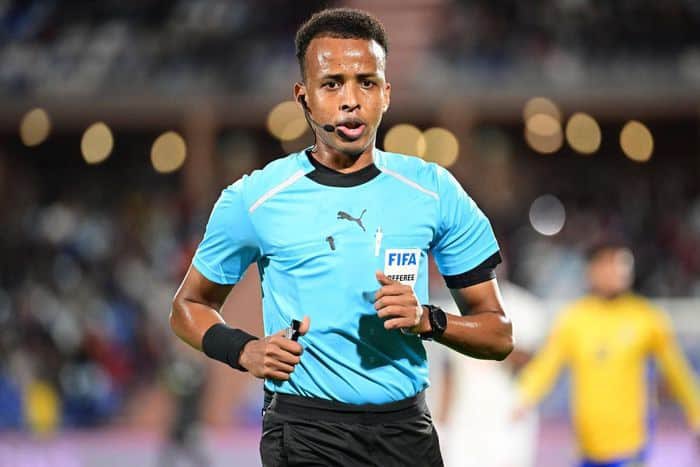
Then I saw the news about Omar Artan.
And I just sat there, staring at my screen.
The Somali referee who did everything right
Omar Abdulkadir Artan is not some random name FIFA pulled from a hat.
The guy was named Africa’s best referee in 2025. Best on an entire continent. He worked his way up from nothing—Somali football doesn’t exactly have fancy academies or smooth roads. He earned every single badge.
When he got selected for the 2026 World Cup, it was history. First Somali official ever at a men’s World Cup. His whole country celebrated. You know how rare that is for a nation that’s been through decades of chaos?
He flew to Miami. Valid U.S. visa. Diplomatic passport—helped by the Somali embassy in Nairobi. Everything in order.
Customs pulled him into “secondary inspection” anyway.
Then they put him on a plane to Istanbul.
Gone. Just like that.
FIFA’s official statement was painfully short: “Match official Omar Abdulkadir Artan will be unable to train and officiate at the FIFA World Cup 2026 after he was denied entry.”
No outrage. No apology. Just acceptance.
This isn’t one mistake. It’s a pattern.
You might think: okay, maybe Artan was a weird one-off. Bureaucracy glitch.
But then you look at Iran.
All 26 players got their visas in the end—barely. But most of the coaching staff? Denied. Technical analysts? Denied. The federation president and vice president? Denied.
Iran’s team is now based in Tijuana, Mexico, crossing the border on match days to play in Los Angeles and Seattle. Same-day travel. Hours in lines. Missing their medical team.
One Iranian official called it “vindictive behavior.” Another said “political interference in sport.”
And before you roll your eyes—imagine your national team sleeping in a different country before every game. Imagine your best analyst sitting at home watching on TV.
Then add journalists from Senegal, Ivory Coast, and other African nations getting rejected or handed single-entry visas that make covering three host countries impossible.
Add fans from visa-ban countries getting denied for no clear reason.
It’s not one story. It’s a flood.
What people are saying on X
I spent an hour scrolling through posts yesterday. Here’s a small sample:
“Visa refusals for Africa’s Best Referee, journalists from Iran, Senegal, Ivory Coast mean this World Cup is a disaster before it even begins.”
“From Iranian players training in Tijuana to Omar Artan sent back at Miami airport… the 2026 World Cup arrives as the most politically toxic sporting event in modern history.”
“This World Cup is the worst. And it hasn’t even kicked off.”
Even former Somali Prime Minister Hassan Ali Khaire posted:
“I am deeply disappointed… Omar has earned his place through talent, hard work, professionalism, and integrity. Football is at its best when it brings people together. Omar, Africa and the world stand with you.”
You don’t see prime ministers tweeting about referees often. That’s how bad this is.
But doesn’t the host country have a right to security?
Yeah. Of course.
Nobody’s saying open every border without checking anyone.
But here’s the thing: FIFA vetted Artan. The U.S. State Department gave him a visa. The Somali government backed him with a diplomatic passport. And then CBP overruled all of it at the gate.
That’s not security. That’s confusion at best—or something uglier at worst.
Somalia is on the U.S. travel ban list. Fine. But Artan isn’t a random traveler. He’s a FIFA-appointed official for the biggest sporting event on earth. If that doesn’t get you through, what does?
And if the answer is “nothing,” then don’t co-host a World Cup.
FIFA wants to stay neutral. That’s cowardice.
FIFA keeps saying: “Host countries control their borders. We can’t interfere.”
But FIFA chose the United States as a host. They knew the visa policies. They knew the travel bans. They accepted the bid that promised accessibility and unity.
Now when unity crashes into reality, they shrug?
That’s not neutrality. That’s passing the buck.
If you’re going to award a World Cup to a country that blocks entry to your own appointed officials, you either fight like hell behind the scenes—or you admit you don’t actually care about inclusion. You just care about the money.
And let’s be real: this tournament is going to make billions.
What actually happens now?
Practically:
Artan is replaced last minute. VAR teams reshuffled. Quality drops.
Iran plays tired, missing key staff. That affects their group—which affects everyone else’s tournament.
Fewer traveling fans from certain nations means quieter stadiums. Less color. Less noise.
And the media narrative? It’s not about Mbappé or Vinícius Jr. or some rising star from Ghana. It’s about visas.
The tournament will happen. Goals will be scored. Someone will lift the trophy.
But every time a referee makes a questionable call, people will remember the best ref from Africa who wasn’t allowed in.
Every time Iran plays, people will remember they drove up from Mexico that morning.
That’s the legacy, unless something changes fast.
Can football still win?
Look, I love this sport. I really do.
There’s nothing like a World Cup goal in the 89th minute. Nothing like an underdog making it out of the group stage. Nothing like 60,000 people screaming the same song in four different languages.
I want that magic.
But this time, the pre-game show has been embarrassing. It’s been political. It’s been unfair.
And the phrase that keeps looping in my head—the one I see all over X—is:
Borders Over Ball.
That’s not a slogan we should need for a World Cup.
The matches will go on. But the scar is already there. Whether the football can heal it… honestly?
I’m not sure anymore.
What do you think? Should FIFA push back harder on host countries? Or is national security always the final word? Drop your take in the comments below
This post was created with our nice and easy submission form. Create your post!
Written by
A sports Journalist with RabSports Uganda, Advocate for Children’s Rights and Youths, Amazing Storyteller with DW Akademie and UNICEF, Independent Researcher, Student at Muni University
Did this story move you? Every gift goes directly to Tema Innocent — writers on Muwado earn from reader appreciation, not algorithms. Even $1 makes a difference.






Muwado weekly chart
Get Africa’s top 10 stories every Thursday
No account needed — just your email.
Want to follow Tema Innocent and get notified every time they publish?
Create a free Muwado account →