

 Shadreck Chikoti
We should never fear our history. Neither should we conceal it, distort it, or reshape it to suit contemporary preferences. History belongs to the past, and its duty is to tell the truth as faithfully as possible.
Modern discussions about ethnicity in Malawi often treat the Mang’anja and the Chewa as entirely separate peoples. However, when one examines the historical, archaeological, linguistic, political, and religious evidence, a different picture emerges.
Much of the distinction between Mang’anja and Chewa appears to be a relatively recent development when viewed against the broader sweep of history. The available evidence suggests that the Mang’anja are best understood not as a separate people who later interacted with the Chewa, but rather as a southern branch of the wider Maravi Chewa civilisation that expanded across much of present-day Malawi, Mozambique, Zambia, and neighbouring regions between the twelfth and seventeenth centuries.
The Mang’anja in Historical Scholarship
Writing about the Bimbi religious tradition, which originated at Nsinja but became particularly prominent in southern Malawi, James N. Amanze describes the people of the Shire Valley as follows:
“The Chewa who inhabit the Upper and Lower Shire Valley are known interchangeably as Mang’anja, Nyanja, etc., with identical cultural ethos” (Amanze, 2002, p. 62).
This observation is significant because it highlights the close cultural relationship between the Chewa, Mang’anja, and Nyanja peoples. Rather than viewing them as entirely separate groups, Amanze presents them as communities sharing a common cultural foundation.
Similarly, archaeologist and historian Yusuf M. Juwayeyi, in his landmark work Archaeology and Oral Tradition in Malawi: Origins and Early History of the Chewa, connects the Mang’anja directly to the wider Chewa Maravi heritage. Discussing the use of masks in the Nyau tradition and tracing cultural connections between the Chewa and the Luba of the present-day Democratic Republic of Congo, Juwayeyi writes:
“In Malawi, only the Chewa in central Malawi and their breakaway relatives, the Mang’anja in the Lower Shire Valley, use them” (Juwayeyi, 2020, p. 215).
The phrase “their breakaway relatives” is particularly important. It identifies the Mang’anja not as an unrelated ethnic group, but as a branch of the wider Chewa Maravi family that separated from the main body and established itself in the Lower Shire Valley (Juwayeyi, 2020).
Lundu, Kaphwiti, and the Southward Migration
According to oral traditions documented by Juwayeyi (2020), Kaphwiti and Lundu were close relatives, with Kaphwiti described either as Lundu’s elder brother or uncle. The two separated from Kalonga, the ruler of the Maravi Kingdom, and migrated southward. Different traditions provide different explanations for this departure, but many associate it with disagreements concerning the administration of Mwavi, the ordeal poison used to identify criminals, witches, and practitioners of harmful supernatural practices.
The traditions suggest that Lundu and Kaphwiti opposed the excessive use of Mwavi because it resulted in many deaths and weakened the population (Juwayeyi, 2020). Eventually, they left the Maravi heartland and settled along the Wankurumadzi River in the present-day Mwanza Neno area. From there, their influence expanded southward.
Under Lundu, whose authority became greater than that of Kaphwiti, the kingdom spread into present-day Thyolo, Mulanje, Chikwawa, and Nsanje (Newitt, 1982). Oral traditions further maintain that Mbona, the famous rain priest and spiritual leader, accompanied them during this migration (Schoffeleers, 1992). These communities became established in the region hundreds of years before the arrival of any other ethnic group.
The Zimba Warriors and the Rise of Lundu
An important factor in the growth of the Lundu state was its association with the Zimba warriors. Portuguese records from the sixteenth century describe the Zimba as a formidable military force whose campaigns shook much of southeastern Africa (Newitt, 1982). Some Portuguese writers portrayed them as cannibals. Historian Eric Allina argues that Portuguese descriptions of Zimba cannibalism reveal more about political narratives and perceptions than about verified historical practice (Allina, 2011). The Portuguese priest João dos Santos, writing in the early seventeenth century, described the Zimba as warriors who “killed and ate” their enemies, helping to establish their fearsome reputation (as cited in Allina, 2011, p. 214). What is less disputed is their military effectiveness. Historical studies indicate that the Zimba were employed by Lundu and contributed significantly to the expansion of his authority across the Lower Shire Valley and parts of present-day Mozambique (Schoffeleers, 1987).
Why the Mang’anja Are Sometimes Seen as Distinct
As the Lundu kingdom grew, it became increasingly independent. The great distance between Lundu’s territories and Kalonga’s court at Mankhamba, combined with Lundu’s control of trade networks and military resources, enabled him to operate with substantial autonomy (Juwayeyi, 2020). Over time, Lundu ceased to view himself merely as a subordinate ruler of Kalonga. His kingdom developed its own political identity and exercised considerable independence (Newitt, 1982). This historical reality partly explains why some Mang’anja today do not immediately identify themselves with the Chewa of central Malawi, despite their common ancestry.
The separation was political rather than genealogical from the onset. The Mang’anja remained descendants of the Maravi, even as their kingdom evolved along its own path (Amanze, 2002).
Historically, the Mang’anja occupied almost all of the southern region 500 years ago, before any group had ventured into the southern lands. The histories of major southern chiefdoms provide further support for this interpretation. Traditional accounts concerning Lundu and Kaphwiti connect these rulers directly to the wider Maravi political system (Ntara, 1973). Nsabwe, Kapichi, Kwethemule, Nchilamwera, Thomasi, Mbawela, Thukuta, Nanseta, Chimaliro and Changata in Thyolo, while Chikumbu, Juma, Mabuka, Njema and Mkanda are found in Mulanje. In Zomba, you have Mkumbira, Mwambo, Mgwelero, Ntholowa, while Phalombe has Chiwalo, Nazombe, Nkhulambe. You will find more chiefs in Nsanje, the likes of Malemia, Chimombo, Makoko, Mbenje, Mlolo, Ndamera, Ngabu, Nyachikadza and Tengani. Chikhwawa has Kasisi, Chapananga, Ngabu, Ngowe, Mlilima, Katunga, Ndakwera, Makhuwira, Masache, Maseya all under Lundu. There are many chiefs in Mwanza, Mangochi, Neno, Zomba, Chiradzulu, who established their chieftaincies hundreds of years ago before any occupancy in the region (Phiri, 1975).
The history of the Mang’anja demonstrates an important truth about Malawi. No ethnic group in this country developed in complete isolation. Through migration, marriage, trade, political alliances, and shared cultural traditions, our ancestors became intertwined (Phiri, 2004).
The Mang’anja, Chewa, Nyanja, Sena, Yao, Ngoni, and many others have all contributed to the making of modern Malawi. The deeper one digs into history, the harder it becomes to sustain the idea that any group exists entirely apart from the others.
If we desire national unity, we must return to our history. We must study it honestly and without fear. History is not our enemy. It is the mirror through which a people come to understand themselves.
References
- Alpers, E. A. (1975). Ivory and slaves: Changing pattern of international trade in East Central Africa to the later nineteenth century. University of California Press.
- Allina, E. (2011). The Zimba, the Portuguese, and other cannibals in late sixteenth-century southeast Africa. Journal of Southern African Studies, 37(2), 211–227. doi.org
- Amanze, J. N. (2002). African traditional religion in Malawi. Kachere Series.
- Hamilton, R. A. (1955). The oral tradition of the Central African Kingdom of Maravi. The Journal of African History, 14(2), 191–203.
- Juwayeyi, Y. M. (2020). Archaeology and oral tradition in Malawi: Origins and early history of the Chewa. Boydell & Brewer.
- Langworthy, H. W. (1972). Zambia before 1890: Aspects of pre-colonial history. Longman.
- Linden, I. (1979). Chisumphi theology in the religion of Central Malawi. In J. M. Schoffeleers (Ed.), Guardians of the land: Essays on Central African territorial cults (pp. 187–207). Mambo Press.
- Marwick, M. G. (1965). Sorcery in its social setting: A study of the Northern Rhodesian Cewa. Manchester University Press.
- Metcalfe, M. (1954). Notes on the Chewa tribal law and customs. The Nyasaland Journal, 7(1), 45–56.
- Newitt, M. (1982). The early history of the Maravi. The Journal of African History, 23(2), 145–162.
- Newitt, M. (1995). A history of Mozambique. Indiana University Press.
- Ntara, S. J. (1973). The history of the Chewa (Mbiri ya Achewa) (B. H. Lindgren, Trans.). Franz Steiner Verlag.
- Phiri, K. M. (1975). Chewa history in central Malawi and the use of oral tradition, 1600-1920 (Doctoral dissertation). University of Wisconsin-Madison.
- Phiri, K. M. (2004). Political authority and religious shrines in pre-colonial Malawi. Christian Literature Association in Malawi.
- Rangeley, W. H. J. (1952). Makewana—The mother of all people. The Nyasaland Journal, 5(2), 31–50.
- Schoffeleers, J. M. (1987). The Zimba and the Lundu state in the late sixteenth and early seventeenth centuries. The Journal of African History, 28(3), 337–355.
- Schoffeleers, J. M. (1992). River of blood: The Genesis of a martyr cult in Southern Malawi, c. A.D. 1600. University of Wisconsin Press.
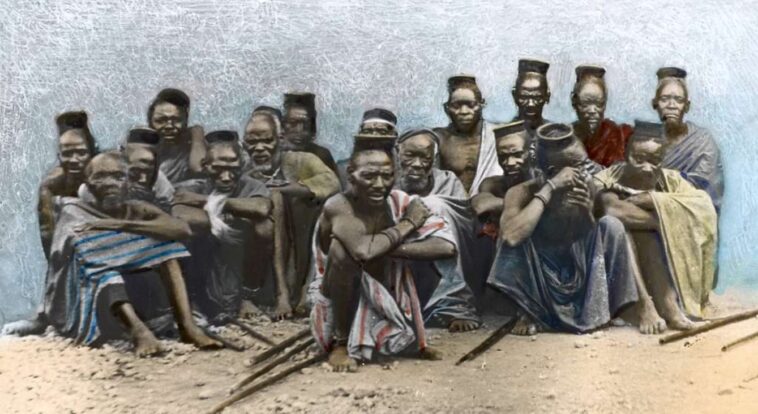
Img: picryl.com
This post was created with our nice and easy submission form. Create your post!

Written by
Did this story move you? Every gift goes directly to Shadreck Chikoti — writers on Muwado earn from reader appreciation, not algorithms. Even $1 makes a difference.






Muwado weekly chart
Get Africa’s top 10 stories every Thursday
No account needed — just your email.
Want to follow Shadreck Chikoti and get notified every time they publish?
Create a free Muwado account →